Kirkuk fell on 10 April 2003 as Iraqi government forces withdrew and Kurdish fighters entered. Contemporary accounts record celebration alongside insecurity, while field research explains why the return of expelled families did not immediately resolve housing or property claims.

The city fell on 10 April, not 11 April
Contemporary reporting places the entry of Kurdish forces into Kirkuk on Thursday, 10 April 2003, after Iraqi government troops withdrew. Eliza Griswold’s report from the city describes soldiers abandoning uniforms that morning and peshmerga arriving before the main American presence. Reports published on 11 April can therefore describe events of the previous day. The article date and the event date must be kept separate. Iraqi state authority collapsed rapidly in the city, but this was not a referendum on Kirkuk’s future administration. [1] [2]
Why the fall carried such weight for displaced people
Human Rights Watch’s pre-war investigation, based on a September 2002 mission, documented forced expulsions of Kurds, Turkmen and Assyrians from Kirkuk and other oil-producing areas. Families faced demands to register their ethnicity as Arab, join the Baath Party or enter paramilitary organisations. Security agencies and police issued orders, detained relatives and supervised departures. This was an organised government campaign, rather than voluntary migration that can be inferred from residence records alone. For people expelled under that system, the fall of Baath rule opened a possibility of return after years of coercion and loss. [3]
Celebration and insecurity occurred together
Griswold witnessed Kurdish flags, flowers and public celebrations, but also looting and growing fear among Arab and Turkmen residents. The early distribution of military authority was uneven: Kurdish fighters entered ahead of larger US formations, and subsequent pressure brought changes in their deployment. Human Rights Watch recorded efforts by peshmerga to arrest looters and protect hospitals, alongside killings and threats against residents in some neighbourhoods. Its investigators could not always determine whether armed perpetrators belonged to official party forces or operated outside their control. Recognising that uncertainty avoids assigning every incident to all members of one community. [1] [2]
An account from before the invasion
The 2003 Human Rights Watch report follows individual families through the expulsion process. It describes Salim Ismail—a pseudonym—as a Kurd pressured to change his registered ethnicity and accept political and military recruitment. After choosing expulsion, he had to sign a statement presenting departure as voluntary; checkpoints confiscated documents and restricted what the family could take. Such testimony explains why a document’s formal wording may conceal coercion. It also shows why a displaced family’s surviving paperwork might be incomplete when later asked to prove residence or loss. [3]
Returning to the city was not the same as recovering a home
The 2004 investigation found different kinds of claim: homes seized outright, properties sold below value under pressure, rented accommodation and neighbourhoods demolished after expulsion. Some returnees lived in public buildings or makeshift settlements because housing and employment were unavailable. The report also documented threats and expulsions directed at Arab families after the regime’s collapse. A response to earlier injustice therefore required procedures for assessing individual claims, protecting civilians and arranging assistance, rather than assuming that a change of military control had restored every family’s property. [2]
The later constitutional question
Iraq’s 2005 Constitution treated the territorial question separately from wartime control. Article 140 carried forward requirements from the Transitional Administrative Law and specified normalisation, a census and a referendum concerning Kirkuk and other disputed territories, with a stated deadline of 31 December 2007. Article 14 set out equality before the law irrespective of ethnicity and other characteristics. These provisions explain why the events of April 2003 cannot themselves be described as a final constitutional settlement. The text of a planned process is distinct from evidence that the process was completed. [4]
Reading the map and the accounts together
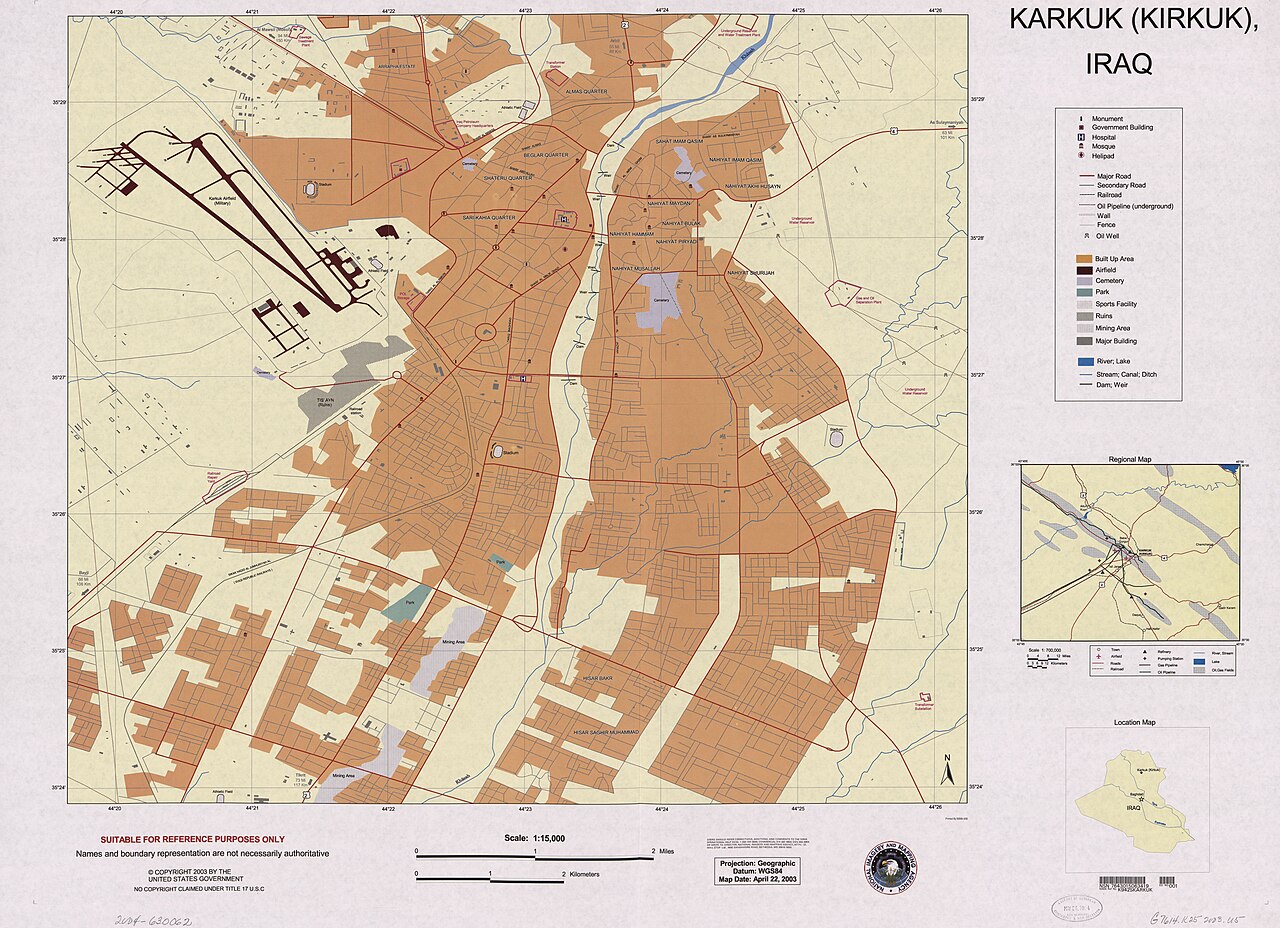
The accompanying map was prepared later in April 2003. It helps locate the river, neighbourhoods and transport infrastructure in a city whose history involved residents, returning families and several military and political actors. It does not establish the ethnicity or ownership of any particular house. Likewise, the reports cited here describe specific periods: the pre-war expulsions, the city’s fall and the first return and restitution problems. Their value lies in identifying dates, witnesses and mechanisms, while distinguishing the end of Baath rule from the unresolved work of return and reconstruction. [2] [3] [5]
Sources and further reading
- Eliza Griswold, “The Kurds Take a City”, The Nation, published online 17 April 2003, issue dated 5 May; reporting from Kirkuk on the fall of the city and its immediate aftermath.
- Human Rights Watch, Claims in Conflict: Reversing Ethnic Cleansing in Northern Iraq (August 2004), chapter VI, “Reversing Arabization of Kirkuk”; field interviews, abuses and property disputes.
- Human Rights Watch, Iraq: Forcible Expulsion of Ethnic Minorities (March 2003), chapter III, “Forced Expulsions”; investigation conducted before the invasion and named/pseudonymous witness accounts.
- Constitution of Iraq (2005), Articles 14 and 140; primary legal text in English translation, Constitute Project.
- US National Imagery and Mapping Agency, Karkuk (Kirkuk), Iraq, map dated 22 April 2003; Library of Congress, G7614.K25 2003 .U5, digital record 2004630062.
- Library of Congress map reproduction via Wikimedia Commons; US federal government work, public domain.