Mohammed ben Osman rose through the government of western Algeria. His career connects Mascara’s public works and learned culture with the fighting and negotiations that returned Oran in 1792.

Family background and the Kurdish connection
Mohammed el Kebir was Mohammed ben Osman, a provincial ruler in the Regency of Algiers. His career was rooted in North Africa. Gorguos’s 1857 historical notice identifies his father as Osman the Kurd, a former caïd of Miliana and bey of Titteri. This is a specific historical basis for the Kurdish family connection; it does not establish that Mohammed himself was born in Kurdistan. The notice also records the earlier nickname Lekh’al. [1] Neither a secure birth year nor an invented childhood in the Kurdish mountains is needed to explain his subsequent career.
From Ibrahim’s household to the government of Mascara
According to the notice, Osman entrusted his surviving family to Ibrahim. Mohammed became Ibrahim’s son-in-law and accompanied him when he took charge of the western province. He became caïd of the Flitta in 1764–65 and khalifa, a deputy in the provincial administration, in 1768. He commanded western contingents during Spain’s unsuccessful expedition against Algiers in 1775. He did not immediately succeed Ibrahim as bey: Khelil held the office first, and the notice dates Mohammed’s appointment at Mascara to 1779. [1] This sequence shows advancement through an established provincial household and administration.
Government involved markets, water and construction
Gorguos describes grain purchases and market releases during scarcity, palace kitchens feeding poor residents, and construction providing paid work. At Mascara he credits Mohammed with repairs and enlargement of mosques, water conduits and fountains, bridges, defensive works and a market funduq. A funduq combined accommodation and commercial functions; properties assigned as habous supported religious institutions. [1] These accounts show how food supply, urban infrastructure and endowments could reinforce provincial authority. They should be read as the claims of a favourable historical narrative, rather than as a modern audit proving that every resident prospered.
Libraries and patronage were part of that authority
The notice describes a madrasa and endowed library attached to Mohammed’s mosque at Mascara, and the restoration of two madrasas and their endowments at Tlemcen. It records rewards for literary and medical compilations, payments to poets, and copyists producing manuscripts for his collection. Gorguos drew heavily on a praise poem with commentary by Ahmed ben Mohammed ben Ali ben Sahnoun, who belonged to the bey’s circle. [1] Patronage helps explain why a ruler appears so generously in surviving literary accounts. The nineteenth-century French compiler also imposed his own colonial assumptions; neither perspective should become an unqualified verdict on Mohammed’s government.
Oran had changed hands before 1792
Spain took Mers-el-Kébir in 1505 and Oran in 1509. Both passed to the Regency in 1708; Spain recovered them in 1732. Spanish possession therefore was not continuous from the sixteenth century to 1792. [2] Mohammed’s later achievement concerned these coastal strongholds, not the reconquest of all Algeria. Mascara remained his provincial base.
Military pressure and a negotiated withdrawal
Ismet Terki Hassaine’s study of Spanish archival documents connects the withdrawal with sustained military pressure and diplomacy. The October 1790 earthquake was important, but negotiations had begun earlier. Renewed fighting accompanied talks in 1791. A convention signed in Algiers on 12 September 1791 and ratified in Madrid that December provided for restitution and Spanish commercial privileges. Spanish troops evacuated in February 1792. The bey sent a ceremonial golden key to Constantinople later that month. [2] Siege, earthquake, agreement and evacuation were related stages, rather than a single battlefield capture.
The palace preserves a history of several periods
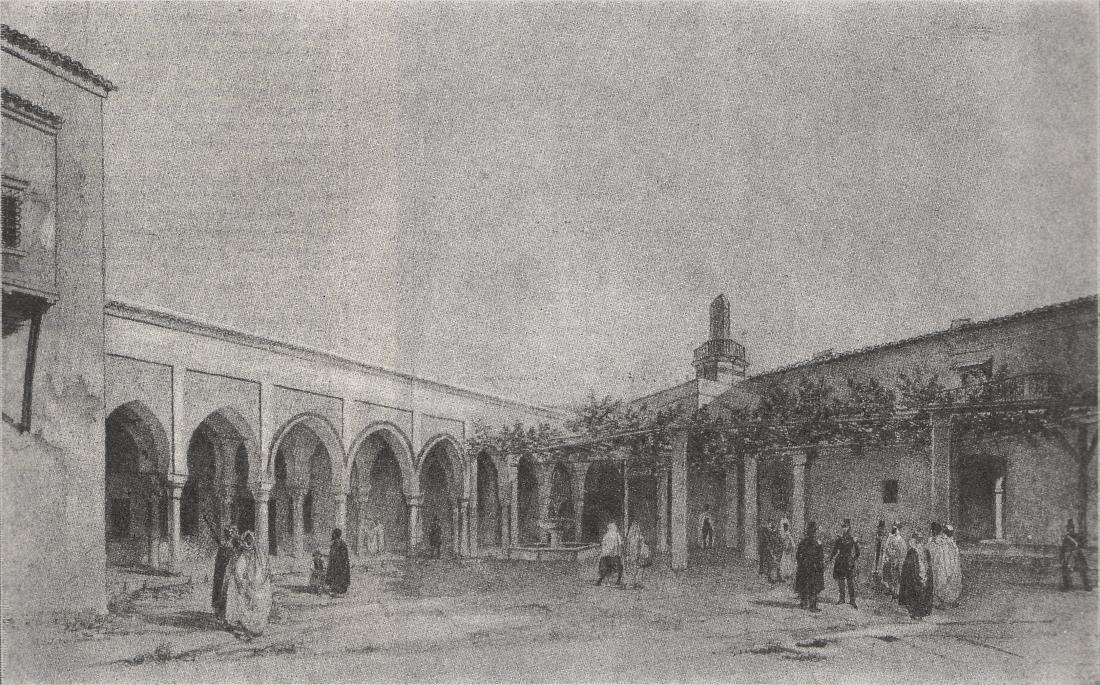
The INHA Imaneo architectural study places Mohammed’s residence within Oran’s earlier Spanish fortress of Rosalcazar. The palace continued under his successors, then became a French military headquarters in 1831. Its colonnade and reception rooms were altered during the nineteenth century; parts of the surviving decoration belong to that later history. [3] The illustrated engraving, catalogued as about 1833, shows the entrance courtyard after Mohammed’s lifetime. [4] The building is valuable evidence for Oran’s changing government, but its present fabric cannot all be assigned to the bey or treated as an untouched interior from 1792.
Sources and further reading
- Gorguos, Notice sur le Bey d’Oran, Mohammed el Kebir, Revue africaine, 1857, pp. 403–416; family, offices, public works and patronage.
- Ismet Terki Hassaine, Oran au XVIIIe siècle, Insaniyat 23–24, 2004, pp. 197–222; Spanish archival research on occupation, negotiations and restitution.
- INHA, Imaneo, Palais du Bey, Oran; architectural history of the fortress, palace and nineteenth-century alterations.
- Bey’s Palace colonnade, Oran, engraving catalogued about 1833, unidentified artist; public-domain reproduction, Wikimedia Commons.