What ancient evidence tells us about Nineveh, why modern communities must be described carefully, and how Iraq's heritage and minority rights fit together.

A city and a province are different places
Ancient Nineveh is an archaeological site at Mosul in northern Iraq. The modern Nineveh Governorate and the area commonly called the Nineveh Plains cover a much larger geography. A statement about the ancient city cannot automatically describe the population, ownership or administration of every modern district bearing its name. Archaeological location, modern identity and political jurisdiction need separate evidence.
What the ancient evidence establishes
Nineveh was a major Assyrian royal centre. The Library of Ashurbanipal research project studies the cuneiform corpus associated with the city, including scholarly texts rather than only royal military narratives. Its project description explains work by the British Museum and Ludwig Maximilian University Munich to reconstruct and analyse the collection. These written sources establish a substantial ancient intellectual history; their survival does not provide a modern population census. [1]
The fall of Nineveh in 612 BCE
The Babylonian chronicle known as ABC 3, preserved as British Museum tablet BM 21901, records the siege and destruction of Nineveh by Babylonian and Median forces in 612 BCE. It also describes later fighting around Harran. The fall of a royal capital was therefore part of a sequence of military events. It cannot by itself prove that an entire population disappeared or establish exclusive modern inheritance through conquest. Readers can examine the translated chronicle and its marked gaps directly. [2]
Ancient names and living communities
The terms Assyrian and Chaldean occur in different ancient, religious and modern contexts. Those contexts should be dated and explained, not treated as interchangeable. Present-day church names are also not a complete account of ethnicity. For example, Pope Francis's 2022 address to Mar Awa III discusses the Assyrian Church of the East and Chaldean Catholic Church as distinct churches with a shared liturgical heritage and ongoing cooperation. That is evidence about church relations, not a genetic test or an exclusive territorial title. Individuals' chosen community names deserve accurate representation. [3]
Rights in present-day Iraq
Article 125 of Iraq's Constitution expressly names Chaldeans and Assyrians, alongside Turkmen and other constituents, in its guarantee of administrative, political, cultural and educational rights. Article 14 addresses equality before the law. These provisions provide a concrete starting point for discussing current rights. They do not make archaeological interpretation a substitute for contemporary law, nor does recognising one community require denying another's existence. [4]
Protecting the site and explaining photographs
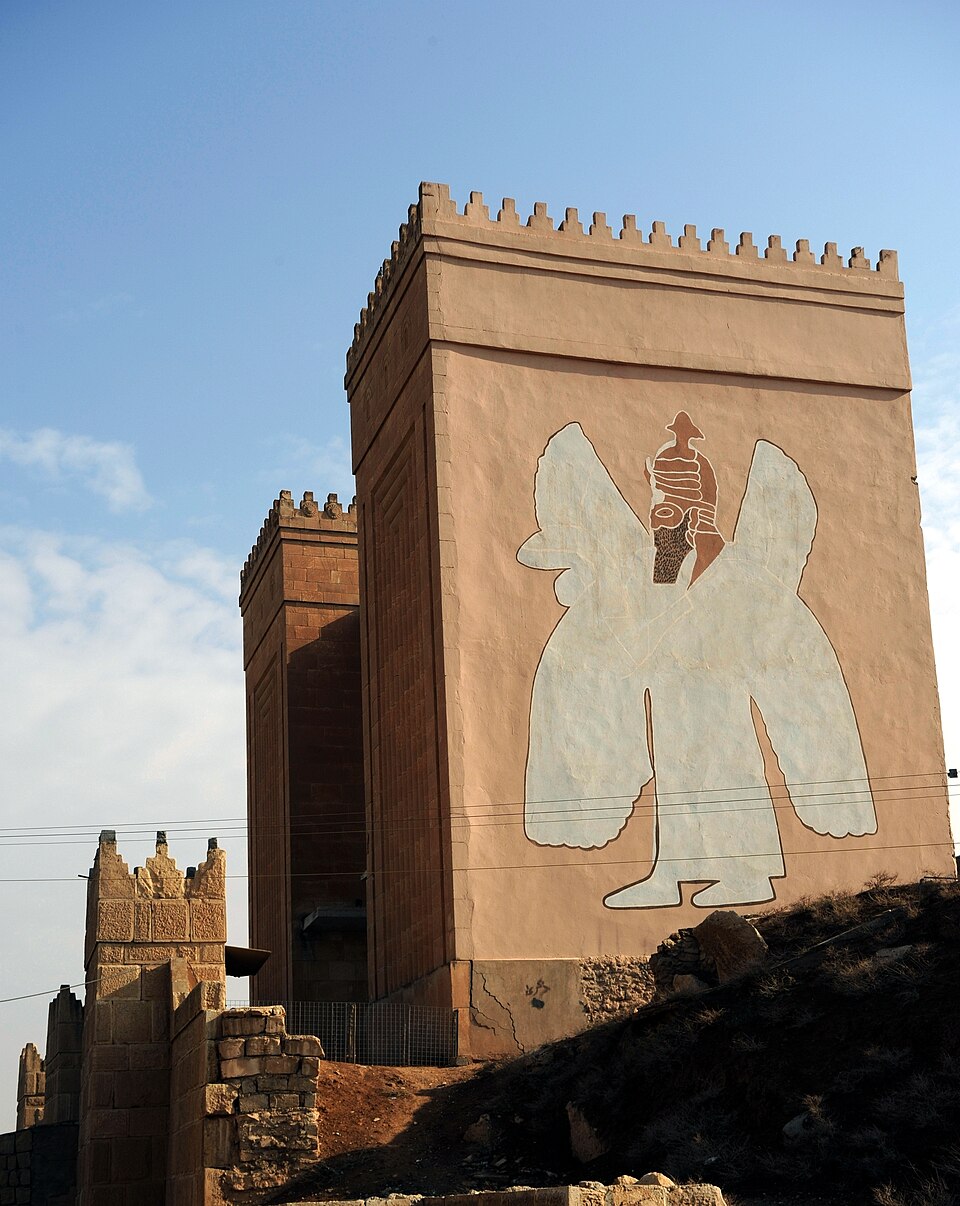
In April 2016 UNESCO condemned destruction at Nineveh's Mesqa and Adad gates and ramparts, following damage to the Nergal Gate winged bull and the Mosul Museum in 2015. Its statement treats these attacks as damage to Iraq's heritage and to wider human memory. Historical photographs must therefore be labelled with their dates: an intact-looking image from 2008 cannot show the site's current condition. Protection, documentation and careful interpretation are practical ways to preserve evidence for everyone. [5]
Editorial correction
Revised 21 October 2026. The previous version made unsupported claims that Nineveh belonged exclusively to one modern community and used collective accusations against another. This replacement distinguishes ancient sources, modern identities and constitutional rights. It makes no unsupported claim of exclusive descent or ownership.
Sources and further reading
- Jonathan Taylor, Reading the Library of Ashurbanipal: project description — British Museum / LMU Munich, ORACC (2022)
- ABC 3: Fall of Nineveh Chronicle, BM 21901 — primary text in translation, adapted from A. K. Grayson and Jean-Jacques Glassner, Livius
- Pope Francis, address to Mar Awa III, 19 November 2022 — Dicastery for Promoting Christian Unity
- Constitution of Iraq, Articles 14 and 125 — Iraqi Council of Representatives
- UNESCO, destruction in the ancient city of Nineveh, 18 April 2016