Urfa, officially Şanlıurfa and also known as Riha, brings together the history of ancient Edessa, Syriac literature, Islamic sacred places and a living musical culture. Nearby Neolithic archaeology belongs to a much earlier regional history, while the city’s Christian past also includes persecution and loss.

Edessa and the Syriac literary world
Edessa was the capital of Osrhoene and a frontier city between Roman and Parthian or Persian powers. The Epidentity research database identifies the local Aramaic dialect as the basis of literary Classical Syriac. It also records the tradition of letters exchanged between King Abgar and Jesus, including a Greek inscription associated with the city’s hoped-for protection. [1] This combination of language, texts and inscriptions gives Edessa’s Christian history a specific cultural setting. The Abgar story belongs to its religious memory; it is not evidence that the city remained unconquered.
Changing rulers and an Ottoman provincial city
Ahmet Nezihi Turan’s history records Mervanid Nasr al-Dawla’s control in the early eleventh century and Byzantine control under Georgios Maniakes in 1030–1031. A Crusader county was established in 1098; Imad al-Din Zengi captured the city in 1144, and Saladin took control in 1182. Urfa entered Ottoman rule in 1517 as the sancak of Ruha within the Diyarbekir administration. [2] These changes connect the city to Kurdish dynastic history, Byzantine frontiers, Crusader warfare and Ottoman provincial government, rather than one continuous political identity.
Balıklıgöl and Abraham’s local tradition
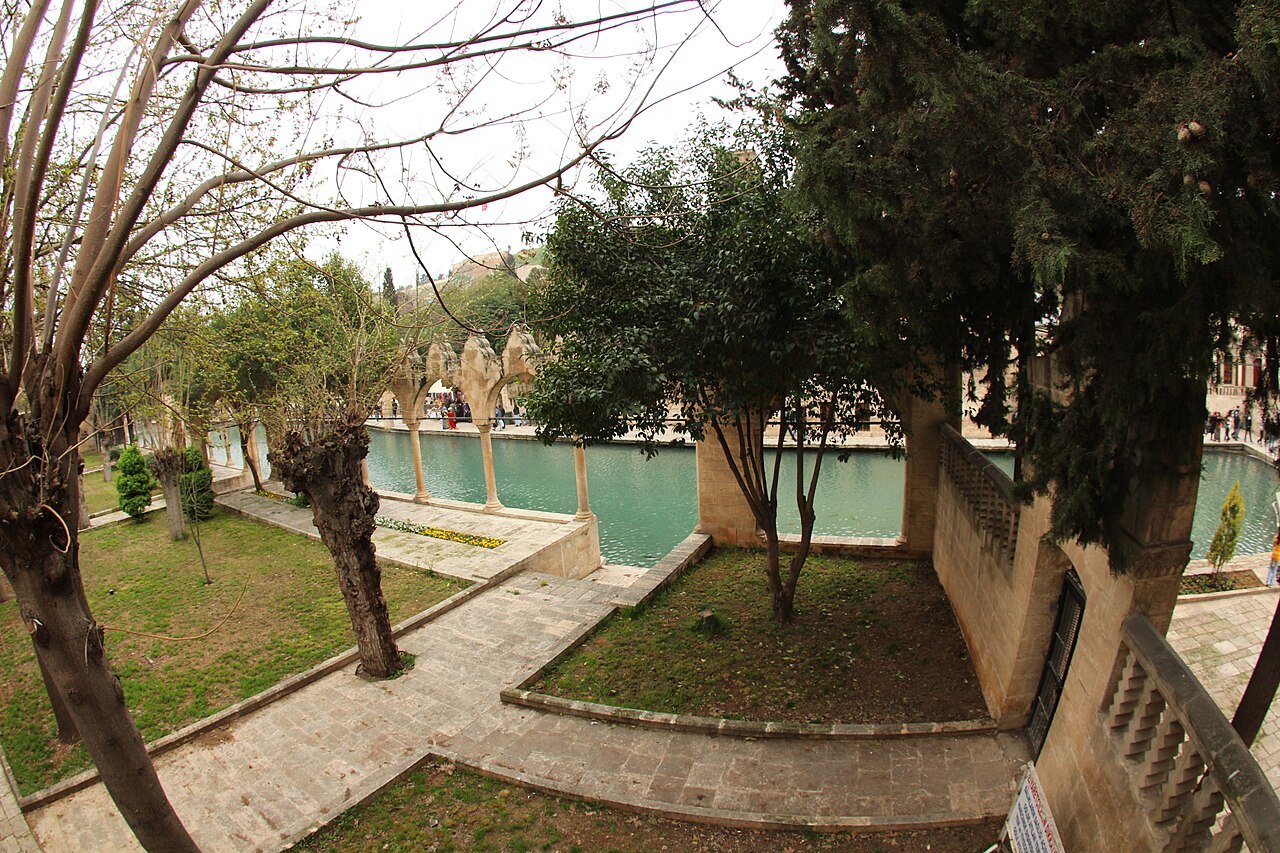
Balıklıgöl comprises the Halilürrahman and Aynzeliha pools and surrounding religious buildings. The local account says Nimrod condemned Abraham to a fire that became water, while the wood became fish. The carp are consequently treated as sacred. A nearby cave is venerated as Abraham’s birthplace. [3] This tradition explains the pools’ devotional meaning. The mosques, water, courtyards and places of prayer form a sacred landscape whose importance can be described without presenting the miracle as an archaeologically dated event.
Neolithic archaeology beyond the city
The Göbekli Tepe research project places the site in the Pre-Pottery Neolithic, in the tenth and ninth millennia BCE. [4] Its monumental buildings and T-shaped pillars belong to regional prehistory long before ancient Edessa. More recent research also changes the familiar description of an isolated temple complex: Jonas Breuers’s account of chipped-stone studies argues for domestic activity and a settlement with a strong ritual component. [5] Everyday tools matter alongside the large carved stones. Modern Urfa and the prehistoric site are connected geographically, but their histories should retain their different scales and dates.
Mosaics make the ancient city visible
Haleplibahçe Mosaic Museum presents excavated mosaics in place. Its own account describes the Amazon Villa and scenes from Achilles’s life. It also identifies the Orpheus mosaic, dated 194 CE, with Syriac writing and the artist’s name Bar Saged. [6] These works connect named artists, language and mythological subjects to the city’s material history. They offer evidence more precise than a general claim that Urfa was a meeting point of cultures.
The destruction of Armenian communal life
The Armenian genocide is part of Urfa’s history. Historian Hans-Lukas Kieser, drawing on hospital worker Jakob Künzler’s testimony, describes massacre, deportation and the disposal of Armenian property in the city. Armenian resistance there did not save the community. Künzler and his wife organised help for people in hiding. [7] Remembering this violence is necessary when discussing the city’s Christian heritage: churches, manuscripts and former neighbourhoods also belong to histories of people who were killed or displaced.
Music as a continuing urban practice
Türkiye’s UNESCO National Commission announced Şanlıurfa’s admission to the Creative Cities Network in music in 2023. [8] The city’s Music Urfa platform describes the transmission of folk songs and hoyrat singing across generations. [9] Such practices place present performers and listeners within the city’s cultural history. This living music belongs alongside the pools, inscriptions and museums in an account of Urfa, with each supported by its own evidence.
Sources and further reading
- Paweł Nowakowski, Epidentity, site 71, Edessa; aliases, Roman–Persian frontier, Syriac and the Abgar tradition; updated 2023.
- Ahmet Nezihi Turan, “Şanlıurfa,” TDV İslâm Ansiklopedisi (2010), history section; Mervanid, Byzantine, Crusader, Zengid, Ayyubid and Ottoman rule.
- Türkiye Culture Portal, “Balıklıgöl”; pools, religious buildings and the local Abraham tradition.
- Göbekli Tepe Research Project, Tepe Telegrams, “Our Project”; Pre-Pottery Neolithic dating.
- Jonas Breuers, “Chipped Stones: What they are and how they can help understand Göbekli Tepe,” Tepe Telegrams, 5 July 2023; research on domestic activity.
- Türkiye Ministry of Culture and Tourism, Haleplibahçe Mosaic Museum; in-situ mosaics, Amazon Villa, Achilles and Orpheus with Bar Saged’s name.
- Hans-Lukas Kieser, “Der jungtürkische Genozid im Ersten Weltkrieg,” Bundeszentrale für politische Bildung, 26 April 2016; Urfa and Jakob Künzler’s testimony.
- UNESCO Türkiye National Commission, “Şanlıurfa UNESCO Yaratıcı Şehirler Ağında!”, 1 November 2023; music designation.
- Music Urfa, city music platform; folk-song and hoyrat transmission.