Feyzi Bey was an Ottoman deputy and later a minister of public works in Ankara. His parliamentary career must be read alongside historical research identifying his role in the organisation of the 1915 genocide in Diyarbakır.
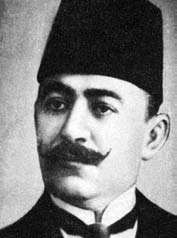

Family, education and entry into parliament
Aziz Feyzi Pirinççizâde, also catalogued as Feyzi Pirinççioğlu, belonged to an influential family of Diyarbakır. The Turkish parliament’s album gives his birth as 1878, names his parents Arif and Emine, and records education at the Diyarbakır military secondary school, clerical employment, agriculture and trade. Arif Bey was himself a deputy. Feyzi entered the Ottoman Chamber through a by-election after his father’s death in 1909, rather than taking the seat at the opening of the 1908 parliament. Detailed studies differ over the precise election and admission dates, so the secure common year is preferable to combining incompatible dates. [1] [2] [3]
Kurdish background does not settle political allegiance
His family background and contacts with Kurdish organisations do not establish that he founded a national liberation programme. Yalçın Doğan’s account of the 1913 Hêvî student congress says Feyzi attended but argued that students should concentrate on their studies rather than political activity, and opposed a separate independent Kurdish course. This is a particular reported intervention, not proof of every view he ever held. It does, however, contradict a simple portrayal of him as the builder of Kurdish national institutions. Üngör identifies his political alignment with the Committee of Union and Progress, the CUP. Different members of a community could pursue sharply different political projects. [3] [4]
The 1915 genocide: an organising role in the historical research
Uğur Ümit Üngör’s study of property, family networks and violence identifies Feyzi as an important collaborator of governor Mehmed Reshid in the destruction of the Armenian population of Diyarbakır province. It names him in the so-called Committee of Inquiry and describes his recruitment of his cousin Bekir Sıdkı into the governing and coercive network. Üngör draws on Ottoman documents, diplomatic records, missionary evidence and accounts by participants and survivors. This is a substantive identification of personal participation; a biography cannot replace it with general remarks that unspecified Kurds variously participated, watched or rescued neighbours. At the same time, the cousin, governor and deputy must remain distinct people. Their acts should not be collapsed into one undifferentiated family or ethnic responsibility. [4]
Detention, escape and the distinction from a trial verdict
Feyzi was detained in 1919 in connection with accusations concerning the wartime persecution and killings. He was taken through Egypt to Malta and escaped in September 1921, before joining the Ankara assembly’s work in January 1922. The parliamentary album notes that detention prevented his attendance at the final Ottoman Chamber despite election. These events explain a gap between membership and participation. They do not amount to a trial acquittal: detention, an accusation, escape and a judicial verdict are different things. Uludağ’s favourable biography records that he was not tried during the Malta detention; that procedural statement does not invalidate the separate archival research on 1915. [1] [3] [5]
Public works and the Chester railway concession
On 14 January 1922 he was elected minister of public works by the Ankara assembly. A contemporary document preserved in the US Foreign Relations series identifies Feyzi as the government’s contracting representative in the Chester railway arrangements. The preliminary agreement envisaged routes from Sivas through Diyarbakır towards Van, a branch towards Yumurtalık and another through Mosul and Kirkuk to Sulaymaniyah. It also required surveys and provided conditional options for construction and mineral exploitation. This is evidence of proposed infrastructure and concession policy, not proof that those complete routes were built by him. The contracting counterpart was a private company; the document should not be described as a treaty committing the US government to build the lines. [3] [6]
Republican office and the end of his parliamentary career
The parliament’s account of his second term lists public-works service on 14 August–27 October 1923 and again on 22 November 1924–3 March 1925. These are separate periods, rather than uninterrupted tenure through all intervening cabinets. The same record identifies committee work and proposals concerning railways, Ergani copper and lighting the assembly. His parliamentary career ended in 1927. Uludağ documents his contacts with Fethi Okyar’s Free Republican Party in 1930 and his death in Istanbul on 17 February 1933. His subsequent exclusion from office should be considered alongside his earlier participation in the Ankara government. It does not turn that entire career into opposition to the republic. [5] [7]
Sources and further reading
- Turkish Grand National Assembly, TBMM Albümü 1920–2010, volume I (2010), p. 23; primary parliamentary biographical record and portrait, including education, family, Ottoman terms and detention.
- Kenan Olgun, “Osmanlı Meclis-i Mebusanı’nda Ara Seçimler (1908–1912 Dönemi)”, Atatürk Araştırma Merkezi Dergisi 28/82 (2012); Diyarbakır by-election and reference to the Chamber’s record.
- Yalçın Doğan, “Feyzi Bey (Pirinççioğlu) (1878–1933)”, Atatürk Ansiklopedisi (2024); education, Hêvî congress intervention, detention, escape and election as minister.
- Uğur Ümit Üngör, “Property and Family: Mobilisation for Violence during the Armenian Genocide”, Tijdschrift voor Sociale en Economische Geschiedenis 10/4 (2013), pp. 97–120, especially pp. 103–105; original historical research on Feyzi, Reshid’s committee and Bekir Sıdkı.
- Mekki Uludağ, “Diyarbakır Milletvekili Pirinççizade Feyzi Bey’in Yaşamı ve Faaliyetleri”, Mukaddime 13/2 (2022), pp. 315–339; parliamentary chronology, Malta, 1930 contacts and death. Its favourable assessment is distinguished from the genocide research.
- Papers Relating to the Foreign Relations of the United States, 1923, volume II, document 1007: Ottoman–American Development Company to the Secretary of State, 25 July 1923, with translated agreements; primary text naming Feyzi and setting out proposed railway and mining conditions.
- Turkish Grand National Assembly, second-term parliamentary activities, Feyzi Bey (Pirinççioğlu), p. 251; separate ministerial periods, committees and proposals.
- Pirinççizade Feyzi Bey, unknown photographer, Wikimedia Commons; public-domain parliamentary portrait, sourced to TBMM Albümü, volume I, p. 23.