Bedri Pasha’s career connected the Bedirhani family to Ottoman Syria and Istanbul. Archival and memoir research also corrects the commonly repeated date of his death.

A son of the exiled Bedirhani household
Ahmed Bedri Pasha was a son of Bedir Khan Beg, the ruler of Bohtan defeated by the Ottoman state in 1847. Barbara Henning cites his Ottoman personnel record, BOA DH.SAİD 2.448, as giving Cizre and 1264 AH, equivalent to 1847–48, for his birth. Ahmet Kardam’s archival account lists Ahmed Bedri among the five sons accompanying the household into exile at Heraklion in October 1847. These accounts should be presented with their dating limits rather than converted into a precise birthday. [1] [2]
What family exile involved
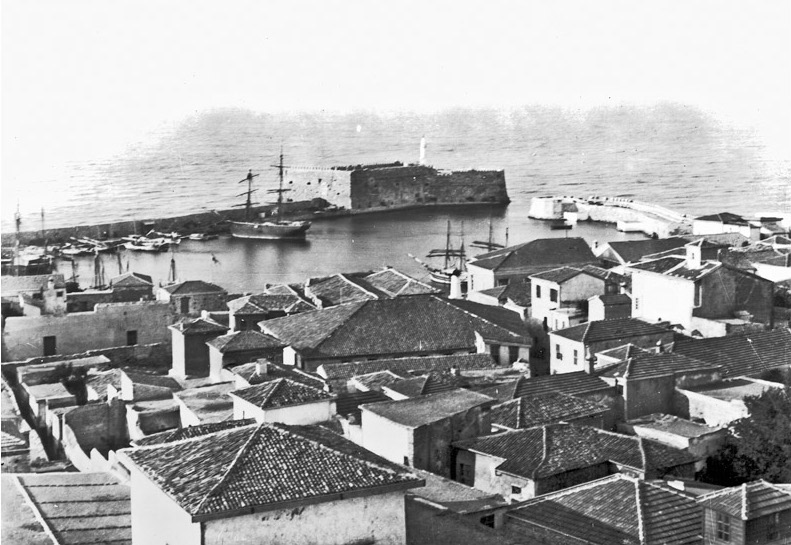
Kardam describes the family’s removal through Istanbul to Crete and the restriction of its movements within Heraklion. His research also follows disputes over confiscated property, delayed allowances and the destruction caused by the 1856 earthquake. These documents provide a different setting from an imagined carefree court in exile. The photograph on this page shows the harbour decades later, helping locate that history without claiming to depict the deportation itself. Bedri’s later entry into administration took place after this experience of family displacement and dependence on imperial decisions. [2] [5]
Posts in Ottoman Syria and Istanbul
Henning dates Bedri’s first administrative employment to 1871. He helped recruit Kurdish volunteers for the 1877–78 war but handed their command to another officer. Appointments included Quneitra in 1880 and Safed in 1881–82, followed by higher district governorships in Hawran, Hama and Tripoli. In 1900 he joined the Council of State in Istanbul. These were distinct offices and places, not a single governorship of all Syria. Their succession illustrates a career built within Ottoman administration. [1]
The family’s Syrian connections
Stefan Winter’s research places Bedri among relatives who established substantial local ties in Syria. He describes appointments held by family members across provincial towns and the activity of Bedri’s nephew and son-in-law Mehmed Salih among clients and landowners. Their influence involved households, administrative employment and rural property as well as later cultural activity. Winter’s argument broadens a history often centred on the best-known Kurdish writers in exile: the family’s Syrian presence also depended on local relationships. Membership of the Bedirhani family did not impose one political programme on every relative. [3]
Reading a critical family memoir
Mehmed Salih’s recollections are a valuable but interested witness. Henning’s separate study explains his frustrated wish for education and an independent official career. He married Bedri’s daughter Samiye in 1890 and lived within his father-in-law’s household. His account includes accusations of corruption and resentment at his dependence. Henning reads those judgements alongside his own self-presentation and the political divide between Bedri’s support for Abdülhamid II and Salih’s sympathy for opposition. The memoir can illuminate authority within the household without making every accusation an independently established fact. [4]
Rhodes, return and a corrected death date
After Rıdvan Pasha’s murder in 1906, Bedri lost his Council of State position and was exiled to Rhodes. He was not among the relatives tried in Tripoli, Libya. He returned after the constitutional revolution of 1908, receiving a salary without another office. Henning’s memoir study explicitly places his death in İzmir in autumn 1914 and describes Salih attending to the burial. This is stronger evidence than the unsupported 1911 date and Constantinople burial repeated in the former draft. It also distinguishes Syrian Tripoli, where Bedri had held office, from the Libyan city associated with the family’s trials. [1] [4]
Sources and further reading
- Barbara Henning, Narratives of the History of the Ottoman-Kurdish Bedirhani Family (2018), pp. 185–195: personnel file BOA DH.SAİD 2.448, offices, patronage and exile.
- Ahmet Kardam, “Emir Bedir Khan: Exile Years,” Études kurdes: original Ottoman archival research and the 1847 household list.
- Stefan Winter, “The Other Nahḍah: the Bedirxans, the Millis and the Tribal Roots of Kurdish Nationalism in Syria,” Oriente Moderno 86/3 (2006), pp. 461–474, especially p. 465.
- Barbara Henning, “Die Erinnerungen Meḥmed Sāliḥ Bedirḫāns,” pp. 381–413, especially pp. 392–396, 405–407: memoir analysis; p. 394 explicitly dates Bedri’s death to autumn 1914 in İzmir.
- Giuseppe Gerola, Heraklion harbour, circa 1900–02; public-domain photograph sourced to the Heraklion municipal archive.