Bersaq and beji belong to the food traditions of western Iran, including Kurdish and Laki-speaking communities. Recipes, oral storytelling and a heritage interview reveal regional variety rather than one fixed formula.

Names used in homes and recorded speech
Bersaq, borsaq and beji are names readers encounter for related fried sweets in western Iran. Sara Belelli’s documentation of Harsini, the Laki variety spoken in Harsin in Kermanshah Province, records birsāq in actual storytelling. Her explanatory note also gives bežī and describes oblong fritters associated with New Year and weddings. This is a firmer basis for describing local usage than treating every spelling as proof of a single historical derivation. [1] [2]
The fritter that carries a message
Food becomes part of the plot in Čuwīna, The Wooden Girl, recorded in Harsin on 24 January 2014. As a prince prepares to search for a mysterious girl, fritters are made for the journey. She hides his ring in one; finding it leads him back to the house. Belelli prints the original speech alongside translation, allowing readers to trace the food term within the story. The episode connects familiar provisions with recognition and reunion. It is evidence of a food’s place in a recorded narrative, rather than a date for its invention. [1]
Making and sharing the Ilam sweet
Nazari’s account describes flour combined with water or milk, egg and fat, with seasonings including cumin, fennel, turmeric, saffron or cinnamon. The dough is worked until manageable, shaped by hand, fried and rolled in sugar or icing sugar before cooling. His account places the work in urban as well as rural homes, particularly for Nowruz and Shab-e Chelleh. Experienced women prepare it with help from other family members. The social history therefore includes skilled household labour and festive sharing, alongside the association with travelling provisions. It should not be restricted to an imagined exclusively nomadic past. [2]
A different published recipe from Kurdistan Province
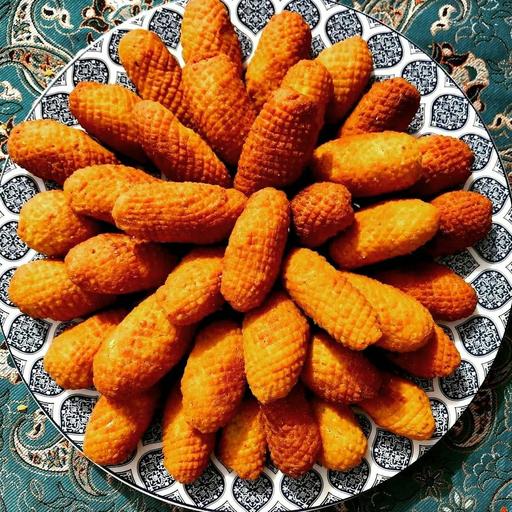
Fatemeh Askarieh’s January 2021 account offers both plain and filled borsaq. The plain dough uses milk, flour, sugar, egg, fat and a little seasoning; pieces are flattened and fried. The filled preparation includes walnuts and powdered dried mulberry, with fennel among the dough ingredients. Significantly, the filled version can be baked or fried, and its rest differs from the plain preparation. These are useful examples of variation in one published account, not universal rules for every Kurdish household. The oblong sweets in this article’s photograph also show why it is misleading to define all bersaq as flat rounds. [3] [4]
A living skill and its registration
Ilam heritage official Sajjad Nazari told ISNA on 18 January 2024 that Ilam’s beji-bersaq preparation skill entered Iran’s national intangible heritage list in Bahman 1397, corresponding to January–February 2019, under number 1770. He also described licensed household workshops producing traditional and packaged versions. The registration concerns a named local skill; it does not establish the first inventor or exclude related traditions elsewhere. Read together, the interview, recorded folktale and recipes show a food sustained through speech, repeated preparation and exchange. [2]
Sources and further reading
- Sara Belelli, The Laki Variety of Harsin: Grammar, Texts, Lexicon (University of Bamberg Press, 2021), p. 240 note 156 and Text 2, pp. 253–271: primary linguistic fieldwork and recorded folktale.
- Nazanin Kargar, ISNA, interview with Ilam intangible-heritage official Sajjad Nazari (18 January 2024): preparation, household practice and registration number 1770.
- Fatemeh Askarieh, “Borsaq: A Yummy Iranian Kurdish Bread,” Iran Front Page (15 January 2021): published plain and filled preparations from Kurdistan Province.
- Wikimedia Commons, Bersagh photograph, author unidentified; source listed as Nan Berenji Eftekhar on Basalam; catalogued under CC BY 4.0.