Kurdish music includes narrative singing, communal dancing, devotional repertoires and contemporary collaboration. Named performers, field research and sound archives offer a practical way to explore these traditions without reducing them to one rhythm or an unbroken ancient origin.
Start with a place and a performance
A song in a family gathering, a dance at a wedding and a concert arrangement need different kinds of listening. Jonathan Sanjeev Withers’s research at Kurdish cultural centres in Istanbul in 2013–14 examines how musicians connect performance with migration, memory and political commitments. [1] Its specific setting matters: an account of activist institutions in one city cannot stand for every Kurdish audience or religious community.
Dengbêj Gazîn: a voice with a documented repertoire
The digital edition Dengbêj Gazîn: Songs of a Kurdish Woman presents the work of Gazîn (1959–2018), a singer-poet from Tetwan/Tatvan. It is based on 210 sound recordings and provides Kurdish transcriptions, Turkish translations and editorial commentary. The editors describe dengbêjs recounting historical events, legendary narratives and personal experience through melodized speech. They also discuss the social restrictions encountered by women performers. [2] This named collection lets a reader connect a voice with a text and a performer, rather than treating oral tradition as anonymous material.
Govend: music and movement together
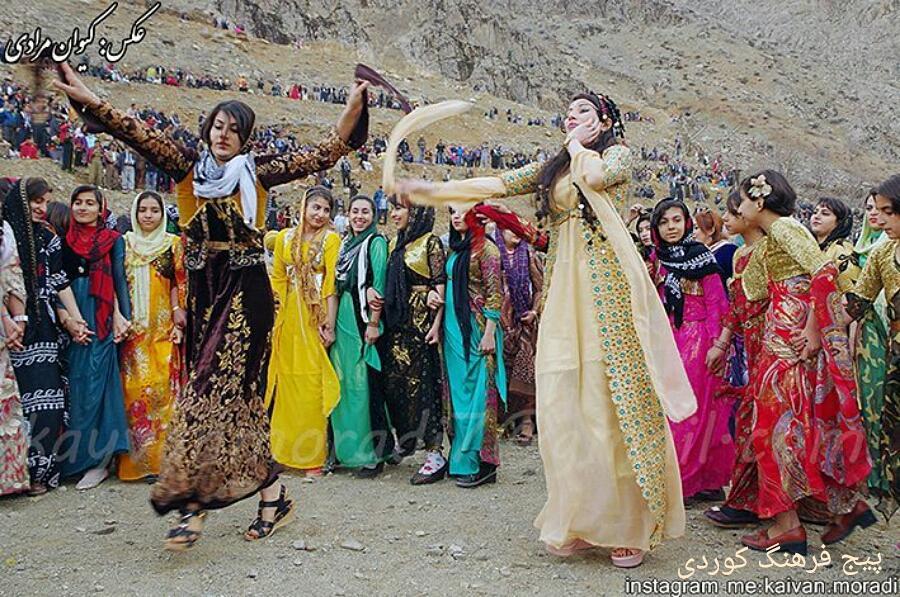
Withers describes govend as participatory group dancing with locally associated variants. His account includes davul–zurna accompaniment: a large double-headed drum and a double-reed wind instrument. Dancers may also sing, including exchanges between a leader and the group; contemporary performances can use other music. His Istanbul observations distinguish spontaneous participation from classes that arrange several dances with rehearsed transitions. [1] The instruments, steps and setting should therefore be identified separately. A dance photograph cannot establish its rhythm or reconstruct its entire choreography.
Tanbūr: an instrument with a devotional setting
The Metropolitan Museum’s 2014–15 exhibition The Sacred Lute examined Ostad Elahi’s instruments, manuscripts and musical life. Its overview places the long-necked tanbūr within Ahl-e Haqq devotional practice in western Iran and Iraq, including contemplation and meditation. It also describes Elahi learning from his father and encountering visiting musicians. [3] This gives the instrument a particular social and religious context. The much wider history of long-necked lutes does not by itself establish that every modern Kurdish performance preserves an unchanged ancient repertoire.
Radio recordings and the work of preservation
The Armenian public radio archive describes holdings in several languages, including Kurdish and Yezidi material. Its institutional account identifies a renewed digitization process beginning in 2017 and explains that catalogue entries provide information such as recording year, music and lyric authors, and genre. [4] Those details are part of the evidence. A recording’s date, performer and circumstances help distinguish a studio arrangement from a field recording or later reissue. The archive’s total collection must not be mistaken for a count of Kurdish songs alone.
Aynur: reinterpreting songs for new audiences
WOMEX’s own record identifies Aynur Doğan as its 2021 Artist Award recipient. It describes a singer and bağlama player drawing on Kurdish folk songs and Alevi heritage, alongside collaborations with Yo-Yo Ma, Kayhan Kalhor, Mercan Dede and Javier Limón. The award citation recognizes both preservation and innovation. [5] This is a documented example of an artist working across musical settings. An acoustic ensemble, a new arrangement or an international stage can be part of a song’s continuing history; change does not automatically make a performance culturally empty.
A practical way to explore the sources
Begin with one identified performance. Note the singer, language variety, place, date and occasion before comparing another version. For Gazîn’s edition, read the transcription or translation while following the recording, then consult the editorial commentary. [2] For dance, look for a named local version and an account of its accompaniment. Keep the song’s subject separate from the circumstances of its recording: a narrative about an earlier event is not an audio document made when that event occurred.
Sources and further reading
- Jonathan Sanjeev Withers, Kurdish Music-Making in Istanbul: Music, Sentiment and Ideology in a Changing Urban Context, Harvard PhD, 2016, introduction and pp. 66–71.
- Max Weber Stiftung / Orient-Institut Istanbul, Dengbêj Gazîn: Songs of a Kurdish Woman, digital edition, introduction and description of recordings and editorial materials.
- Metropolitan Museum of Art, The Sacred Lute: The Art of Ostad Elahi, exhibition overview, 5 August 2014–11 January 2015.
- Armenian Public Radio Archive, About the Archive, Armenian institutional account: multilingual holdings, digitization and catalogue information.
- WOMEX, 2021 Award Recipients, Artist Award: Aynur; organiser’s account of her repertoire, collaborations and award.