The third Marwanid ruler governed from Mayyafariqin after 997. His Byzantine diplomacy, a dated building inscription and the coins of his assassin provide a more concrete account of his reign than general claims about a dynastic golden age.

Succession at Mayyafariqin
Abu Mansur Sa’id ibn Marwan, known as Mumahhid al-Dawla, became the third ruler of the Kurdish Marwanid dynasty after his brother Abu Ali al-Hasan’s assassination in 997. His centre was Mayyafariqin, modern Silvan. Arafat Yaz’s study traces the ruling family’s connection with the founder Badh through Sa’id’s mother. [1] The translated chronicle of Elias of Nisibis records his accession and change of title, providing a contemporary narrative alongside later historical studies. [4]
Diplomacy and the limits of control
Amid, modern Diyarbakır, was not simply a second capital under equally direct control. Yaz describes arrangements recognizing its local rulers while leaving them substantial independence. Around 1000, Sa’id met Emperor Basil II and received the Byzantine title magistros. The agreement helped secure the northern frontier. [1] This diplomacy involved accommodation with a powerful neighbour. Elias’s account emphasizes the welcome given to Sa’id and the peace that followed. [4]
A dated inscription survives in the record
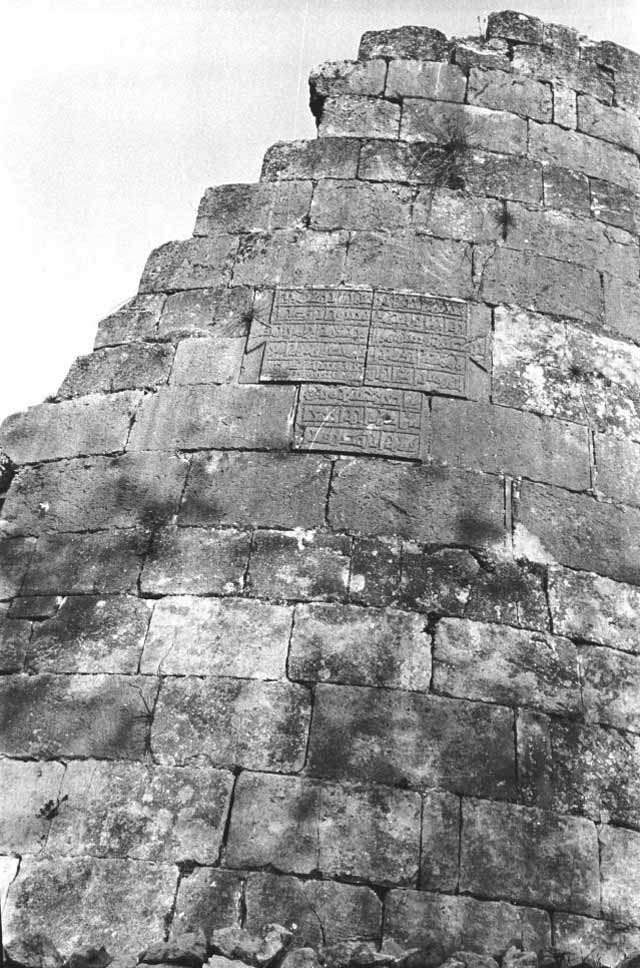
Yaz transcribes an inscription dated 391 AH, or 1000–01, naming Mumahhid al-Dawla Abu Mansur. It states that he ordered the work and paid from his own funds. [1] Gertrude Bell’s photograph, preserved in the Newcastle University archive and reproduced on Wikimedia Commons, records the text on a tower at Mayyafariqin in May 1911. [2] Its carved lettering remains visible in the photograph. Bell’s record allows the inscription’s lettering and its position in the tower to be examined together.
Assassination and disputed chronology
Sa’id was killed in a coup led by his chamberlain Sharwin ibn Muhammad. Stefan Heidemann compares Ibn al-Azraq’s extended account with Elias’s independent chronicle. The narratives differ over timing: Elias gives a December 1010 date, while Heidemann argues for an earlier point in 1010 from the sequence of events and coin evidence. [3] Sa’id’s brother Abu Nasr Ahmad resisted Sharwin and ultimately secured the succession. This was a contested transfer of power, involving sieges and competing claims to authority.
Why the coins matter
Heidemann identifies a dirham struck at Mayyafariqin in 401 AH bearing Sharwin’s name. It also acknowledges the Abbasid caliph al-Qadir and Buyid ruler Baha al-Dawla. This evidence establishes that the assassin asserted rulership, a brief episode missing from some simple dynastic lists. [3] Read together, the chronicle, inscription and coins reveal different aspects of Sa’id’s reign: diplomatic recognition, building patronage and a violent political rupture.
Sources and further reading
- Arafat Yaz, “Mervânî Hükümdarı Mümehhidüddevle Ebu Mansûr Said,” Şarkiyat 12/3 (2020), pp. 536–558, especially 538, 543–547 and 553. DOI: 10.26791/sarkiat.739809.
- Gertrude Bell, photograph S_102, May 1911, Gertrude Bell Archive, Newcastle University Library; image and original catalogue description reproduced on Wikimedia Commons. Public domain.
- Stefan Heidemann, “A New Ruler of the Marwanid Emirate in 401/1010—and Further Considerations on the Legitimizing Power of Regicide,” ARAM 9–10 (1997–98), pp. 599–615, especially 599–603.
- Kurdish Institute of Brussels, “La dynastie kurde des Merwanides (983–1085)”: reproduced French extracts from the chronicle of Elias of Nisibis.