Süreyya Bedir Khan was a Kurdish writer and political organizer active in Cairo and the Xoybûn movement. His later Kurdistan newspapers followed the pioneering publication founded by his uncle in 1898.

Family, schooling and exile
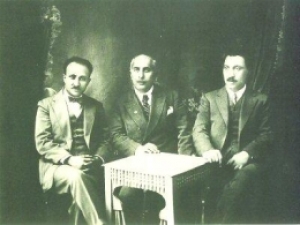
Süreyya was born in Istanbul in 1883 and died in 1938. He was Emin Ali Bedir Khan’s son, Bedir Khan Beg’s grandson, and brother of Celadet and Kamuran. Mehmed Uzun identifies him as an author, lawyer and political organizer. [1] Barbara Henning documents his interrupted Galatasaray schooling and family exile to Isparta in 1906, followed by a return to Istanbul in 1908. [2] His career developed across the transition from Ottoman institutions to exile politics.
Different newspapers called Kurdistan
The first Kurdistan newspaper was founded in Cairo in 1898 by Miqdad Midhat Bedir Khan and continued by his brother Abdurrahman. They were Süreyya’s uncles. [2] Malmîsanij distinguishes Süreyya’s own later publications: Kurdistan in Istanbul in 1909 and another in Cairo in 1917. [3] Reuse of the title expressed a family publishing tradition, but does not make Süreyya the founder of the 1898 paper. These editions belong to different political moments and should not be treated as one uninterrupted editorial career.
Cairo and the postwar independence campaign
Henning traces Süreyya’s work with the Cairo committee for Kurdish independence in 1918 and his petitions to British representatives that December. They sought support for a Kurdish state and opposed Armenian territorial claims. His claim to represent almost all Kurdish tribes was disputed by British officials. Henning also establishes that he could not travel to the Paris Peace Conference as intended and pursued lobbying from Egypt instead. [2] These records document political advocacy, with clear limits to his claimed authority.
Xoybûn and publications in 1930
Uzun places Süreyya among the founders of Xoybûn in 1927 alongside his brothers. [1] His writing extended beyond newspapers. The Kurdish Institute of Paris catalogue records La question kurde, ses origines et ses causes under the name Bletch Chirguh, issued in Cairo by the Kurdish national league Hoyboun in 1930, with 56 pages. A linked Arabic record attributes Al-qadiyya al-kurdiyya to Sureya Bedirxan, published in Beirut that year, with 112 pages. [4] These are distinct bibliographic records, not identical editions.
Literature and public debate
Malmîsanij lists Süreyya’s 1913 article on women among the Kurds in Roji Kurd, a 1931 treatment of Mem o Zine in L’Ethnographie, and contributions on Kurdish towns and countryside, literature and women at the 1935 anthropology congress in Brussels. [3] His interests therefore included social questions and literary representation as well as diplomacy. Celadet’s editing of Hawar and linguistic work were related family projects, but should retain their own attribution. [1]
Sources and further reading
- Mehmed Uzun, “Bedir Khan,” Encyclopaedia Iranica IV/1 (1989), p. 74; family relationships, Süreyya’s dates and Xoybûn.
- Barbara Henning, Narratives of the History of the Ottoman-Kurdish Bedirhani Family in Imperial and Post-Imperial Contexts (University of Bamberg Press, 2018), pp. 354–358 and 412–414.
- Mehemed Malmîsanij, “Les Bedir Khan et leur rôle dans le patriotisme kurde,” Studia Kurdica, online 1 March 2023, sections 3–4: dated writings and newspapers.
- Kurdish Institute of Paris library catalogue, La question kurde (1930), record 1188, and linked Arabic record 1989; publisher, language and pagination.
- Unknown photographer, Bedir Khan brothers, before 1938; Institut kurde de Paris source, Wikimedia Commons public-domain photograph.