Taufiq Wahby combined public service with Kurdish language scholarship. His grammar and the 1966 Kurdish-English dictionary, co-authored with C. J. Edmonds, document his work on spelling and vocabulary.

From Sulaymaniyah to public service
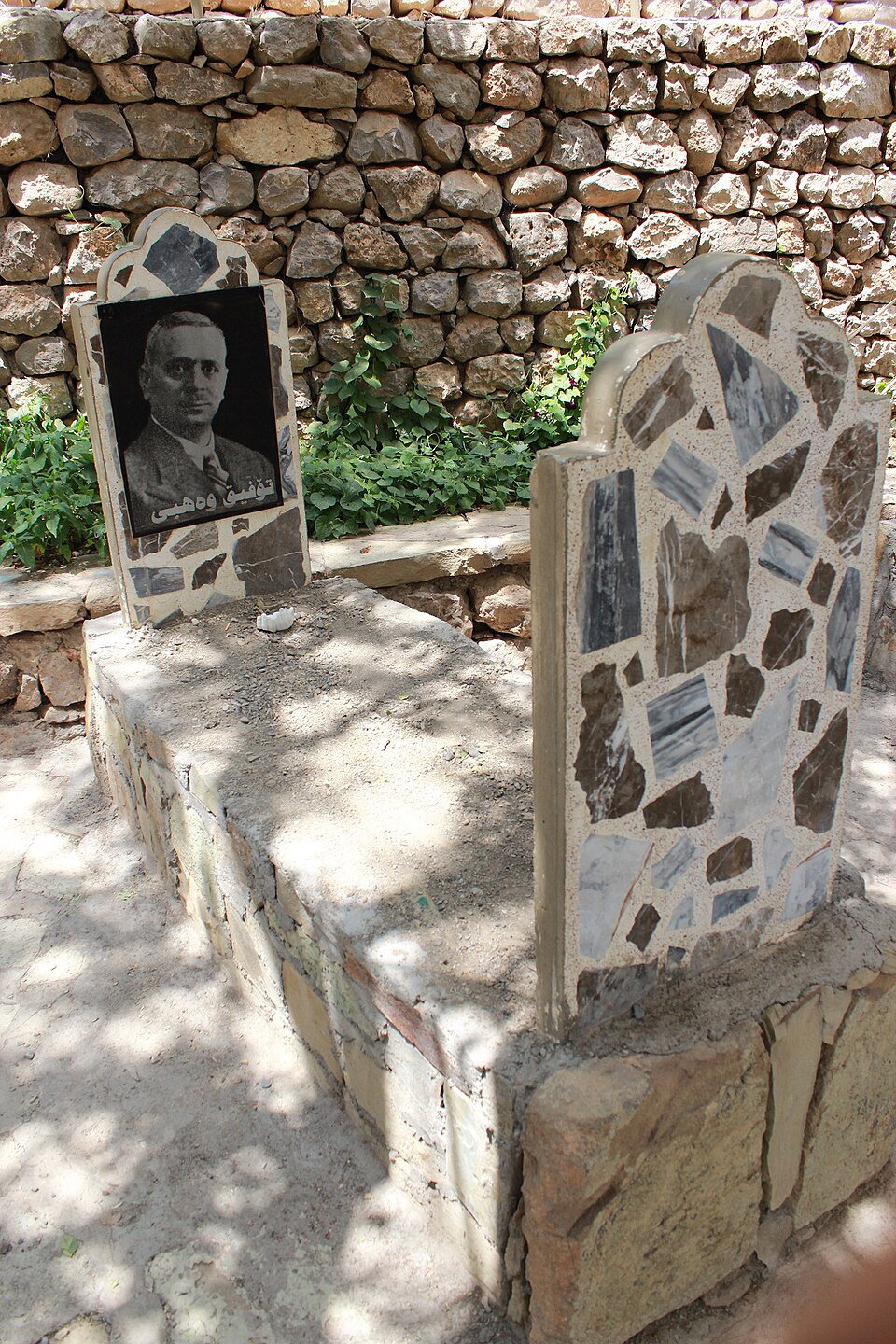
Born in Sulaymaniyah in 1891, Taufiq Wahby was a Kurdish scholar whose career also included Ottoman and Iraqi military service. The Kurdish Institute of Paris’s contemporary obituary records his appointment as Sulaymaniyah’s governor in 1930 and subsequent ministerial and parliamentary roles in Iraq. [1] Metin Yüksel’s biographical study identifies education in Sulaymaniyah, Baghdad and Istanbul. [2] His work developed within several institutions and languages rather than a single lifelong scholarly post.
The 1966 dictionary and its language
Wahby and C. J. Edmonds co-authored A Kurdish-English Dictionary (Clarendon Press, 1966). It covers Sulaymaniyah’s literary language, historically called Southern Kirmanji and now Central Kurdish or Sorani. ERIC describes loanword markers, grammatical labels and appendices on calendars, names, verbs and a narrative. [3] This identifies its scope within Kurdish’s wider diversity.
Grammar and spelling reform
Their introduction links the spelling to Wahby’s Destûrî Zimanî Kurdî (Baghdad, 1929–1930) and his grammar in Arabic (Beirut, 1956). It uses Roman transliteration of modified Arabic script, preferring ch, gh and sh. [4] This is the dictionary’s particular system, rather than one alphabet for all Kurdish writing.
Scholarship across languages
Yüksel argues that Wahby’s command of European languages and engagement with Orientalist scholarship helped shape his programme of Kurdish language reform. He highlights contributions to Kurdish-, Arabic- and English-language journals and collaboration with British scholars. [2] The dictionary is a concrete example of such cooperation. Understanding these exchanges places Wahby within a network of intellectual work, alongside his own commitment to describing and developing Kurdish.
London, remembrance and continued access
The Institute’s obituary records that Wahby settled in London after leaving Iraq in 1958, continued writing in exile and died there in January 1984. It identifies him as an Institute founding member and reports his burial at Pîre Megrîn in Iraqi Kurdistan. His final linguistic article appeared in Hêvî. [1] VejînLex now provides a searchable edition of the dictionary and credits Aso Mahmudi’s digitization work, extending access to the joint publication. [5]
Sources and further reading
- Kurdish Institute of Paris, “La disparition de Tawfiq Wahby,” Bulletin de liaison et d’information, no. 4 (January–February 1984); contemporary institutional obituary.
- Metin Yüksel, “Tawfiq Wahbi and the Reform of the Kurdish Language in Contact Zones,” Archiv orientální 91/3 (2023 issue), pp. 403–421; public abstract in Hacettepe University’s research record.
- ERIC, record ED029287, A Kurdish-English Dictionary (1966), by Taufiq Wahby and C. J. Edmonds; bibliographic description and contents.
- Taufiq Wahby and C. J. Edmonds, A Kurdish-English Dictionary (1966), introduction, especially “Vocabulary” and “Transcription”; text presented by VejînLex.
- VejînLex, A Kurdish-English Dictionary: Central Kurdish–English edition, searchable entries and digitization credits.
- Ara Qadir, Tofiq Wehbi Mezar, 23 July 2011; own photograph, Wikimedia Commons, CC BY-SA 3.0.