top of page

The Life and Legacy of Khana Qubadi: Celebrating Kurdish Poetry and Identity

Khana Qubadi stands as a towering figure in Kurdish literature, whose work continues to inspire pride in Kurdish language and culture. Born in 1700, he was a poet from the Jaff tribe who wrote in Gorani, a Kurdish dialect. His poetry not only reflects artistic mastery but also a deep commitment to preserving Kurdish identity during a time of political and cultural challenges. This post explores his life, his contributions to Kurdish poetry, and the lasting impact of his work on Kurdish cultural heritage.


📜 The Poet of Linguistic Pride: Khana Qubadi and the Hawrami Renaissance


Khana Qubadi (c. 1700–1759) is one of the most intellectually courageous figures in the history of Kurdish letters. Born into the influential Jaff tribe during the tumultuous early 18th century, he did not just write poetry; he consciously waged a cultural war to elevate his mother tongue, Gorani (or Hawrami), to the level of the dominant imperial languages, Persian and Arabic. His life was defined by a commitment to linguistic sovereignty—a concept powerfully articulated in his famous verse: "But, for me Kurdish is sweeter than sugar."

His most famous acts—the composition of the epic Şîrîn û Xesrew and the revolutionary translation of the Quran—were not merely literary exercises; they were political statements that directly challenged the established religious and administrative order of the Ardalan Principality, a defiance that ultimately resulted in his forced exile to the neighboring Baban Emirate. Khana Qubadi’s legacy is a profound reminder that language is the ultimate vessel of national identity.


⛰️ I. The Geopolitical and Cultural Context of the 18th Century


Khana Qubadi lived during a period of immense fragmentation and geopolitical flux following the collapse of the Safavid Empire (1722) and the weakening of central Ottoman authority.

A. The Kurdish Triangle of Power

The Kurdish lands of the 18th century were dominated by the rivalry and occasional alliance of three powerful, semi-autonomous principalities:

  1. Ardalan (Western Iran): Based in Sanandaj, this was Khana Qubadi's original home. Ardalan was historically the cultural center of the Gorani dialect and a hub of Kurdish scholarship. It operated under nominal Persian (later Afsharid) influence.

  2. Baban (Modern Iraqi Kurdistan): The neighboring principality, based in Sulaimaniyah (after 1784). Baban was the rising power and the future home of the Sorani dialect's literary ascendancy.

  3. Bajelan: A smaller, but strategically important tribe situated along the frontier.

The complex politics—Kurdish lords caught between Ottoman, Persian, and later, Afsharid ambitions—created an environment where cultural expression was both cherished and viewed with deep suspicion by imperial powers wary of unified Kurdish identity.

B. The Supremacy of Gorani/Hawrami

Khana Qubadi wrote at the end of the Golden Age of Gorani Literature. For centuries, Gorani (specifically the Hawrami sub-dialect) had served as the lingua franca of Kurdish literary culture, particularly in Ardalan and Kermanshah, due to its antiquity and its suitability for classical metrical forms like Aruz.

This tradition, known as the Hawrami School, was characterized by:

  • Mystical Content: Heavily influenced by Sufi poetry and philosophical themes.

  • Classical Form: Strict adherence to the metrical and structural requirements of Persian and Arabic classical poetry.

  • Widespread Prestige: Gorani works were read and admired across multiple Kurdish principalities.

Khana Qubadi was deeply rooted in this tradition, yet he was about to use its most prestigious forms to introduce radical, proto-nationalist themes.


🖋️ II. The Nationalist Manifesto: Şîrîn û Xesrew (1740)


Khana Qubadi’s enduring masterpiece, completed in 1740, is his long masnavi (epic poem in rhyming couplets), Şîrîn û Xesrew. It is a testament to his ambition to create a Kurdish national epic on par with the Persian masterpieces he so admired.

A. Appropriation and Transformation of the Narrative

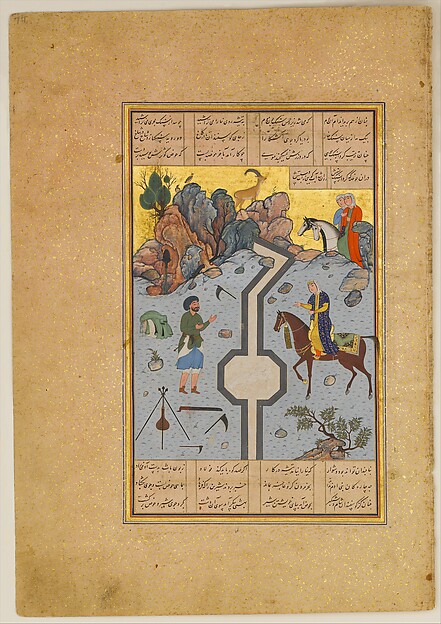
The story of Shirin and Khasraw (or Khosrow) is one of the most famous romances in Persian literature, immortalized by the 12th-century poet Nizami Ganjavi (d. 1209). It tells the story of the Sasanian Shah Khosrow II, his love for the Armenian princess Shirin, and the doomed rivalry with the stonemason Farhad.

Khana Qubadi's genius lay in his conscious appropriation and Kurdish refraction of this story:

  • Linguistic Statement: By rewriting the epic in flawless Gorani, he was asserting that the Kurdish language was equally capable of sustaining monumental literary art as Persian. He demonstrated that Kurdish did not need to borrow literary forms; it could claim and redefine them.

  • Cultural Claim: The act of retelling a classical Persian story in Kurdish asserted that the Kurdish cultural sphere was not merely a tributary to the Persian one, but an independent entity with the right to its own literary canon.

  • Literary Bridge: His work served as a bridge, making the classical themes and complex structures of the epic tradition accessible and relevant to a Kurdish-speaking audience that may have been excluded by the Persian-language court culture.

B. The Verse of Linguistic Pride

The most famous stanza from his work, quoted in the prompt, serves as Khana Qubadi’s explicit linguistic manifesto and proto-nationalist statement:

"Although it's said that Persian is sweet as sugar, / But, for me Kurdish is sweeter than sugar. / Clearly, in this perfidious world, / Everyone is happy with his own beautiful mother tongue."

This is a direct, eloquent defense of linguistic self-determination. In an era where Persian was the language of power, administration, and high culture across the region, this verse was a revolutionary call for Kurds to value and use their own language, viewing it not as a vernacular, but as the sweetest expression of their identity.


🕌 III. The Act of Defiance: The Quran Translation and Exile


Khana Qubadi's most profound act of cultural defiance was his endeavor to translate the Quran into the Gorani dialect. This single action was directly responsible for his political downfall and subsequent exile.

A. The Religious and Political Norms

For centuries, the Holy Quran was studied and recited almost exclusively in Arabic, the language of the revelation. When translation was necessary for administrative or scholarly purposes, it was usually done into Persian or, within the Ottoman domains, Ottoman Turkish.

Translating the text into a regional vernacular like Kurdish was viewed as deeply problematic by the ruling religious and political authorities of Ardalan for several reasons:

  1. Religious Orthodoxy: It was seen as potentially diluting the sanctity and purity of the revealed Arabic text, risking heresy or misinterpretation among the common people.

  2. Challenge to Authority: The clerical class (Ulama) derived enormous power from being the sole interpreters of the Arabic text. A Kurdish translation would have dramatically democratized religious knowledge, undermining the Ulama's authority and their close relationship with the Ardalan ruler.

  3. Linguistic Nationalism: The translation was seen as an extension of Khana Qubadi’s linguistic agenda. If Kurdish could carry the weight of the Holy Quran, its claim as a sovereign, literary language would be unassailable. This was a political threat to the Persian-aligned Ardalan ruler.

B. The Forcing of Exile

Facing pressure from the conservative Ulama and the Ardalan Emir, who feared being accused of tolerating heresy by the larger Persian power, Khana Qubadi was forced into exile. He fled his home in Ardalan (or possibly the border region of the Jaff tribe) and took refuge in the neighboring Baban Emirate (in what is now Iraqi Kurdistan).

This exile serves as a powerful historical marker: it underscores the tension between imperial pressure and cultural preservation in Kurdish intellectual life. Khana Qubadi sacrificed comfort and security for the principle of his language.


🌊 IV. The Legacy and the Shift in Kurdish Literature


Khana Qubadi's exile had unforeseen consequences, serving as an inadvertent catalyst for the next great shift in Kurdish literary history.

A. The End of Gorani Dominance

Khana Qubadi’s work, while masterful, represents the final great flowering of the Gorani literary tradition. The political pressures that forced his exile, coupled with the rising political and economic power of the Baban Emirate in Sulaimaniyah, soon led to a linguistic shift.

After Khana Qubadi, the Sorani dialect (Central Kurdish), which was the language of the Baban court, began to rise in prominence. Later poets like Nalî (1800–1856) and Kurdi would consciously use Sorani to create their own literary school, replacing Gorani as the prestige dialect.

Khana Qubadi is thus a tragic-heroic figure: the greatest champion of a dialect whose dominance was about to end, a fate sealed by the very political pressures he sought to overcome.

B. The Enduring Power of the Manifesto

Despite the shift to Sorani, Khana Qubadi’s legacy remains critical because his linguistic philosophy was adopted by the next generation of Kurdish nationalists and writers.

  • Inspiration for Sorani Poets: The Sorani poets of the 19th century inherited his spirit of linguistic pride and his commitment to creating a literature that was politically conscious and nationally focused.

  • Symbol of Resilience: Today, Khana Qubadi is celebrated by Kurds across the linguistic spectrum (Kurmanji, Sorani, Gorani) as the original intellectual who clearly articulated the political importance of the mother tongue. His work is a fundamental text for modern Kurdish identity movements that continue to fight for the right to education and administration in their native language.


💡 V. Khana Qubadi's Lasting Relevance


Khana Qubadi's life and work offer profound lessons on the link between language, faith, and identity that resonate far beyond the Kurdish context.

  • Linguistic Sovereignty: His advocacy proves that the fight for cultural survival is inherently political. By demanding literary and religious parity for Gorani, he was demanding national dignity for the Kurdish people.

  • Courage in Translation: The risks he took to translate the Quran underscore the revolutionary potential of translation in breaking down religious elitism and making sacred texts accessible to the common person.

  • The Power of the Poet: Khana Qubadi’s exile and continued production of great works demonstrated that the poet, armed with the power of language, can possess an authority that transcends that of the temporary political ruler.


Khana Qubadi’s Şîrîn û Xesrew remains a cornerstone of Kurdish literature, and his declaration that Kurdish is "sweeter than sugar" is the eternal rallying cry of Kurdish linguistic pride. His is the story of a classical poet who became a foundational modern nationalist through the sheer force of his cultural conviction.


References:


Comments


bottom of page