Ali Mardan Khan moved from Safavid to Mughal service after surrendering Kandahar in 1638. His career connects frontier government, military command, canals, gardens and a surviving tomb in Lahore.
Family and the Safavid frontier
Muhammad Afzal Khan identifies Ali Mardan Khan as a Kurd of the Zig tribe and the son of Ganj Ali Khan, a trusted official of Shah Abbas I. [1] This identifies a specific family background; it should not be replaced by an unsupported Zanganeh attribution. Mehrnoush Soroush explains that Ali Mardan succeeded to his father’s governorships in 1624 and governed from Kandahar. His early life remains poorly documented. [2] His later prominence arose within the institutions and rivalries of two empires.
The surrender of Kandahar in 1638
Soroush compares Safavid and Mughal chronicles of the transfer. Safavid writers condemned it while Mughal writers celebrated it, and their explanations reflect those different allegiances. Fear that Shah Safi intended to kill him emerges as a plausible motive. The negotiations culminated in March 1638, when the khutba and coinage proclaimed Shah Jahan’s authority. [2] This account gives readers a way to distinguish the transfer itself from interpretations of personal motive. Calling the decision either simple betrayal or inevitable self-preservation removes the differences between the surviving accounts.
Office, rank and military service
Under Shah Jahan, Ali Mardan held responsibilities in Kashmir, Lahore and Kabul and participated in the Mughal campaigns around Balkh and Badakhshan. Afzal Khan’s study follows these appointments alongside the advancement of his household. [1] Soroush dates his promotion to the rank of 7,000 zat and 7,000 sowar, with the title Amir al-Umara, to January 1643. [2] Rank and office made him an important imperial noble. They also connected his military duties, provincial resources and opportunities to sponsor construction.
The Lahore water project required revision
Afzal Khan describes a canal project begun in 1639 to supply Lahore, irrigation and Shalamar Garden. The initial work failed to bring water into the city. Mulla Ala-ul-Mulk Tuni, known as Fazil Khan, then used part of that channel and excavated a new course. [1] Abdul Rehman also discusses a separate intervention on the old Firoz Shah canal supplying Shahjahanabad, or Old Delhi. [3] These projects need to be distinguished by place and phase. Ali Mardan’s role as patron and supervisor is significant without treating every completed channel as his unaided engineering achievement.
Gardens and a pavilion at Peshawar
Rehman’s architectural research examines Ali Mardan’s surviving baradari, a garden pavilion, at Peshawar. Field documentation and historical texts identify a building reshaped by later Sikh, British and military use. His analysis considers its plan, decoration and Persian architectural connections. [3] The pavilion offers evidence of a noble’s contribution to Mughal landscapes alongside royal patronage. It also shows why a present-day building cannot simply be assumed to preserve its original appearance.
The tomb and its surviving decoration
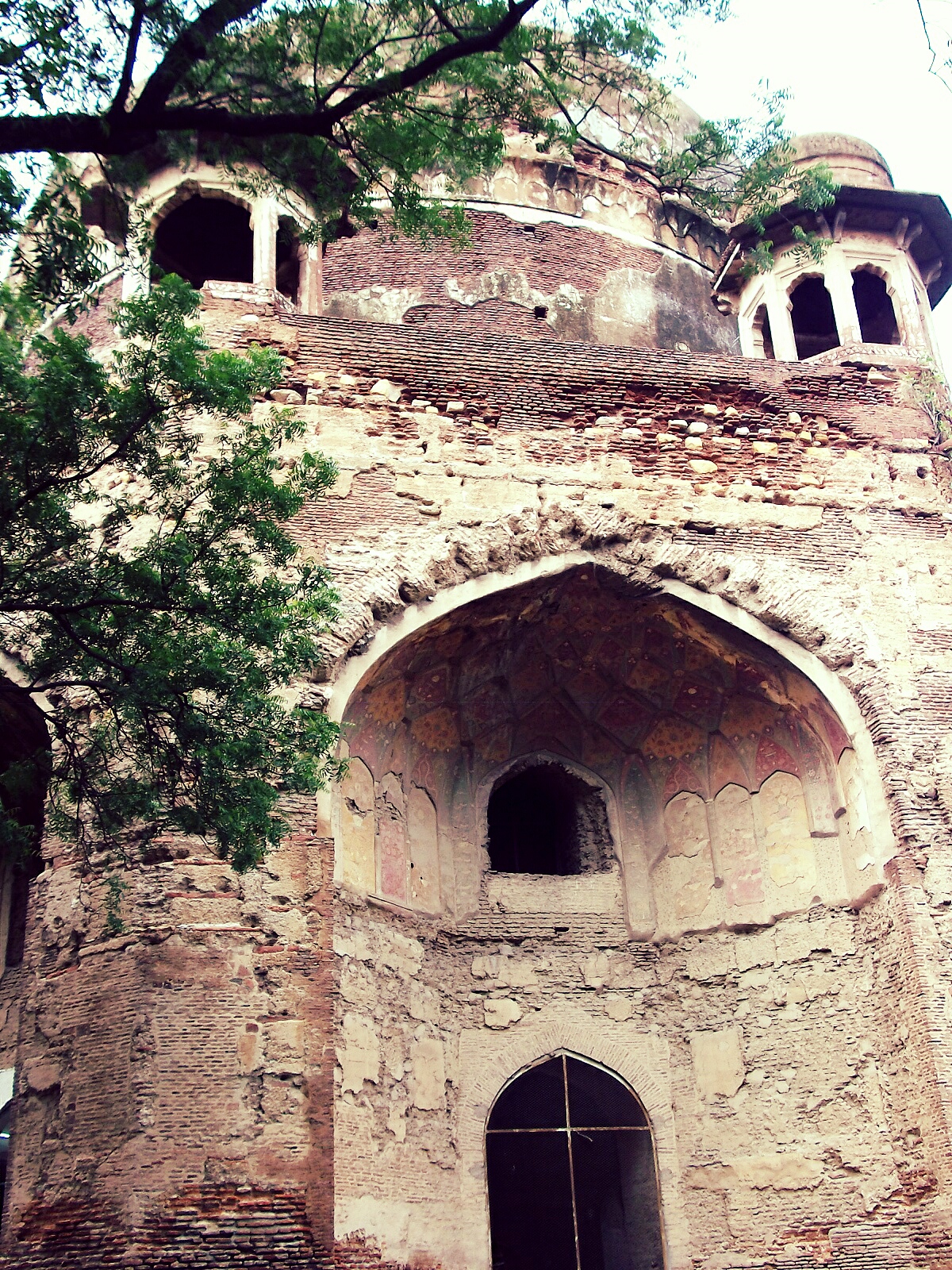
Ali Mardan died in 1657. [2] Masooma Abbas’s study of his Lahore tomb examines an octagonal monument and reconstructs its lost decorative scheme theoretically from surviving evidence and comparisons. She records a remaining original garden gateway and distinguishes it from later enclosure walls. [4] Pakistan’s archaeological inventory identifies the tomb’s brick construction, high dome and octagonal podium. [5] The photograph illustrates this surviving monument. Studying its fabric adds a material record to the chronicles and helps explain how a governor’s memory became attached to the buildings he sponsored.
Sources and further reading
- Muhammad Afzal Khan, Ali Mardan Khan: A Great Iranian Noble of Shahjahan, Proceedings of the Indian History Congress 44 (1983), pp. 198–210, especially pp. 198–201 and 204–206; publicly displayed article text.
- Mehrnoush Soroush, ʿAli Mardān Khan, Encyclopaedia Iranica, updated 2017; family, surrender, offices and death.
- Abdul Rehman, Garden of Nobility: Placing Ali Mardan Khan’s Baradari at Peshawar in the Context of Mughal Architecture, South Asian Studies 35/1 (2019), pp. 129–144, especially pp. 129–136; publicly displayed research text.
- Masooma Abbas, The Tomb of Ali Mardan Khan at Lahore: A Reconstruction of Its Original Decoration (2012), especially pp. 13–17, University of the Punjab journal archive.
- Department of Archaeology and Museums, Government of Pakistan, Tomb of Ali Mardan Khan, monument inventory entry.
- M Umair Astro, Front view of the tomb of Ali Mardan Khan, 8 September 2014, Wikimedia Commons, CC BY-SA 3.0.