Kangavar’s monumental platform in Kermanshah Province is widely known as the Temple of Anahita. Its columns and stairways survive, but archaeology has complicated both the temple identification and early dates once assigned to it.
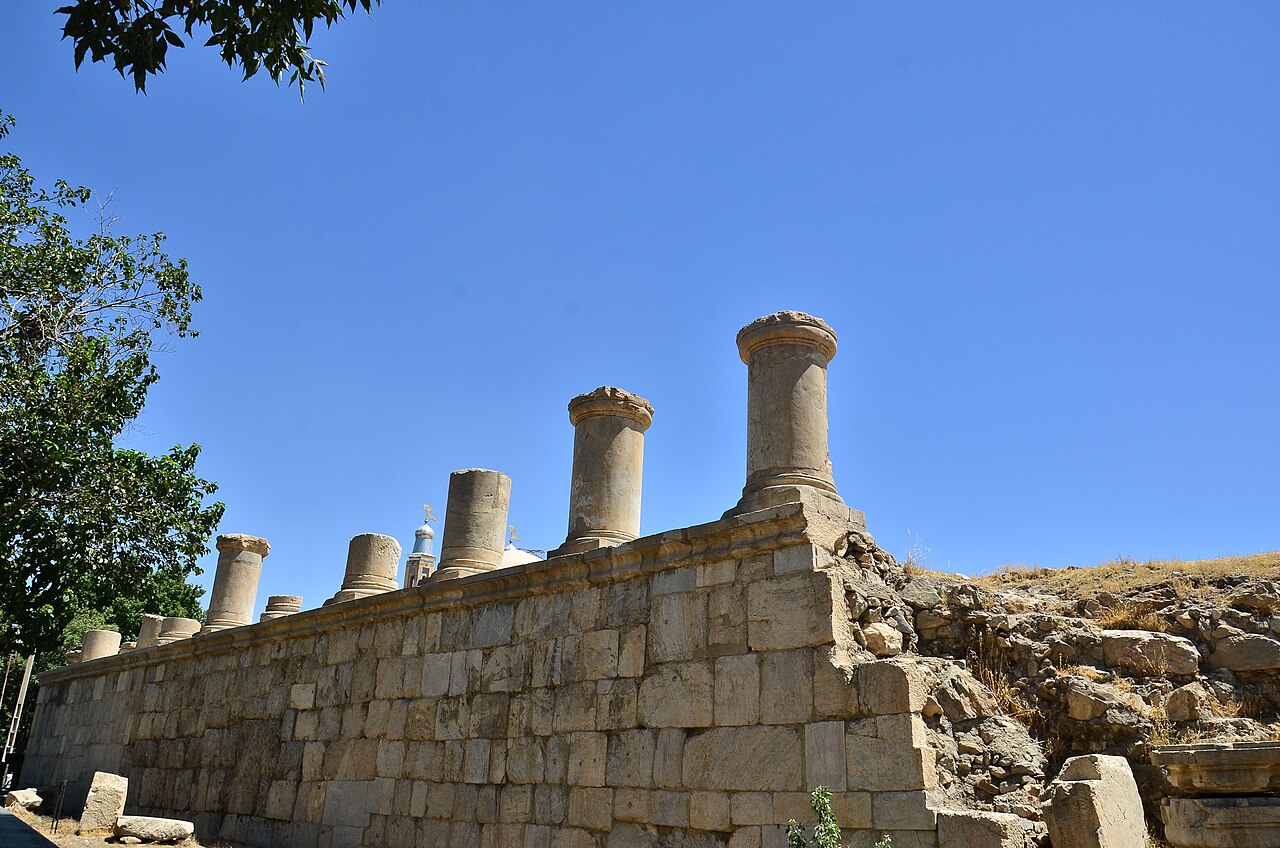

A monumental platform in the Zagros
The complex stands within Kangavar, in the eastern part of Kermanshah Province on the route toward Hamadan. Its large terrace encloses a natural hill, with dressed facing stones, substantial retaining walls and stairways. The UNESCO submission describes an overall size of about 220 by 212 metres; Wolfram Kleiss records sides of 224 and 209 metres. These are approximate descriptions of a large irregularly preserved complex, not measurements of a fully standing temple interior. The visible remains establish monumental investment, while the arrangement of buildings once above the terrace is less secure. [1] [2]
What Isidore actually wrote
In section 6 of Parthian Stations, Isidore of Charax names a temple of Artemis at Concobar. Later in the same passage he names a sanctuary of Anaitis at Ecbatana. Distinguishing these places prevents moving the explicitly named Anaitis temple from one city to another. Scholars associated Concobar with Kangavar and understood Artemis as an Iranian goddess’s Greek counterpart. That interpretation helped produce the modern name, but the brief itinerary does not describe the dimensions, columns or surviving ground plan of today’s monument. [3]
How the familiar identification developed
Nineteenth-century visitors, including Eugène Flandin and Pascal Coste, recorded the ruins with drawings and plans. Classical-looking architectural details encouraged comparisons with Greek temples and with Isidore’s text. The Irano-Hellenica research catalogue traces how these proposals became the conventional Temple of Artemis-Anahita identification. Reconstructed colonnades and temple plans are therefore part of the history of interpreting the site. They should be read alongside excavation evidence rather than treated as photographs of an ancient building that survived intact. [4]
Excavations and the question of date
Iranian investigations began in 1968 under Seifollah Kambakhsh Fard, followed by work including Massoud Azarnoush’s campaigns in 1977–1978 and later excavation and restoration. The research catalogue identifies several reasons for a Sasanian date: architectural comparisons, signs cut into stone blocks and analysis of a brick found beneath the terrace. Parthian ceramics and an eastern hillside cemetery show earlier activity nearby, but do not automatically date the platform itself. Kleiss favours late Sasanian construction, possibly under Khosrow II; the proposed ruler remains an attribution rather than a dated foundation inscription. [2] [4] [5]
Temple, palace or another kind of complex?
Azarnoush proposed a connection with the palace described by later historical geographers as Qasr al-Lusus. Other interpretations retain a religious function or an open-air sanctuary. Kleiss considers a palace plausible but notes that a convincing palace ground plan has not been recovered; an enclosed temple plan is also unproven. Architectural resemblance to Persepolis does not by itself establish an Achaemenid construction date. The most useful description keeps the surviving platform, the possible date and the proposed function as separate questions. [2] [4]
Later use, preservation and UNESCO status
Excavation documented Islamic-period houses on the platform as well as later kilns and stone removal that damaged ancient fabric. This history helps explain gaps in the plan and the importance of conservation. Iran submitted the Historic Monument of Kangavar to UNESCO’s Tentative List on 9 August 2007. That is a proposal for possible nomination, not World Heritage inscription. The site contributes to the historical landscape of Kermanshah and the Zagros, while its interpretation depends on particular evidence rather than an unsupported claim about the beliefs or identity of every later inhabitant. [1] [2] [4]
Sources and further reading
- UNESCO World Heritage Centre, “Historic Monument of Kangavar”, Tentative List reference 5189, submitted by Iran on 9 August 2007; state submission, dimensions and proposed criteria.
- Wolfram Kleiss, “Kangavar”, Encyclopaedia Iranica XV/5 (2010), pp. 496–497, updated 2012; architecture, excavation, dating arguments and unresolved function.
- Isidore of Charax, Parthian Stations, section 6, translated by Wilfred H. Schoff (1914), reproduced at Parthia.com; ancient itinerary, distinguished here from the translator’s later commentary.
- Irano-Hellenica, “Kangāvar: The so-called Temple of Artemis-Anāhitā”, Mapping Ancient Cultural Encounters: Greeks in Iran ca. 550 BC–ca. AD 650; research catalogue marked as preliminary draft, with excavation history and references through 2015.
- Irano-Hellenica, “Kangāvar: Archaeological Reports”; bibliographical guide to fieldwork, including Massoud Azarnoush, “Excavations at Kangavar”, AMI 14 (1981), pp. 69–94, and later dating studies.
- Peymanpakzad, Kangavar monument, 14 August 2015, Wikimedia Commons; CC BY-SA 4.0.