Dilshad Meriwani (1947–1989) was a Kurdish poet, writer, teacher and playwright. His surviving poems and the documented staging of Vietnam’s Eye offer a clearer account of his contribution than a biography detached from his actual work.
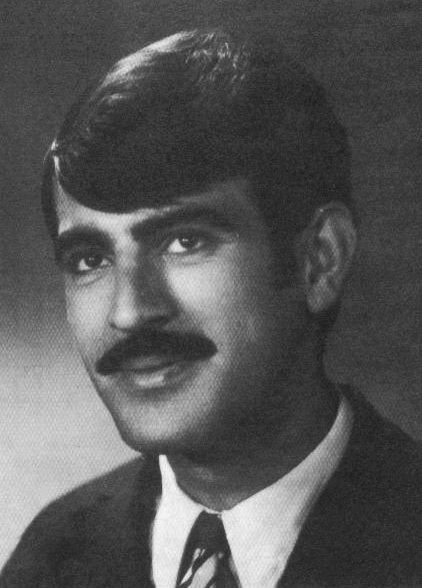

A writer whose work crossed forms
Dilshad Meriwani, also written Dilşad Merîwanî, belongs to the history of Kurdish poetry and theatre. Mahroo Rashidirostami’s study identifies him as a writer and teacher and documents his political writing. His literary record is substantial enough to approach through named texts rather than through general praise: VejinBooks preserves multiple poetry collections, while theatre scholarship identifies a play, its date and its performance location. These are distinct kinds of evidence, connecting a written corpus with public cultural activity. [1] [2]
Collections readers can follow
VejinBooks lists Firmêsk û Zerdexene (Tears and Smiles, 1968), Bibin be Tîşk (1977), Êmeyş le Xoşewîstî Dezanîn (1979), and two collections dated 1980, including سەمفۆنیای وەنەوشە. Its catalogue also gives several 1989 titles, among them Ishqî Bê Nexşan. These dates identify the editions or works listed by the archive; they do not establish exactly when each individual poem was composed. Consulting the collection as well as the isolated poem helps preserve the relationship between an author’s work and its editorial setting. [2]
Intimacy and the address to Shirin K.
The poem numbered forty in Ishqî Bê Nexşan is dedicated to Shirin K. Vejin classifies it as Central Kurdish free verse. In a close reading of the text, the speaker answers a question about love by directing the addressee towards his poetry. Bodily and emotional images connect the poems with the beloved’s stature and gaze, before pain and the stories she has written enter the address. This is an intimate literary conversation, with the addressee also appearing as a writer. The dedication’s initials alone should not be treated as a complete biography of that person. [3]
Autumn as an emotional season
Xezan (Autumn), preserved from Firmêsk û Zerdexene, offers a different example. Vejin labels its form mesnevi and records a fifteen-syllable pattern. The poem opposes other people’s springtime pleasure to the speaker’s experience of autumn, falling leaves and lost happiness. Read alongside the free-verse dedication, it shows why descriptions of Meriwani should leave room for changing poetic forms and for grief, affection and personal address. These readings describe the poems’ speakers and imagery; they do not turn every line into a verified episode of the author’s life. [4]
Vietnam’s Eye and resistance on stage
Rashidirostami identifies Çawî Vietnam (Vietnam’s Eye, 1973) as a play staged in Kirkuk. In her account, captors destroy freedom fighters’ eyes, yet resistance continues: the image turns the eyes of a people into something an oppressive power fears. Its Vietnamese setting connects Kurdish political theatre with an international struggle. A dramatic representation of violence is evidence of a writer’s political imagination, rather than a documentary record of a particular Iraqi prison incident. [1]
Political activity, death and literary memory
The same thesis describes imprisonment and torture, work in a clandestine literary society during 1962–1966, participation in the 1975 uprising and life as a peshmerga in 1983–1985. It reports his execution in 1989. That account supports a history of political repression; it does not identify a particular Anfal operation in which he died. His legacy can be read in accessible poems, their differing forms and the theatre record, while the precise circumstances of his final detention require more specific documentation. [1]
Sources and further reading
- Mahroo Rashidirostami, Theatre and Cultural Nationalism: Kurdish Theatre under the Baath, 1975–1991, University of Exeter PhD thesis, September 2015, p. 136: biography, political activity and Çawî Vietnam.
- VejinBooks, Dilshad Meriwani author catalogue: preserved poetry collections and listed publication years.
- Dilshad Meriwani, “Fortieth: For Shirin K.,” from Ishqî Bê Nexşan, Central Kurdish text and form metadata, VejinBooks. Literary interpretation in this article is an editorial close reading.
- Dilshad Meriwani, “Xezan,” from Firmêsk û Zerdexene, Central Kurdish text and metrical metadata, VejinBooks. Literary interpretation in this article is an editorial close reading.
- Unknown photographer, Dilshad Meriwani portrait, dated 1970s in the file record; Wikimedia Commons public-domain designation and linked scanned-book source.