Irarum is named in the Gutian section of the Sumerian King List, which assigns him two years. His entry follows La-erabum and precedes Ibranum; it preserves a place in the tradition rather than a detailed political biography.

Reading Irarum’s entry
Oxford’s ETCSL translation assigns Irarum two years, following La-erabum, also two years, and before Ibranum, one year. [1] Jacobsen’s critical edition prints i-ra-ru-um beside the two-year figure on pp. 118–119. [2] The neighbouring entries identify the sequence as transmitted. They do not name Irarum’s parents, describe a transfer ceremony or prove that the three men belonged to one family.
| Ruler | Years listed |
|---|---|
| La-erabum | 2 |
| Irarum | 2 |
| Ibranum | 1 |
Two years are not an accession date
A reign-length figure and a calendar date answer different questions. The text does not put 2115 BCE beside Irarum’s name. Its Gutian passage gives competing total durations, including 124 years and 40 days in one witness and 25 years in another. [1] Van De Mieroop also discusses the possibility of Gutian rulers in different cities being contemporaries. [4] A precise accession year or an unqualified position such as twelfth therefore requires a stated chronological reconstruction. Two listed years alone do not show stability, a coup or a peaceful succession.
Why the later manuscript matters
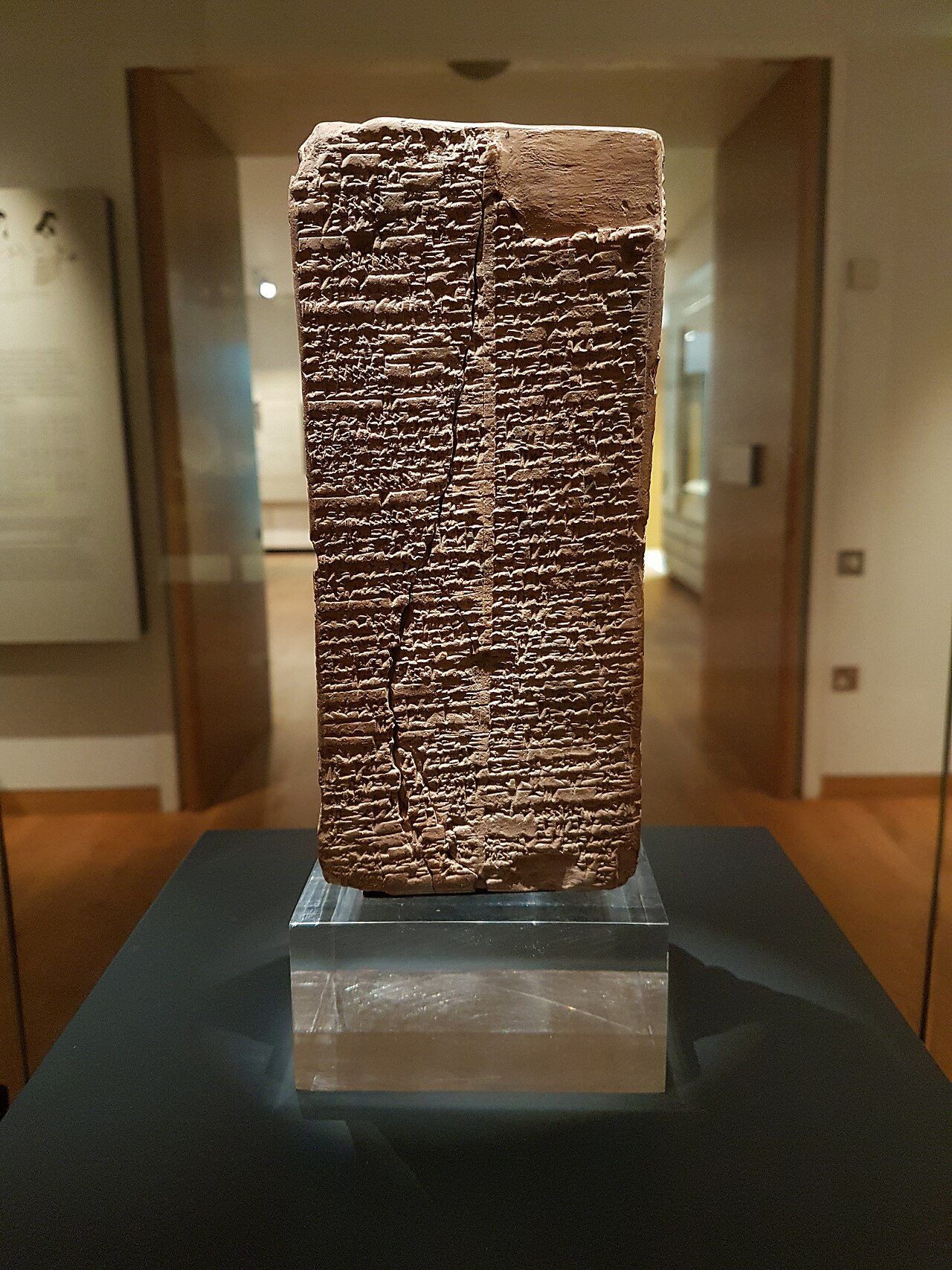
The Ashmolean dates its extensive prism to about 1800 BCE and identifies Larsa as its probable origin. Each of its four sides has two columns of Sumerian cuneiform. The museum explains that the list combines myth, legend and historical material and presents kingship as passing between cities, supporting Isin’s claim to legitimate succession. [3] Irarum’s inclusion is important evidence of remembered kingship. It is not a neutral contemporary certificate of authority over all Mesopotamia, and the date of the surviving object should not be mistaken for his lifetime.
Context without an invented personal programme
Van De Mieroop emphasises changing uses of the labels Gutium and Gutian, hostile Mesopotamian portrayals and limited linguistic evidence, largely personal names. [4] This calls for caution in both directions: an unfavourable literary image does not describe every ruler, while Irarum’s brief entry cannot establish decentralised government, patronage of Gudea or a documented national project. The Zagros connection belongs in the history of lands important to Kurdish communities today. A geographical connection and a proposed resemblance between names do not by themselves demonstrate Irarum’s direct ethnic descendants.
Sources and further reading
- University of Oxford, ETCSL 2.1.1, Sumerian King List, lines 308–334; Irarum’s two years, neighbouring entries and manuscript totals.
- Thorkild Jacobsen, The Sumerian King List, Assyriological Studies 11 (1939), pp. 118–119; i-ra-ru-um and the two-year entry.
- Ashmolean Museum, Sumerian King List, AN1923.444; physical description, date, probable origin and political purpose.
- Marc Van De Mieroop, Gutians, Encyclopaedia Iranica XI/4 (2002), pp. 408–410, updated 2013; political labels, chronology and linguistic evidence.
- Gts-tg, Sumerian King List, photograph of 15 March 2017, Wikimedia Commons; CC BY-SA 4.0.