Sadegh Sharafkandi combined a career in chemistry and teaching with leadership of the Democratic Party of Iranian Kurdistan. His murder in Berlin in September 1992 led to the Mykonos trial, whose judgment established both individual criminal responsibility and the involvement of Iran’s state leadership.
A teacher and analytical chemist
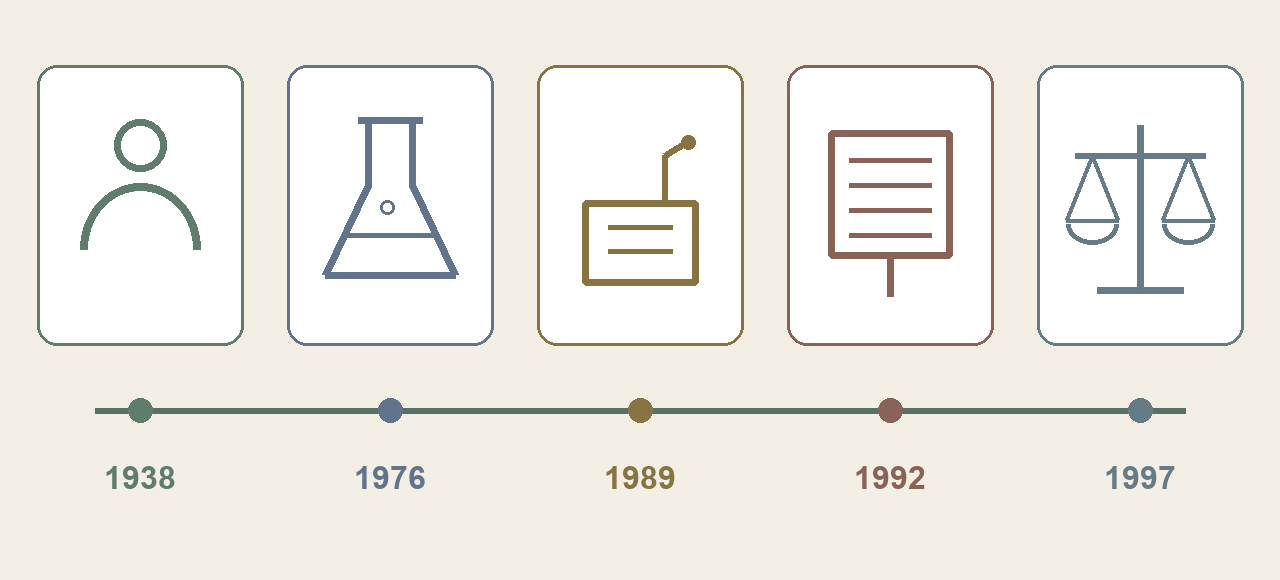
The Abdorrahman Boroumand Center’s biography, drawing on interviews and documentary records, places his birth on 11 January 1938 in Targhe, in the Bukan district. He graduated in chemistry from Tehran’s Higher Teacher Training College in 1959 and taught in Urmia and Mahabad. A scholarship took him to France in 1972; he completed a doctorate in analytical chemistry in Paris in 1976 and returned to university teaching in Iran. [1] His scientific career preceded his full-time party work.
Taking over after Ghassemlou
Sharafkandi met Abdulrahman Ghassemlou while studying in France. He entered the party’s Central Committee in 1979, its Political Bureau in 1980 and became Ghassemlou’s deputy in 1986. After Ghassemlou was killed in Vienna on 13 July 1989, Sharafkandi initially led on an interim basis. The Central Committee elected him secretary-general that autumn; the Ninth Congress subsequently confirmed him. [1] His leadership therefore belongs to the party’s history of organizing under repression and in exile.
Why he travelled to Berlin
Sharafkandi’s visit coincided with the Socialist International’s nineteenth congress. The organizer dates the gathering to 15–17 September 1992 and records more than 600 delegates from over 150 parties and organizations. Hosted by Germany’s Social Democratic Party, it included debate on minorities and human rights. [2] The Berlin court’s account places the Kurdish delegation’s visit in this international political setting. [3] The congress and the later restaurant meeting were separate events.
The four people killed at Mykonos
On 17 September 1992, Sharafkandi, Fattah Abdoli, Homayoun Ardalan and Nouri Dehkordi were murdered at the Mykonos restaurant. The Berlin memorial identifies the first three as representatives of the Democratic Party of Kurdistan–Iran and Dehkordi as a politician living in Berlin. [4] Remembering each name preserves the distinction between a party delegation and the wider political community around it. The site is at Prager Straße 2a in Berlin-Wilmersdorf.
What the judgment established
On 10 April 1997, Berlin’s Kammergericht sentenced Kazem Darabi and Abbas Hussein Rhayel to life imprisonment for four murders. Youssef Mohamad El-Sayed Amin received eleven years for complicity; Mohamad Atris received a combined sentence of five years and three months, incorporating an earlier conviction. Atallah Ayad was acquitted. The judgment also found that Iranian state leaders had arranged the attack through state decision-making structures. That finding concerns the attack’s authorship; it does not mean that every senior official discussed in the judgment was a convicted defendant in this trial. [3] A UN report recorded Iran’s rejection of the ruling and its claim of opposition infighting. Special Representative Maurice Danby Copithorne regarded the court’s findings as substantially credible. [5]
A memorial in the city
A stainless-steel commemorative plaque outside the former restaurant was unveiled on 20 April 2004. Berlin’s memorial register documents the delayed approval process and the diplomatic controversy surrounding remembrance. It also records Dehkordi’s burial at Friedrichsfelde’s central cemetery. [4] The public memorial links four individual lives to a specific place, while the biography and court record provide different kinds of evidence: education and political work on one side, findings about a prosecuted assassination on the other.
Sources and further reading
- Abdorrahman Boroumand Center, Omid Memorial: Mohammad Sadeq (Sa’id) Sharafkandi; biographical section and source methodology.
- Socialist International, XIX Congress, Berlin, 15–17 September 1992; organizer’s record.
- Kammergericht Berlin, Mykonos judgment, 10 April 1997, case (1) 2 StE 2/93 (19/93); dispositive section and pp. 21–26, 368–371; reproduced by IHRDC.
- Gedenktafeln in Berlin, Attentat auf kurdische Politiker, Prager Straße 2a; inscription and memorial history.
- United Nations, A/52/472, 15 October 1997, Maurice Danby Copithorne’s interim report, paragraphs 54–60.