Sarı Süleyman Bey was a seventeenth-century Mahmudi ruler associated with Hoşap, southeast of Lake Van. His most securely dated legacy is the castle’s Persian building inscription, AH 1052 (1642–43). Architecture, travel writing and archaeology provide evidence for his setting and patronage.
Hoşap and the Mahmudi rulers
Hoşap, also called Güzelsu, lies southeast of Lake Van on the route towards Iran. Yağmur Şen and Rahmi Tekin’s study places Süleyman among the Mahmudi rulers operating under Ottoman authority and records his strengthening of the castle in 1643. Their discussion also cites Ottoman records describing the Mahmudis as Ekrad, or Kurds. [1] His position is therefore tied to a particular ruling house and frontier territory, rather than inferred simply from the title bey.
The inscription and its date
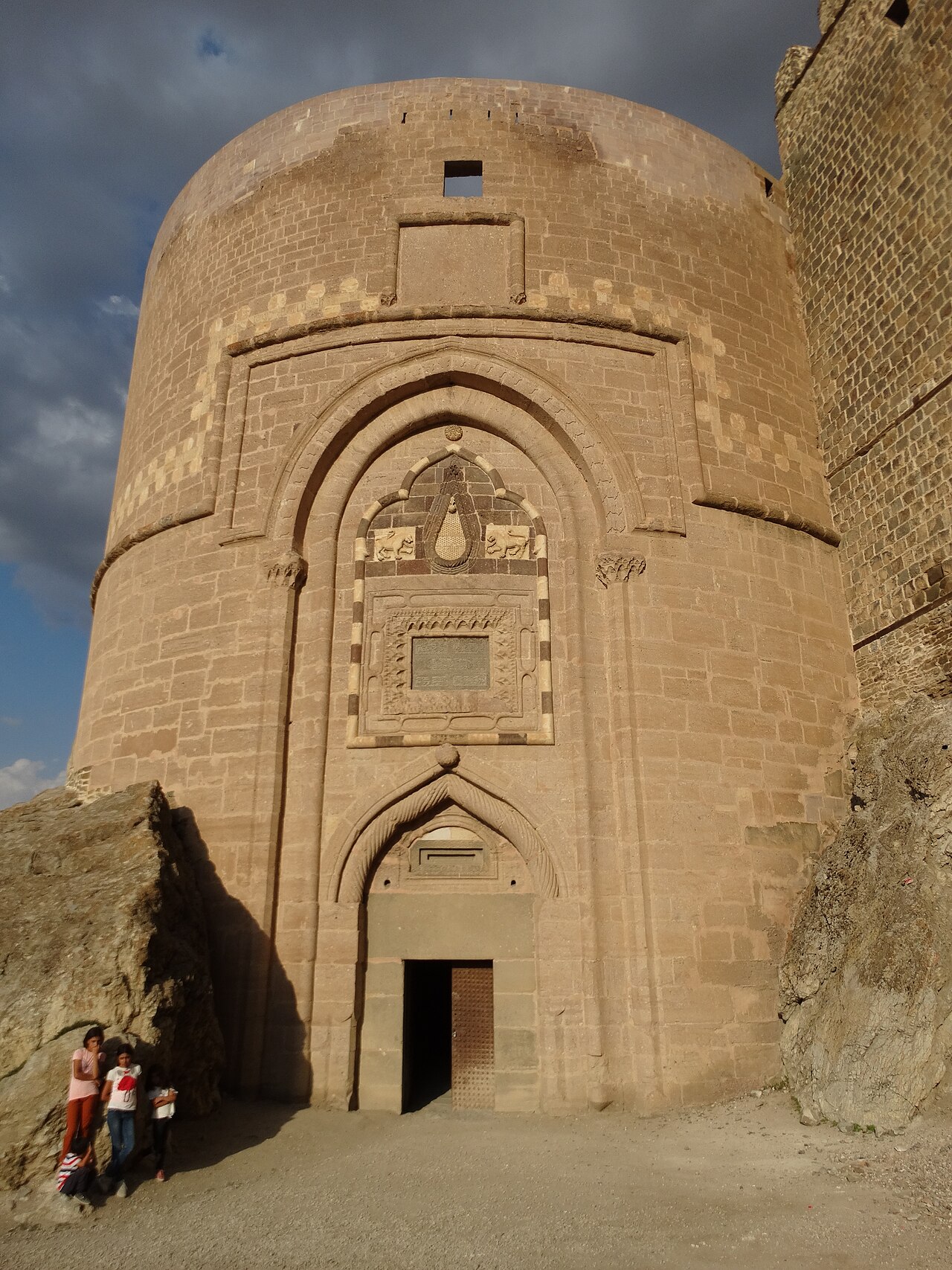
Abdüsselam Uluçam describes the Persian verse inscription over the citadel entrance as naming Sarı Süleyman and AH 1052. Uluçam gives 1642; Mehmet Top and Hale Telli give 1643. [2] [5] Birgül Açıkyıldız-Şengül renders the date as 1642–43 and emphasizes that historical accounts mention a castle before this building phase. [4] The inscription dates patronage at an existing fortified site. It cannot, by itself, date every wall or establish when the settlement first began.
A gate and a fortified household
Uluçam identifies the great entrance tower with Süleyman’s building activity. A relatively small doorway sits within a monumental decorated façade, with the inscription, paired lions and a central pendant-shaped motif above it. The citadel combined defensive spaces with reception and domestic rooms, storage, bathing and prayer facilities. [2] This was a fortified residence as well as a stronghold. Its architectural setting helps explain how a local ruler housed a household, received visitors and displayed authority.
What a traveller adds
Architect Ali Saim Ülgen’s 1953 study records his own 1948 visit and reproduces a passage from Evliya Çelebi. The traveller describes cisterns, stores, gates and a mechanism attributed to the late Süleyman Bey for lifting water from the Hoşap stream. [3] The account adds the practical problem of supplying a high rocky residence. It remains a traveller’s description, distinct from a measured archaeological reconstruction or an inscription recording a particular work.
The probable mausoleum
Açıkyıldız-Şengül examines a detached mausoleum southeast of Evliya Bey’s madrasa. It has no surviving foundation inscription, and earlier scholars proposed different dates and patrons. She argues for Süleyman Bey and a construction date between 1643 and 1655, noting that Evliya’s 1655 account describes him as deceased and names Ibrahim Bey as ruler. The attribution is an argument, not an intact dedicatory record. Her discussion also leaves the meaning of the tomb’s six-pointed ornament open: Islamic, Yazidi or decorative readings cannot be settled from the motif alone. [4]
Later finds and the limits of a biography
Top and Telli’s study of stucco excavated in 2017 found material from several decorative phases near the western tower. They could not assign every fragment to its original room. [5] Such finds illuminate a changing elite residence, without making every surviving decoration Süleyman’s commission. The sources establish a named patron active around 1642–43 and, through the interpretation of a later account, deceased by 1655. [4] They do not supply a complete, securely dated account of his childhood, education or reign.
Sources and further reading
- Yağmur Şen and Rahmi Tekin, “Osmanlı Devrinde Mahmudî (Hoşab) Beyliği”, Van YYÜ Social Sciences Institute Journal 50 (2020), pp. 141–162, especially 148–153.
- Abdüsselam Uluçam, “Hoşap Kalesi”, TDV İslâm Ansiklopedisi 18 (1998), pp. 247–248; inscription and architecture.
- Ali Saim Ülgen, “Hoşap (Mahmudiye) Kal’ası”, Ankara Üniversitesi İlahiyat Fakültesi Dergisi 2/4 (1953), pp. 83–88; 1948 observations and reproduced Evliya passage.
- Birgül Açıkyıldız-Şengül, “From Yezidism to Islam: Religious Architecture of the Mahmudî Dynasty in Khoshâb”, Iran and the Caucasus 20 (2016), pp. 369–383; author’s public text, especially 372, 379–381.
- Mehmet Top and Hale Telli, “Ornamented Stucco Fragments from Hosap Castle in 2017 Excavation Season”, Sanat Tarihi Dergisi 29/1 (2020); original research abstract.