Suleiman al-Halabi killed the French commander Jean-Baptiste Kléber in Cairo on 14 June 1800. Contemporary accounts, the military trial and later literature offer different evidence about the student from Aleppo and the meanings attached to his act.

A student from Aleppo
The name al-Halabi associates Suleiman with Aleppo. Al-Jabarti’s account identifies him as a Syrian from that city who said he lodged at al-Azhar. [1] Modern descriptions add other layers: Anadolu’s 2021 account identifies a Kurdish family from Kukan in the Afrin area and gives his birth year as 1777. [2] The contemporary geographical identification and the later account of family origin should be identified as different kinds of evidence.
The attack in a contemporary account
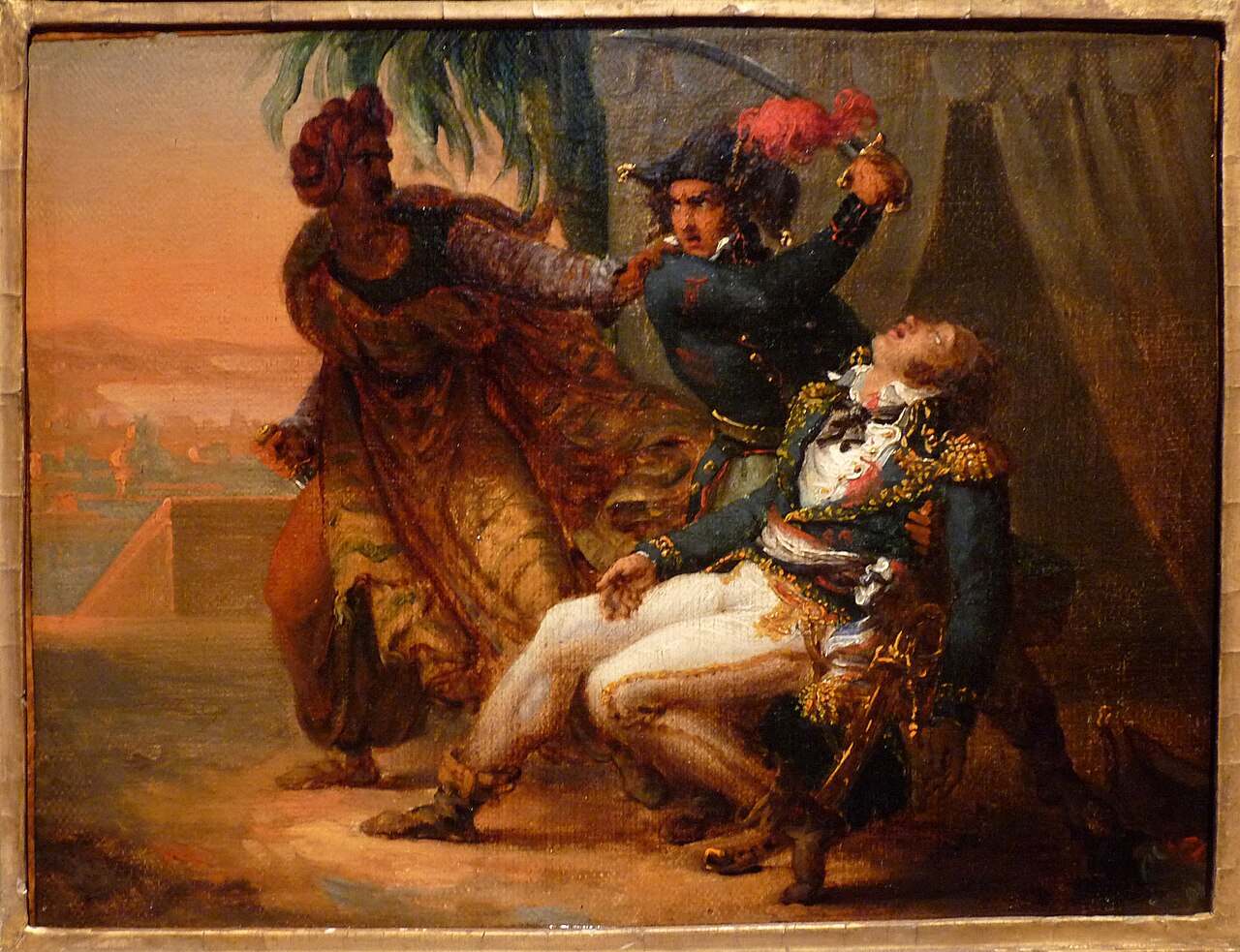
In the passage reproduced from al-Jabarti, Kléber is walking with an engineer in the garden at his residence in Azbakiyya. Suleiman approaches, attacks the commander and wounds the engineer when he intervenes. Soldiers find the attacker hiding by a wall in a neighbouring garden. The chronicler describes alarm among Cairo’s population and an initial French suspicion of wider Egyptian involvement, followed by the discovery that the accused was Syrian. [1] The passage preserves a local account of the event and the fear surrounding the investigation.
A military trial and a printed record
The American University in Cairo holds the Arabic trial proceedings, published in 1800 by Matba‘at al-Jumhur al-Faransawi. Its catalogue notes colloquial Arabic features in the text. [3] Daniela Potenza describes the French military’s circulation of proceedings in French, Arabic and Turkish. She also notes a change in Suleiman’s statements after he was beaten, followed by the interrogation of men he had told about the plan. [4] The French executed him days after the attack. [2] The conditions in which testimony was obtained matter when assessing its claims.
Who organised the killing?
The official investigation linked the assassination to Ottoman officials. Alexander Tchoudinov’s 2019 study challenges the attribution to Grand Vizier Yusuf Pasha using reports by the Russian diplomat Frankini. It argues that the killing disrupted the vizier’s plans for a negotiated French evacuation. The author acknowledges that the organisers cannot be established securely. [5] This disagreement makes it misleading to present either a complete conspiracy or an entirely private motive as proven. It also complicates the claim that the assassination simply hastened withdrawal.
How literature changed his image
Potenza follows Suleiman’s transformation across later writing: Zakariyya Tamir’s The Crime, published in 1963; Alfred Faraj’s historical drama, written in 1964; and Sun‘allah Ibrahim’s The Turban and the Hat, published in 2008. Her analysis relates changing portrayals of criminal, victim and hero to the circumstances in which authors wrote. [4] The painting shown here likewise belongs to the history of representation. These works reveal later arguments about power and resistance alongside the historical event they reinterpret.
Sources and further reading
- Abd al-Rahman al-Jabarti, Aja’ib al-athar, Arabic excerpt reproduced as L’assassinat de Kléber au Caire, TextArab 14, March–April 1992, p. 2. Primary chronicle excerpt.
- Alaattin Dogru, Suleiman al-Halabi: a Kurdish scholar who struck French occupation in Egypt, Anadolu, 18 June 2021; account of family origin and execution.
- American University in Cairo, Rare Books and Special Collections Digital Library, Pièces relatives à la procédure et au jugement de Soleyman El-Hhaleby, 1800; catalogue record and Arabic proceedings.
- Daniela Potenza, Literary Trajectories of Sulaymān al-Ḥalabī, a Hero Who Was Born a Criminal, Annali di Ca’ Foscari, Serie orientale 56, 2020, pp. 81–104; especially pp. 82–88. DOI: 10.30687/AnnOr/2385-3042/2020/56/003.
- Alexander Victorovich Tchoudinov, Assassination of Kléber: qui prodest?, Izvestia, Ural Federal University Journal, Series 2, Humanities and Arts 21/2 (187), 2019, pp. 11–25; abstract and argument concerning Frankini’s diplomatic reports.