Resolution 688 condemned repression in Iraq and demanded humanitarian access on 5 April 1991. Its provisions, the divided vote and the coalition’s later relief measures explain the date’s significance and its limits.
The emergency behind the resolution
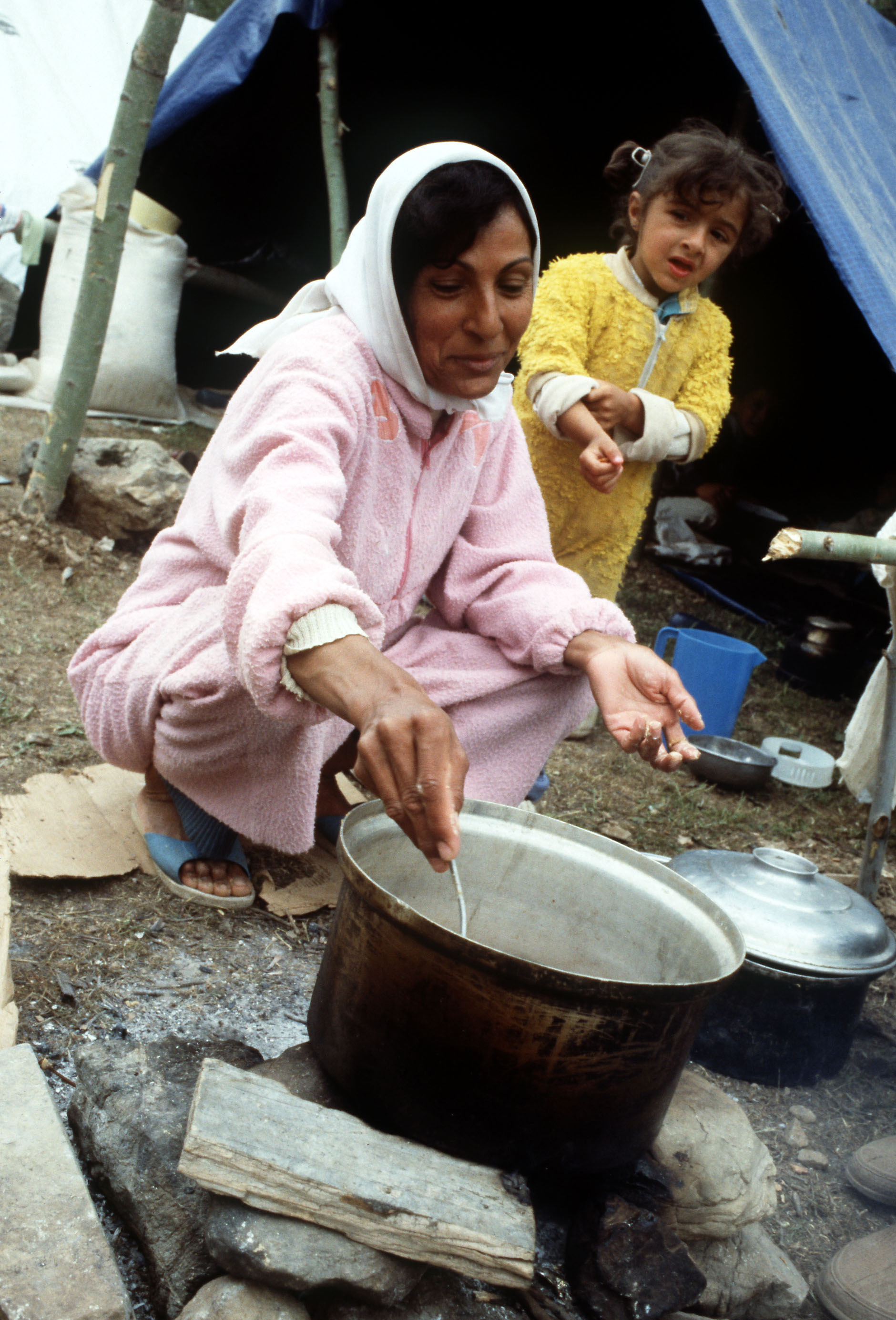
After the 1991 Gulf War, uprisings challenged Saddam Hussein’s government in southern and northern Iraq. The government’s counter-offensive drove large numbers of Kurds towards Iran and Turkey. Peter Malanczuk’s contemporary study describes fear, displacement and the difficult mountain conditions behind the diplomatic response. [2] Canada’s operational history records more than a million people fleeing towards the border regions. [4] This was a crisis of shelter, food, health and physical safety, as well as a struggle over political authority. The photograph from near Zakho later that month shows one family preparing food in a tent settlement.
What the Security Council demanded on 5 April
Resolution 688 was adopted at the Security Council’s 2,982nd meeting on 5 April 1991. The UN record gives the vote as ten in favour, three against and two abstentions. It condemned repression of Iraq’s civilian population, explicitly including Kurdish-populated areas, and connected its consequences to threats to regional peace and security. [1] This was a divided decision, rather than a unanimous international settlement. The Council demanded an end to repression, insisted on immediate humanitarian access and asked the Secretary-General to address the needs of refugees and displaced people. It also expressed hope for dialogue protecting the human and political rights of all Iraqi citizens. [1]
Humanitarian demands and military measures were distinct
Malanczuk’s legal analysis argues that Resolution 688 did not endorse the coalition’s military security zone. He notes that its preamble reaffirmed Iraq’s sovereignty and territorial integrity and that the Council had not explicitly approved those protective measures. [2] The resolution’s importance should therefore be explained through its actual demands and the diplomatic response it helped shape. Calling it a direct military authorisation obscures the disagreement over intervention. Equally, recognising that distinction does not diminish the refugees’ urgent need for protection.
Relief developed after the vote
Canada’s history dates the launch of Operation Provide Comfort to 6 April and the arrival of British and French cargo aircraft to the following day. It distinguishes humanitarian relief from the security component, including the no-fly zone north of the 36th parallel. [4] On 16 April, President George H. W. Bush announced expanded assistance and camps inside northern Iraq, with protection by US, British and French air and ground forces. He described this as a temporary response aimed at enabling eventual return home. [3] The vote, opening relief flights and protected camps thus belong to a sequence of decisions.
Remembering the date without compressing the history
The anniversary recalls both the people displaced and the decision to bring their plight before the Security Council. Resolution 688 addressed repression and humanitarian access; it did not create a Kurdish government or supply a complete political settlement. [1] Later institutions and negotiations require their own chronology. Reading the resolution beside the operational history and presidential announcement makes the sequence clearer: a Council demand, multinational relief and protective arrangements developed by other actors. [1] [3] [4] Each deserves its own date, evidence and assessment.
Sources and further reading
- UN Security Council, Resolution 688 (1991), 5 April 1991; UN Digital Library record, vote and operative summary.
- Peter Malanczuk, The Kurdish Crisis and Allied Intervention in the Aftermath of the Second Gulf War, European Journal of International Law 2 (1991), pp. 114–132, especially 114–119 and 127–130.
- George H. W. Bush, Remarks on Assistance for Iraqi Refugees and a News Conference, 16 April 1991; American Presidency Project transcript.
- Canada Department of National Defence, Operation PROVIDE COMFORT (I), operational history, 11 December 2018; displacement, relief launch and security component.
- PHAN April Hatton, Kurdish mother and daughter near Zakho, 25 April 1991, US Department of Defense / National Archives 6469323, Wikimedia Commons, public domain.