At Sarpol-e Zahab in Kermanshah Province, Anubanini’s cliff carving combines a victorious ruler, Ishtar, prisoners and an Akkadian inscription. Reading its separate elements reveals both the king’s message and the limits of what the monument can establish.
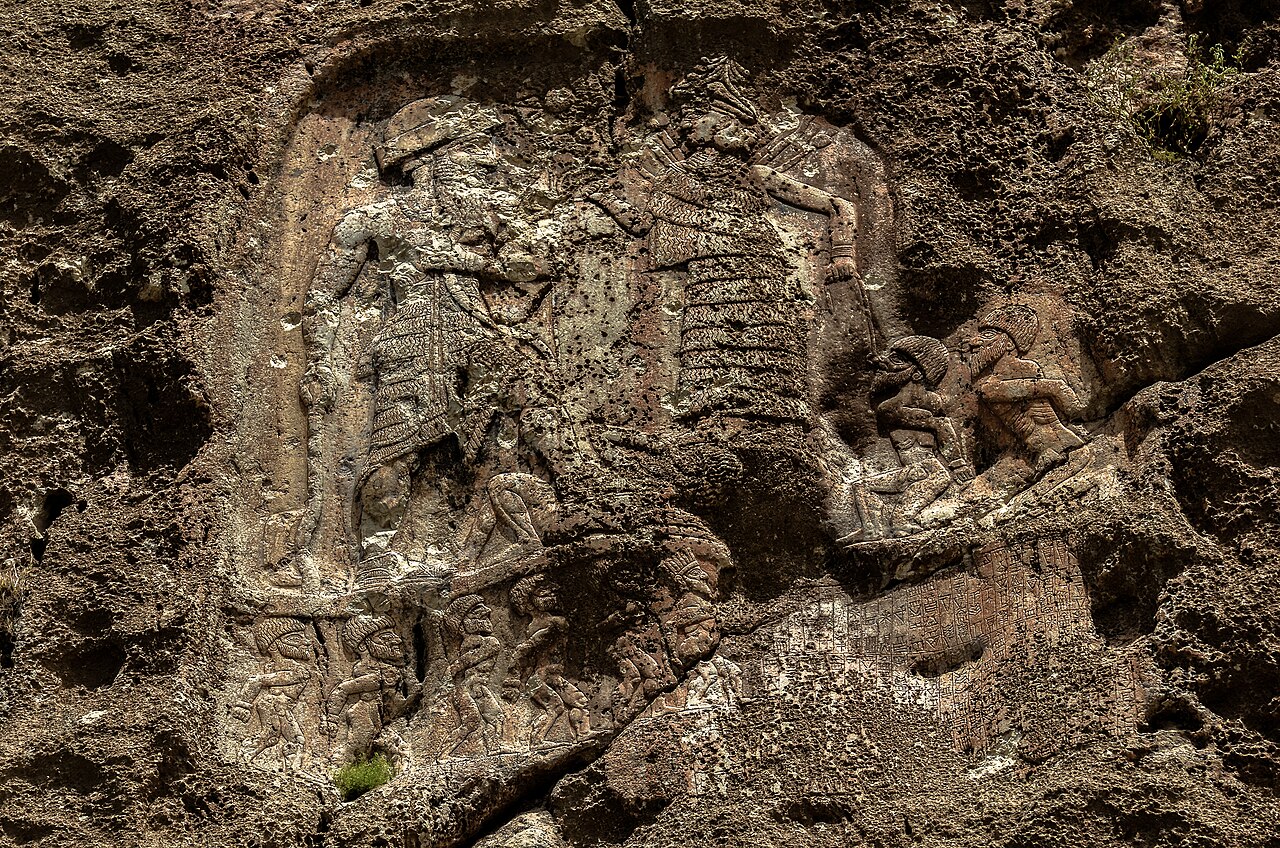

A monument in a layered landscape
The relief is carved into the rock beside the Alvand River at Sarpol-e Zahab, west of Kermanshah. Archaeological accounts distinguish several early reliefs on the river’s two banks and a much later Parthian equestrian carving. The Anubanini monument is commonly numbered relief II. Numbering matters: an inscription or measurement recorded for another carving cannot automatically be attached to this one. The surrounding group shows repeated use of the locality for royal display, across different periods and political settings. [1] [5]
Reading the scene from upper figures to lower row
The king stands at the left, with a bow and an axe or club-like weapon, placing one foot on a fallen enemy. Facing him is a horned goddess, identified with Ishtar, with weapons projecting from her shoulders. She holds a ring and ropes attached to two captives. Six further prisoners occupy the lower register; together with the fallen figure, the scene contains nine defeated people. Their relative scale, restrained bodies and arrangement convey victory and unequal power. The carving presents the ruler’s desired public image, rather than identifying every prisoner as a particular ethnic group. [1] [6]
The inscription’s actual subject
In the CDLI edition, the opening names Anubanini, his royal title and Lullubum, then states that he commissioned images of himself and Ishtar on Mount Batir. The following text threatens anyone who removes the images or inscription with divine punishment. Several passages are damaged and remain incomplete. References to the Upper and Lower Sea occur within that broken text; they cannot safely be turned into a complete account of conquests between two seas. Most of the surviving inscription protects the monument rather than narrating a dated battle. [2]
Dating through language and comparison
Dating proposals have changed as the relief and its text were studied. Zadok places it around the end of Ur III or beginning of the Old Babylonian period. Tavernier argues for an Isin-Larsa setting around 1900 BCE, drawing in part on linguistic features. These are scholarly assessments, not a surviving dated foundation statement. Comparisons with nearby Simurrum-related material help place the work in a wider artistic and inscriptional setting; similarities alone do not identify all the region’s rulers or produce exact reign dates. [1] [3] [4]
How scholars learned to identify the king
Tavernier traces an early published description to Henry Rawlinson’s 1839 article, which initially associated the carving with the Achaemenid period. Jacques de Morgan and Jean-Vincent Scheil’s work in 1891, published in 1893, copied the main inscription and established Anubanini’s name. Later studies revised readings and investigated small captions as well as the main text. This is a history of scholarly interpretation of an already existing local monument. Changing identifications explain why older books can preserve useful observations while giving dates that later research rejects. [1]
Photographs as evidence of the monument
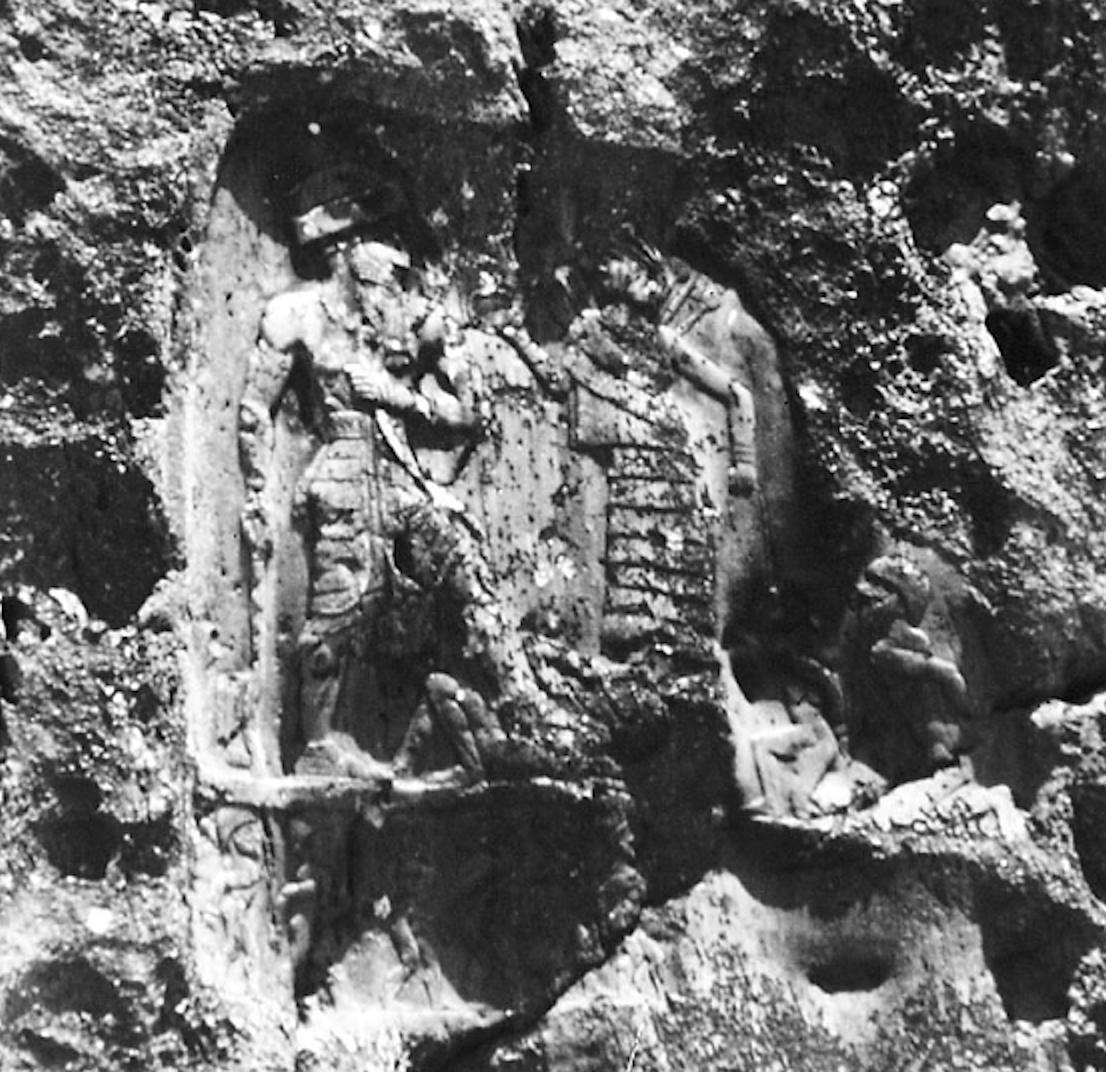
The early image below, attributed to Ernst Herzfeld and catalogued as 1913, records the same arrangement from another photographic moment. Comparing it with the 2016 photograph helps readers locate figures and damaged areas. Differences in lighting, viewpoint, resolution and photographic processing must be considered before treating a missing-looking feature as new physical loss. The photographs reproduced here do not provide a measured conservation survey or a percentage of wartime damage. A condition assessment would require dated field documentation and a method for distinguishing kinds of deterioration. [6] [7]

The king in stone and the king in literature
Anubanini’s name later appears in the Cuthaean Legend about Naram-Sin. The study by Adalı and colleagues separates possible historical inspiration from proof of a real encounter. The relief is direct evidence of a ruler’s commissioned display; the legend is evidence of literary transmission. Both belong in the history of the Zagros, but they answer different questions. Likewise, later comparisons with other royal victory reliefs concern artistic and political representation. They should not be used as a substitute for evidence about the identity of every later community living near the site. [4]
Sources and further reading
- Jan M. Tavernier, “Sar-e Pol-e Zahab Relief (Anubanini)”, The Encyclopedia of Ancient History: Asia and Africa (2021), pp. 1–3; site distinctions, scene, dating and research history.
- Cuneiform Digital Library Initiative, Q006359, RIME 4.18.01.01; Anubanini inscription, transliteration and translation with marked lacunae.
- Ran Zadok, “Lulubi”, Encyclopaedia Iranica (2005), updated 2012; relief chronology and the limits of reconstructing Lullubian identity and organisation.
- Selim F. Adalı, M. Fatih Demirci, A. Murat Özbayoğlu and Oğuz Ergin, “Why the Names? Anubanini and His Clan in the Cuthaean Legend”, Gephyra 11 (2014), pp. 15–28; especially pp. 16–17.
- Jona Lendering, “Sar-e Pol-e Zahab”, Livius (2009, revised 2020); illustrated locality overview and bibliography to the relief group.
- Koorosh Nozad Tehrani, Anubanini relief, 1 May 2016, originally Flickr, Wikimedia Commons; CC BY-SA 2.0.
- Ernst Herzfeld, historical photograph of the Anubanini relief, catalogued 1913, Wikimedia Commons, citing Smithsonian; public domain.