Assyrian history includes ancient trading cities and empire, later settlement and Syriac traditions, and living communities whose modern identity has its own history.
From trading city to imperial administration
Assyrian history predates the great imperial conquests. Nancy Highcock’s study of the Old Assyrian period, approximately 2000–1600 BCE, describes Ashur’s merchants and their Anatolian trading networks. Textiles, tin, contracts and family correspondence reveal a society engaged in commerce and law. [9] Much later, the eighth-century BCE empire extended far beyond the northern Mesopotamian heartland of Assur, Nineveh and Arbail. The Assyrian Empire Builders project presents royal correspondence with governors and officials, providing evidence for communication and provincial government as well as military power. [1] These records help distinguish different periods and institutions.
The fall of the empire: several events
The Babylonian Fall of Nineveh Chronicle is a key primary record. It describes the Median capture of Assur in 614 BCE and the subsequent alliance with Nabopolassar. In 612, Median and Babylonian armies besieged and sacked Nineveh. The account continues with Assyrian rule at Harran and an unsuccessful attempt, supported by an Egyptian army, to recover it in 609. [2] The collapse was a sequence of campaigns. Its perpetrators should be identified using the ancient sources, without simply replacing ancient peoples with modern national names.
Later settlement and Syriac writing
An empire’s end does not establish the disappearance of an entire population. The Ashurbanipal Library Project records renewed occupation at Nineveh in the Hellenistic, Parthian and Sasanian periods, with traces continuing into early Islamic times. [3] Later literary history also requires its own evidence. Beth Mardutho’s Syriac Institute describes Syriac as an Aramaic variety associated with Edessa that became an important literary language in the early Christian centuries. Its writings include theology, history, philosophy and science, and its translation traditions contributed to exchanges between Greek and Arabic scholarship. [10] These developments belong to a changing regional history, rather than an empty chronological gap.
What modern language evidence shows
Cambridge’s North-Eastern Neo-Aramaic project documents recordings, texts and grammar from Christian and Jewish communities historically living in northern Iraq, northwestern Iran and southeastern Turkey. Christian speakers commonly call their language Sureth; Assyrian Christians also use Assyrian in English. The project emphasizes dialect diversity, displacement and the danger of language loss. [4] A modern community name, a spoken language classification and the language of an ancient imperial archive answer different questions. Changes of language cannot, by themselves, establish either the disappearance of a population or a complete genealogy for every family.
Missions, education and modern nationalism
Adam Becker’s Revival and Awakening examines American evangelical missions in nineteenth-century Iran and their relationship with the Church of the East. The publisher’s account of his research describes missionary schools, religious reform and the community’s use of scriptural and archaeological knowledge in developing national consciousness. [5] This supports investigating modern identity formation. It does not justify reducing Assyrians to people arbitrarily invented by British officials: Becker’s subject includes American missions and local responses in the Qajar–Ottoman borderlands. Historical change and the existence of a living identity can be studied together.
Living communities and the meaning of heritage
Archaeologist Helen Malko argues for including Assyrian communities’ own engagement with ancient heritage through site visits, music, art and cultural memory. [6] Niveen Kassem and Mark Jackson’s research adds interviews and questionnaire responses collected in 2017 from 106 participants in Iraq and the diaspora. It describes how displacement, marginalisation, family and religious practice shaped their sense of belonging. The authors note that some respondents specifically identified as Chaldeans or Syriacs. [7] Such evidence calls for attention to people’s own names and experiences, alongside careful distinctions between state continuity, cultural inheritance and modern nationalism.
Sources and further reading
- Assyrian Empire Builders, ORACC/UCL–LMU project description: eighth-century royal correspondence and administration.
- Fall of Nineveh Chronicle, BM 21901, years 12–17; primary text in translation adapted from Grayson and Glassner, Livius.
- Ashurbanipal Library Project, Areas of Nineveh: later occupation and archaeological context.
- University of Cambridge, North-Eastern Neo-Aramaic Database Project: introduction, recordings and dialect research.
- Adam H. Becker, Revival and Awakening (2015), University of Chicago Press overview and contents.
- Helen Malko, The Assyrians of South West Asia: Modern People, Ancient Past, University of Helsinki, community heritage perspective.
- Niveen Kassem and Mark Jackson, Cultural Trauma and its Impact on the Iraqi Assyrian Experience of Identity, Social Identities 26/3 (2020), 388–402; accepted manuscript, methods and findings.
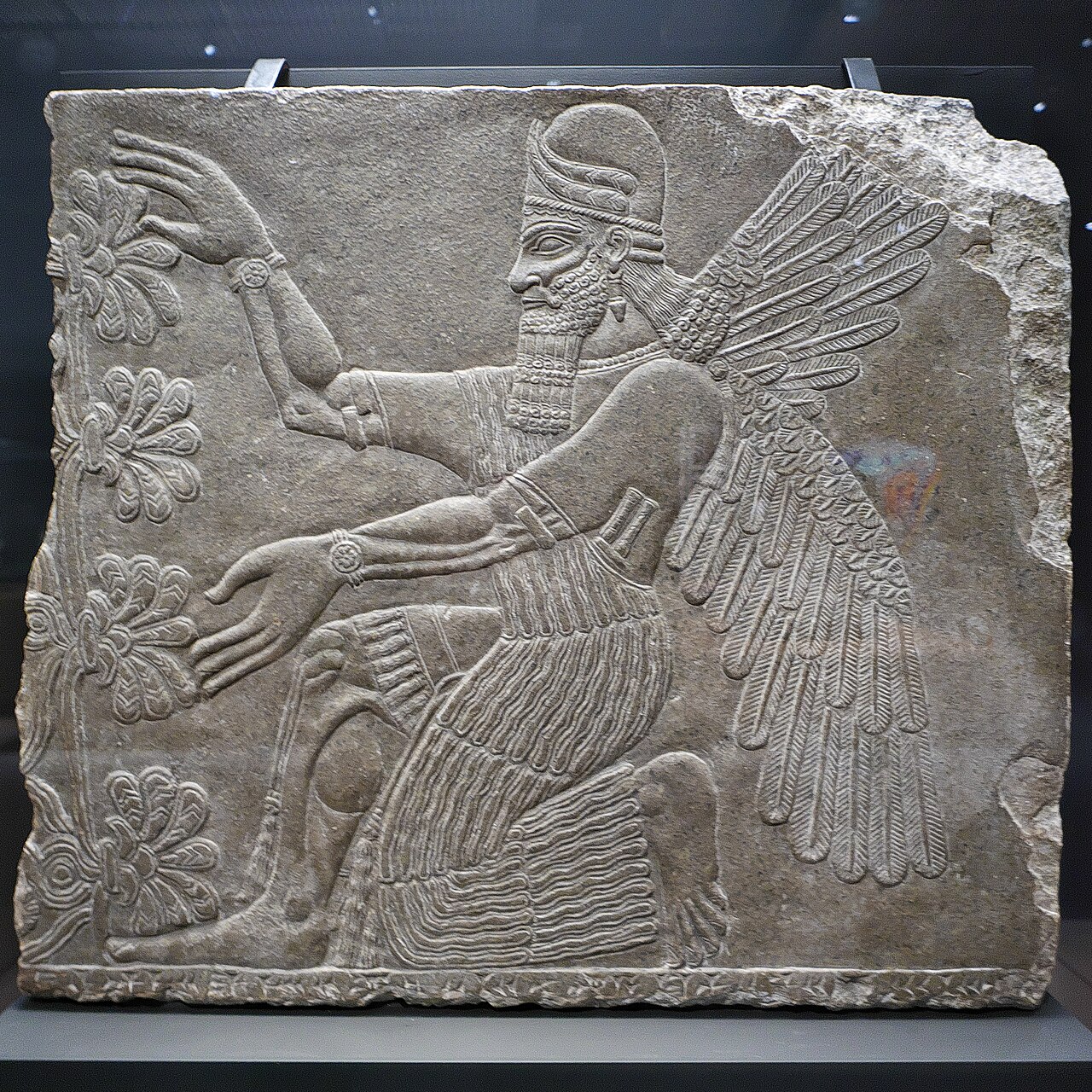
- Jl FilpoC, winged figure from Ashurnasirpal II’s palace at Nimrud, 17 February 2022, Wikimedia Commons, CC BY-SA 4.0.
- Nancy Highcock, The Old Assyrian Period (ca. 2000–1600 B.C.), Metropolitan Museum of Art, 2017.
- Beth Mardutho, The Syriac Institute, History of Syriac: origins, literature and translation traditions.