The Dimdim epic transforms the siege of 1609–10 into sung narrative. Its surviving texts and recorded performances reveal different voices, religious language and ways of remembering resistance.

The historical fortress and siege
Dimdim stood near Lake Urmia, in present-day northwestern Iran. Amir Khan Lapzêrîn, the Bradost ruler remembered as the Golden-Handed Khan, rebuilt its ruined fortress around 1609. Shah Abbas I had recognised his hereditary authority, but the strengthened stronghold threatened Safavid control. Hatam Beg led the siege from November 1609 to summer 1610. Amir Hassanpour’s historical synthesis reports the massacre of the defenders after its capture, wider killings and Kurdish deportations. It also specifies that Bradost and Mukri survived as weakened principalities: the fall of the fortress did not simply erase both political formations. [1]
A narrative carried in different forms
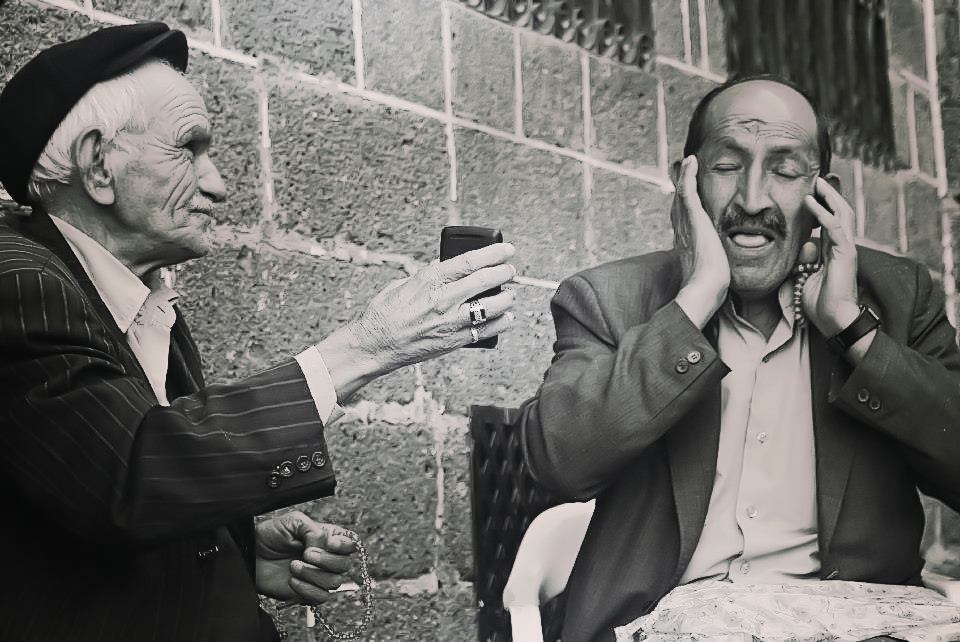
Beyta Dimdim belongs to a narrative tradition rather than one universally fixed text. A bayt may be sung throughout or combine sung verse with spoken prose. Hassanpour’s account of the genre notes variation in stanza length, rhyme, melody and the balance between speech and song. The listener follows a story, with the singer shaping its pace and emphasis. The historical battle consequently survives through performance as well as through pages. The photograph above illustrates this broader art in Diyarbakir; it is not evidence of a particular Dimdim rendition. [2] [6]
What field recordings add
Giulia Ferdeghini’s 2023 study examines a Bahdinan collection made in 2009: five beyt performances and two shorter, strophic stran versions. Named performers include Ibrahim Awa, Fahmi Balawa and Halala Barçî. Their accounts show the repertoire passing through family learning, social gatherings and lives marked by displacement. Halala recalled Dimdim being sung and danced at weddings. Ferdeghini also examines alternating voices and different rhythmic and melodic models. Some shorter versions use a long-necked lute; an absolute rule that every Dimdim performance lacks instruments would miss this distinction between genres and performances. [3]
Reading the poem attributed to Feqiyê Teyran
An early literary treatment is attributed to Feqiyê Teyran. VejinBooks provides a Kurmanji text from his collected poetry, while marking its transcription as awaiting review. Its opening stanzas invoke religious allegiance, the Prophet, Abu Bakr, Umar and martyrdom. Later passages move between armed confrontation and lament. These details matter: the poem’s vocabulary cannot be fully described by replacing every religious reference with a modern political slogan. Readers can examine the surviving text while keeping its attribution and the online transcription’s editorial status visible. It is one witness to the tradition, not a verbatim report of everything said in 1609. [1] [4]
The collector and the individual voice
Heciyê Cindî’s notes, transcribed by VejinBooks, identify individual narrators and explain how they learned their versions. His account of Himêyê Memed names Bedo Heyderî as a teacher and describes the singer’s facial expressions and hand movements. His note on Bekirê Ecem records a version collected at Keleşbeg in summer 1932 and subsequently printed in Yerevan in 1936. Such details connect an epic to particular speakers, places and acts of collecting. They also show what a printed plot summary leaves out: delivery, memory, relationships between performers, and the circumstances in which a collector encountered a song. [5]
Resistance, belief and historical memory
The epic’s enduring importance lies partly in its transformation of defeat into a remembered act of resistance. Hassanpour contrasts the language of rebellion in Safavid historiography with Kurdish commemorative readings. Ferdeghini’s material and Cindî’s notes make that memory more specific: different singers, audiences and forms carry it forward. Reading a chronicle, a literary poem and a recorded performance together preserves these differences. The siege gives the tradition a historical centre; subsequent acts of telling give it a continuing cultural life. [1] [3] [5]
Sources and further reading
- Amir Hassanpour, “Dimdim,” Encyclopaedia Iranica VII/4 (1995; updated 2013), pp. 404–405: historical siege, aftermath and literary tradition.
- Amir Hassanpour, “Bayt,” Encyclopaedia Iranica IV/1 (1989), pp. 11–12: sung narrative, prose, regional and formal variation.
- Giulia Ferdeghini, Beyta Dimdim: storia, tradizione e struttura di un canto epico curdo (Fondazione Levi, Venice, 2023), especially pp. 50–63 and 206–211: primary Bahdinan fieldwork and musical analysis.
- Beyta Dimdim, attributed to Feqiyê Teyran, Dîwana Feqiyê Teyran, VejinBooks transcription: original Kurmanji text, editorial review pending.
- Heciyê Cindî (Hajye Jndi), narrator notes in Dimdim, VejinBooks transcription: primary collecting accounts, Himêyê Memed and Bekirê Ecem.
- Kolpakovtour, Dengbêj storytellers/singers in Diyarbakir, 18 May 2015, CC BY-SA 4.0: contextual performance photograph.