Analysis updated 22 October 2026. The case for a Kurdish political gain rests on a documented shift toward negotiation and law; lasting success depends on implementation, political freedoms and rights that remain contested.

From an opening to a change of strategy
DEM’s December 2025 report traces the opening through Devlet Bahçeli’s October 2024 gestures and call for Abdullah Öcalan to announce the PKK’s dissolution. Öcalan’s 27 February 2025 message called for disarmament and dissolution; the PKK announced its congress decisions ending its armed-struggle strategy on 12 May. These are identifiable decisions, not proof that every weapon had been surrendered. [1] They created a basis for a different kind of political contest: how an end to organized armed conflict could be connected to democratic participation and Kurdish rights.
Why a political gain is a defensible interpretation
In his anniversary message published by DEM on 27 February 2026, Öcalan described a choice for democratic politics and called for a transition toward constructive democratic integration. He linked it to legal guarantees, citizenship, cultural expression and women’s participation, while rejecting forced assimilation. This is his political programme, not an independent account of outcomes. [2] The gain argued for here is an opening for Kurdish claims to be pursued through public negotiation and institutions. It does not require treating all Kurdish citizens, DEM and the PKK as interchangeable, or claiming a consensus among Kurds that the sources do not demonstrate.
A law passed; its conditions still matter
Parliament’s record identifies Law 7595, adopted on 10 August 2026 and published on 18 August. Its text provides conditional postponement of certain investigations, prosecutions and sentence enforcement, with exclusions including specified intentional-killing and older life-sentence cases. The central trigger is publication of a National Security Council decision confirming security agencies’ finding that the organization has ended its actual existence and surrendered its weapons. Article 7 establishes an executive board and parliamentary monitoring arrangements; Article 9 ties an application window to that confirmation. The law itself entered force on publication. Its existence must therefore be distinguished from fulfilment of the conditions for individual measures. It is not an unconditional release of every prisoner. [3]
The rights agenda is wider than disarmament
DEM’s report asks for an end to the replacement of elected local leaders by appointed trustees, implementation of European Court of Human Rights and Constitutional Court rulings, language rights and mother-tongue education, and work on truth, justice and past disappearances. These are the party’s stated proposals, not a list of reforms already secured. [1] Their substance explains why disarmament alone cannot settle the political argument. From a Kurdish rights perspective, the meaningful test is whether people can speak, organize, elect representatives and use their language with durable protection.
What officials and DEM were saying in October
On 12 October 2026, Vice-President Cevdet Yılmaz told Anadolu’s Editors’ Desk that field verification and National Security Council confirmation preceded the next phase. He declined to promise a fixed completion date. [6] On 20 October, DEM co-chair Tuncer Bakırhan demanded concrete government decisions, citing withdrawal and camp-evacuation announcements and raising prisoners, elected mayors and freedom of expression. His account records DEM’s position; it is not an independent verification of complete disarmament. [5] The distance between these statements is part of the process itself, not evidence that all implementation questions have been settled.
Judging the opening by its results
In a 24 September parliamentary publication, Speaker Numan Kurtulmuş described legislative monitoring, scrutiny of security findings and executive case decisions, and possible further legislation as parliamentary responsibilities. He presented fair implementation and judicial safeguards as necessary to lasting results. [4] The editorial case for a Kurdish political gain is strongest as a claim about opportunity and public political agency. Its success should be judged through observable changes: secure participation, accountable administration, enforceable rights and an end to renewed violence. A negotiation can be significant while its final settlement remains unfinished.
Sources and further reading
- DEM Party commission members, Milli Dayanışma, Kardeşlik ve Demokrasi Komisyonu DEM Parti Raporu, 10 December 2025: pp. 18–20 chronology; sections on trustees, judicial rulings, truth/justice and language rights. A party submission, not the joint commission’s adopted report.
- Abdullah Öcalan, anniversary message published by DEM Party, 27 February 2026: democratic integration, citizenship, legal guarantees and women’s participation.
- TBMM, Law 7595, adopted 10 August 2026, Official Gazette 18 August 2026, no. 33344; linked full text, especially Articles 1, 3, 6, 7, 9 and 11: conditions, exclusions, monitoring and entry into force.
- TBMM, Numan Kurtulmuş interview for Ortadoğu Analiz, published 24 September 2026: parliamentary responsibilities and implementation safeguards.
- Tuncer Bakırhan, DEM parliamentary group speech, 20 October 2026: demands for concrete decisions, political freedoms, elected mayors and prisoner measures; attributed party assessment of withdrawal announcements.
- Anadolu Agency, own Editors’ Desk interview with Vice-President Cevdet Yılmaz, 12 October 2026, peace-process section: verification stages and refusal to promise a fixed completion date.
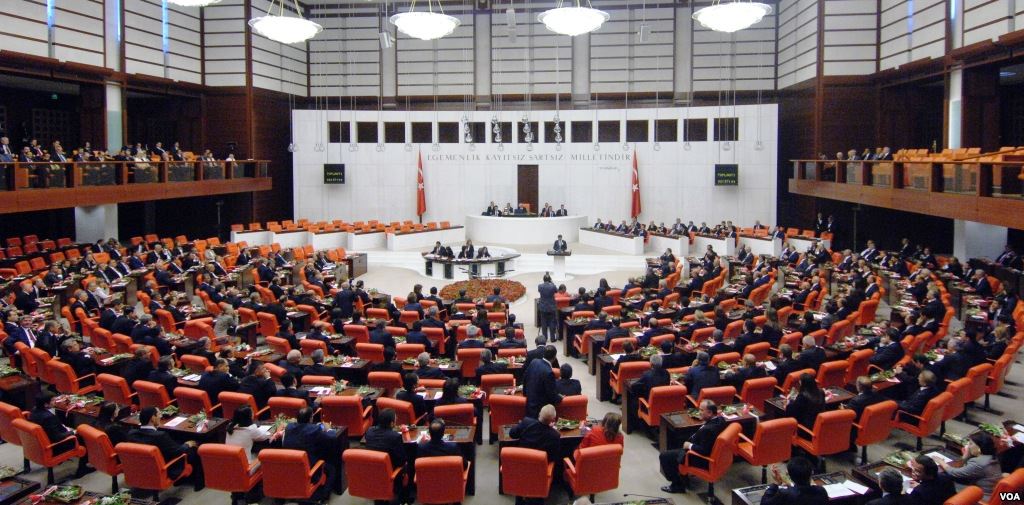
- Yıldız Yazıcıoğlu / Voice of America, Turkish parliamentary chamber, 23 June 2015, Wikimedia Commons, public domain. Contextual image, not a 2026 peace-process session.