Local cultivars, cooking and remembered beliefs give pomegranates a specific place in Kurdish life, alongside their wider regional history.

An orchard fruit with local names
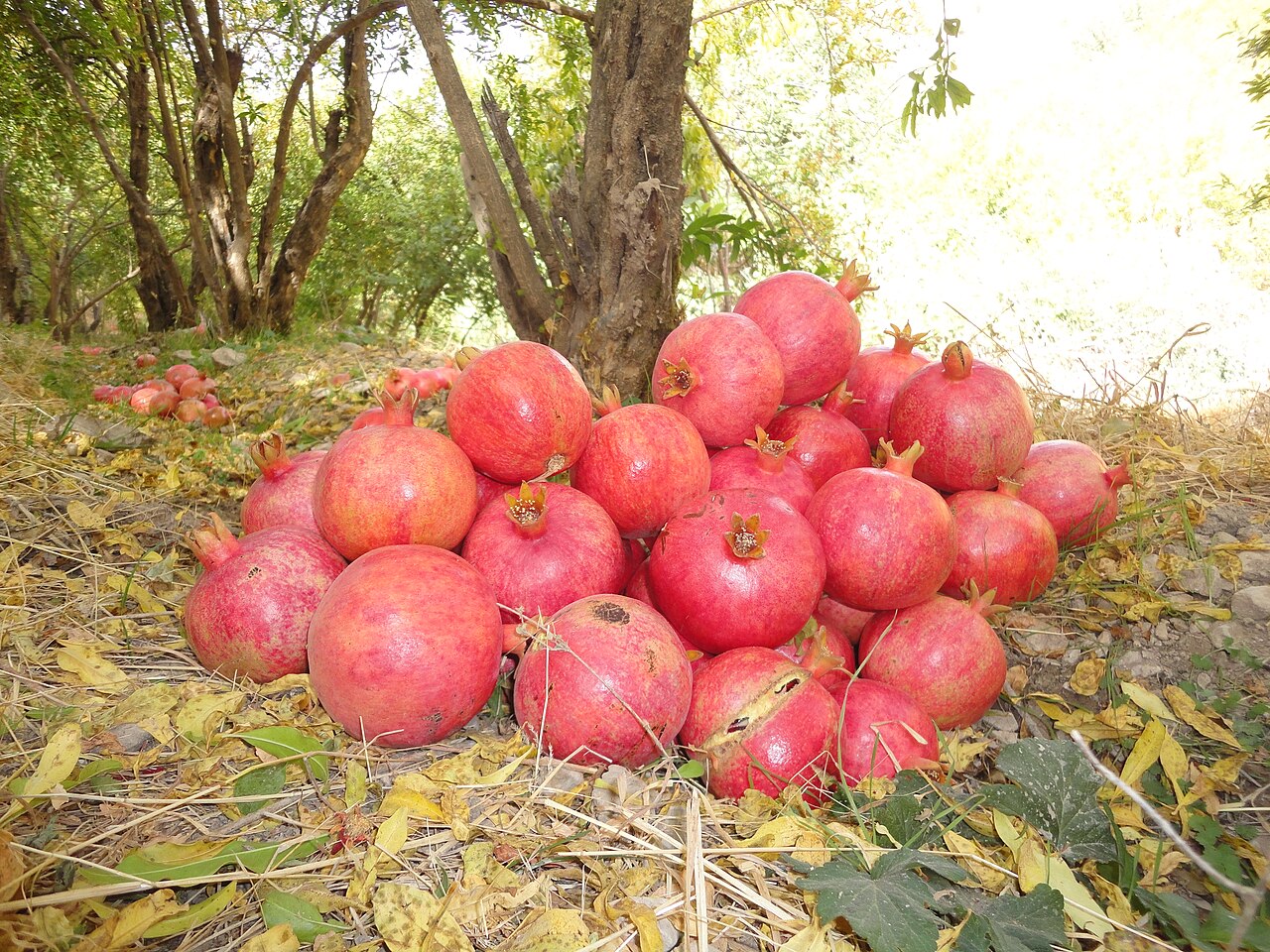
Hênar, also written hinar or hanar, is a Kurdish name for pomegranate. Writer Jan Dost’s 2023 account connects its cultivation with Halabja, Hawraman and Sharazur, and describes fresh juice, dried seeds and concentrated molasses in food. His most specific culinary recollection concerns a bottle of molasses bought in Tawila in 2015 and used in salads. Such a named place and remembered purchase make the connection tangible without implying that every Kurdish region grows or prepares the fruit in exactly the same way. [1]
Halabja has several cultivars
A 2024 study by Tara Tahır M Amın, Ebru Sakar, Ali İkinci and Hülya Ünver examined Laswara, Kawahanar, Meyhoş and Salaxani in Halabja. Across the varieties, reported average fruit weights ranged from 206 to 266 grams and soluble solids from 11.8 to 15.8 percent. The researchers also assessed seed hardness, taste, colour and ease of separating the arils. Their observations included high yields for Kawahanar and Meyhoş and no cracking in the Laswra material they examined. These are results from particular studied material, rather than fixed promises for every orchard or growing season. [2]
Growing new trees
Propagation is another part of the local story. Salih and colleagues’ research, deposited on arXiv in 2024, compared hardwood cuttings from eleven Halabja pomegranate genotypes under four watering intervals. Rooting success differed substantially among genotypes; the authors reported better overall results with a seven-day interval in their experimental conditions. This is a propagation experiment, not a general watering schedule for mature fruit trees. It shows why cultivar identity and growing conditions matter alongside the fruit’s cultural reputation. The cited version is an author-deposited research manuscript. [3]
Molasses in a named cook’s kitchen
Laven Mokri’s recipe for chicken with pomegranate syrup provides a contemporary culinary example. She uses the syrup as a sweet-sour marinade and combines the chicken with walnuts, dried apricots and dried plums, finishing with fresh pomegranate arils. The concentrated syrup supplies flavour in the cooking, while fresh arils provide a separate garnish. Her recipe is one cook’s preparation, not a universal Kurdish formula. Readers can follow her original instructions through the source rather than treating a generic description of “Kurdish food” as a recipe. [4]
Belief, memory and a modern festival
Jan Dost recalls being taught as a child not to waste seeds because elders said each pomegranate contained a seed from paradise. He also retells a Yarsani sacred narrative. These are attributed accounts of belief and memory; they do not establish that all Kurds share one theology, or date the origins of Yarsanism. [1] The modern harvest economy is documented separately: the Kurdistan Regional Government’s report of 2 November 2025 describes a three-day Halabja festival with farmers, food sellers and craftspeople. It reports roughly IQD 1.7 billion in combined sales across those categories, not pomegranate sales alone. The festival connects orchard production with markets and public celebration. [5]
Sources and further reading
- Jan Dost, The Sacred Fruit of Kurdistan, Kurdistan Chronicle, opinion essay, 30 December 2023; personally remembered beliefs and Tawila purchase are attributed to the author.
- Tara Tahır M Amın, Ebru Sakar, Ali İkinci and Hülya Ünver, study of local pomegranate cultivars, Turkish Journal of Agricultural and Natural Sciences 11/1 (2024), 112–120; DOI 10.30910/turkjans.1394244.
- Kocher Omer Salih, Aram Akram Mohammed, Jamal Mahmood Faraj, Anwar Mohammed Raouf and Nawroz Abdul-Razzak Tahir, Rooting behavior of pomegranate hardwood cuttings, arXiv:2407.00408, deposited 29 June 2024.
- Laven Mokri, Kyckling med granatäppelsirap, Food by Laven, 11 November 2019; the cook’s own recipe.
- Kurdistan Regional Government, Department of Media and Information, Pomegranates and Culture Shine at Halabja’s Annual Autumn Festival, 2 November 2025.
- Saad Sazani, Pomegranate of Sazan, photograph dated 19 October 2011, Wikimedia Commons, CC BY-SA 4.0.