The Kurdish filmmaker’s cinema of exile, dark humour and independence, explored through films, interviews and festival archives.

A filmmaker between Kurdistan and Europe
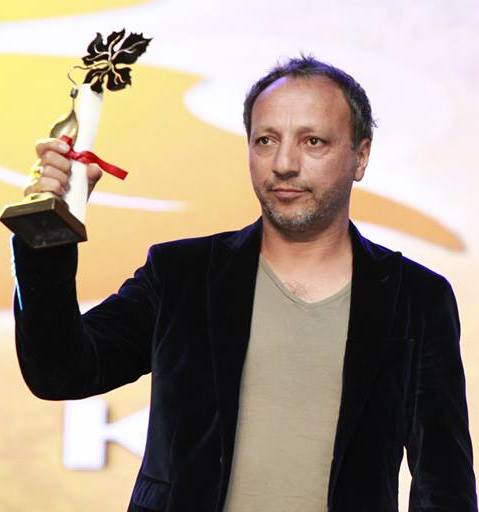
Hiner Saleem, also written Huner Selîm, is a Kurdish filmmaker and writer born in Iraqi Kurdistan in 1964. The contemporary press kit for Kilometre Zero records his departure at seventeen, travelling through Syria to Italy to escape Saddam Hussein’s regime, and his subsequent life in France. Its filmography begins with Vive la mariée… et la libération du Kurdistan (1997), followed by Passeurs de rêves (1999). His career joins Kurdish experiences to filmmaking across several countries rather than remaining within one national production system. [1]
Vodka Lemon: affection in a winter landscape
Vodka Lemon (2003) centres on a widow and widower in a village in post-Soviet Armenia. In Valeria Chiari’s contemporary interview, producer Fabrice Guez describes a screenplay that finds humour within loneliness and material hardship without relying on tearful sentimentality. Saleem explains that a project originally imagined in Kurdistan became a love story filmed in Armenia. This account helps explain why displacement in his work can appear through everyday relationships as well as explicit political conflict. [2] The Vesoul festival’s own archive records the film’s Golden Cyclo award in 2004. [3]
Kilometre Zero: a journey through wartime Iraq
Selected for the Cannes competition in 2005, Kilometre Zero takes place in 1988 during the Iran–Iraq War. Ako, a young Kurdish husband and father conscripted into the Iraqi army, receives orders to escort a dead soldier home. His Arab driver is hostile to Kurds; a flag-covered coffin accompanies their journey. Ako attempts to steer the trip towards the Kurdish north. The contrast between an official military mission and one soldier’s desire to escape gives the road story its particular tension. [4]
Humour without spectacle
In the film’s press-kit interview, Saleem links the reluctant soldier to his brother’s experience of desertion. He describes a wish to evoke dictatorship without turning battle into spectacular entertainment or melodrama. Humour, in this account, emerges from absurd details within frightening situations. His explanation makes the film’s comic moments intelligible without treating the violence surrounding its characters as harmless. The interview also records the practical difficulty of reconstructing the late-1980s setting after 2003. [1]
My Sweet Pepper Land: law, love and independence
My Sweet Pepper Land appeared in Cannes’ Un Certain Regard selection in 2013. [5] The producer’s synopsis places police officer Baran and teacher Govend in a border village where a local strongman challenges public authority. The credits name Korkmaz Arslan and Golshifteh Farahani, with a screenplay developed by Saleem in collaboration with Antoine Lacomblez. [6] In his Cannes interview, Saleem says he wanted to tell a love story in the mountains and imagine greater freedom for a woman facing restrictive social expectations. That stated intention gives Govend’s independence a central place alongside the policing plot. [7]
Writing childhood: My Father’s Rifle
Saleem also writes prose. Atlantic Books published My Father’s Rifle in English in February 2005. Its description follows Azad, a boy growing up amid Kurdish village life, war and displacement in the 1960s and 1970s. Family attachments, a refugee camp in Iran and the aspiration to become a filmmaker connect intimate experience with political upheaval. Reading the book alongside the films offers another route into recurring concerns with childhood, departure and the difficult relationship between a homeland and the person who leaves it. [8]
Sources and further reading
- Kilometre Zero, 2005 press kit hosted by the Festival de Cannes; contemporary filmmaker biography, filmography and interview, printed pp. 6–13.
- Valeria Chiari, Controcorrente – Vodka Lemon, Cineuropa, 5 September 2003; contemporary statements by producer Fabrice Guez and director Hiner Saleem.
- Festival des Cinémas d’Asie de Vesoul, Hiner Saleem; festival archive identifying Vodka Lemon’s Golden Cyclo in 2004.
- Festival de Cannes, Kilometre Zero; official 2005 competition record and synopsis.
- Festival de Cannes, My Sweet Pepper Land; official 2013 Un Certain Regard selection.
- Agat Films – Ex Nihilo, My Sweet Pepper Land; producer’s synopsis and cast, screenplay and production credits.
- Festival de Cannes, interview with Hiner Saleem about My Sweet Pepper Land, 22 May 2013; director’s account of the project and its intentions.
- Atlantic Books, My Father’s Rifle, 10 February 2005, ISBN 9781843543121; publisher’s description and publication record.
- Voice of America, Hiner Saleem holding an award, 17 October 2013; cropped photograph classified as public domain on Wikimedia Commons.