Kürt böreği is a layered, unfilled pastry served with powdered sugar. Accounts by bakers and people from Bilece connect it with Kurdish migration from Bingöl to Istanbul, while interviews document the continuing dispute over the alternative name küt böreği.
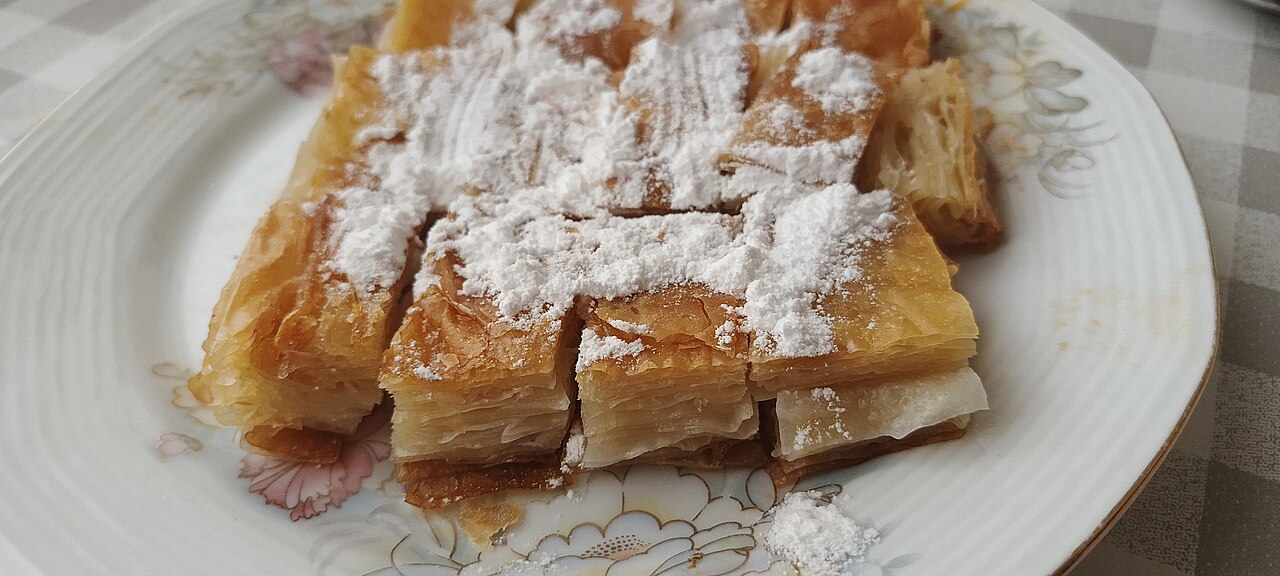

What the pastry is
Kürt böreği combines thin, fat-separated dough layers with a powdered-sugar finish. Its character comes from the pastry itself: the preparation described by Selin Hıdır uses flour, water and salt, with butter and oil between the layers. [1] The photograph shows the contrast between a browned surface, pale inner folds and white sugar. The dough is lightly salty, so describing the dish simply as a sweet can obscure the balance created when sugar is added at serving.
A migration story centred on Bilece and Istanbul
In his 2023 interview with Turan Yiğittekin, Börekçiler Derneği president Bülent Dilbağı traced the trade to Mehmet Alkan, known as Rengo, from Bilece in Kiğı, Bingöl. He placed its beginnings in the 1890s and connected the pastry with the regional preparation kömbe. [2] That dated account supports a late nineteenth-century origin story. It does not support the much earlier claim that Rengo established the business in the early 1800s. The history belongs to movement between a Kurdish village network and Istanbul’s working neighbourhoods.
Workers, apprentices and neighbourhood shops
Şahhaydar Yarkın’s account, published in 2021, is particularly valuable because he identifies himself as a Bilece native and former village teacher and explains that he draws on observations and interviews with bakers. He describes migrants doing loading work around Kasımpaşa, Rengo preparing food for them, and later recruitment of workers from the village into baking and street sales. He also traces later shops run by Bilece families, including the Gürbey brothers. [3] This community history makes visible the relatives, apprentices and sellers who helped sustain the trade beyond a single founder.
Family testimony and the sugar story
In Çiğdem Yılmaz’s interview, reprinted by Ada Gazetesi in November 2023, baker Ali Alkan recalled the family account of Rengo’s move to Kasımpaşa and the preparation of gömbe for labourers. He attributed the suggestion to add sugar to an Armenian customer. [4] This is a named descendant’s testimony about the family’s past. It preserves a specific account of exchange in Istanbul’s mixed working environment, while the precise date and first person to introduce the topping remain matters requiring contemporary documentation.
Why the name is contested
Dilbağı argued in his 2023 interview that Kürt böreği grew from customers identifying the Kurdish baker, and rejected küt as a later invention. [2] In a separate StoryBox interview published in 2022, he had already defended the Kurdish name and linked it to Bingöllü bakers working in Istanbul. [5] These are identifiable statements by a practising baker and trade representative. They document a public naming dispute and the importance of Kurdish identity to the occupational memory. His estimate of how recently küt appeared is his assessment, rather than a demonstrated first occurrence established from historical menus.
How the layers are prepared
Hıdır’s published method divides the dough into six portions, oils the flattened pieces and rests them for thirty minutes before stretching and folding them to fit a baking tray. The pieces are stacked, the surface is oiled and the pastry is baked at 180°C for about thirty minutes, until browned underneath and on top. It is then cut into small squares and finished with powdered sugar. [1] Her full recipe supplies quantities. The linked instructions offer a practical starting point for readers interested in the technique behind the visible layers.
Sources and further reading
- Selin Hıdır, Kürt Böreği, Lezzet, updated 18 December 2024; published ingredients, resting, stretching, folding and baking method.
- Turan Yiğittekin, interview with Bülent Dilbağı on the Kürt/küt naming dispute, Haberler.com, 19 November 2023; trade representative’s historical account and position.
- Şahhaydar Yarkın, Bileceli Rengo’nun Böreği: Kürt Böreği, Çapakcur Gazetesi, 11 April 2021; community history based on personal observations and interviews with bakers.
- Çiğdem Yılmaz, interview with baker Ali Alkan, Bu Börek, Mehmet Dedemden Kaldı, reprinted by Ada Gazetesi, 20 November 2023; family testimony on migration and preparation.
- StoryBox, Böreği Dünyaya Tanıtacağım: Seyyardan Başlayan Çengelköy Börekçisi’nin Hikâyesi, 2022; first-person interview with baker Bülent Dilbağı, including his explanation of the Kurdish name.