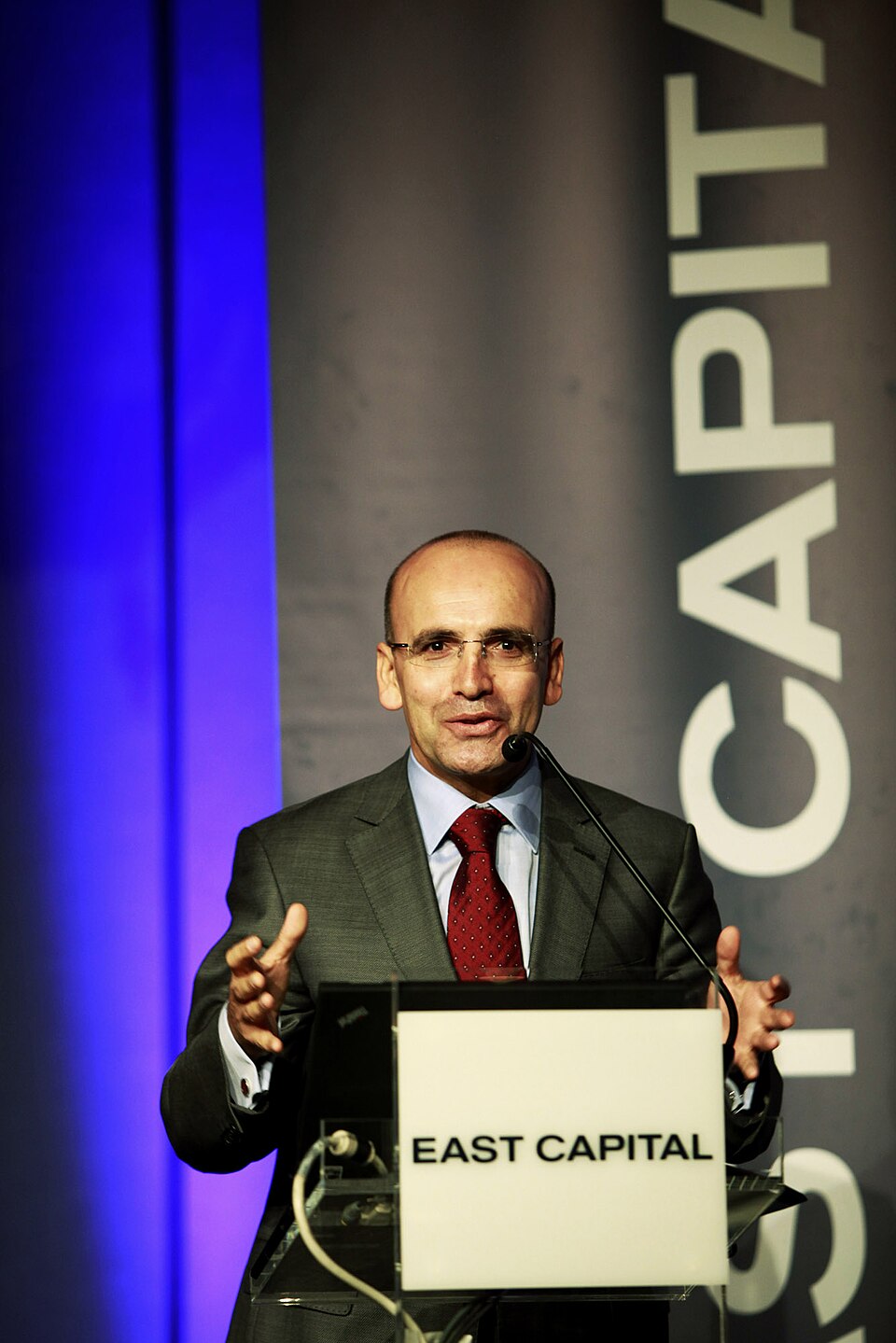
Mehmet Şimşek’s career connects a village in Batman with international banking and several distinct Turkish government offices. Official records, his own description of his Kurdish background and dated policy documents provide a more precise account than claims of personal economic success.

Origins and education
The Turkish presidency’s biography places Şimşek’s birth in 1967 in Arıca, also called Kefre, in the Gercüş district of Batman. It records schooling in Batman and Gercüş, graduation in economics from Ankara University’s Faculty of Political Sciences in 1988, and postgraduate study at Exeter completed in 1993. [1] These details correct the frequently repeated confusion with Adıyaman. His educational route is documented; a narrative of exceptional hardship requires additional evidence rather than assumptions about his birthplace.
A banking career before elected office
The Treasury and Finance Ministry lists work as an economist at the US embassy in Ankara, followed by UBS, Deutsche Bender and Merrill Lynch. His later responsibilities at Merrill Lynch included economic and strategic research covering emerging European, Middle Eastern and African markets. [6] This was a career in financial research before national elected office. An employer’s regional coverage should not be mistaken for a government portfolio or evidence that one individual directed those countries’ economies.
Different offices, different responsibilities
Şimşek entered parliament for the AK Party in 2007. His first government role concerned the Treasury; he subsequently became finance minister, then deputy prime minister. The ministry’s historical register dates his finance tenure from 1 May 2009 to 24 November 2015. [1] [2] Describing him as finance minister continuously until 2018 erases that change of office. He returned as minister of Treasury and Finance on 3 June 2023, according to the presidential appointment record. [1]
His public description of Kurdish identity
An İHA report carried by Star on 9 September 2015 records Şimşek describing himself at the Istanbul Finance Summit as a Turkish citizen of Kurdish origin whose parents did not speak Turkish. [3] This provides a direct, attributable basis for discussing his background. His identity, party affiliation and official responsibilities are separate questions: his participation in government does not by itself establish the views or political representation of all Kurdish communities.
What the April 2026 programme actually proposed
An April 2026 ministry presentation under Şimşek’s name lists price stability, fiscal discipline, a sustainable current-account balance and structural reforms as priorities. Its reform agenda also links regional integration to Kurdish reconciliation, alongside industrial transformation, infrastructure and the green and digital transitions. [4] The document is useful evidence that reconciliation appeared explicitly in an economic programme. It records stated intentions, rather than demonstrating that each reform or reconciliation objective had already been achieved.
Assessing results requires more than a biography
The central bank’s 19 March 2026 open letter to Şimşek reports that 2025 inflation exceeded the uncertainty band around its target. It describes continuing disinflation but also constraints from supply conditions, price-setting behaviour and expectations. [5] This contemporary record complicates blanket claims that inflation had been solved or that one minister had stabilised the economy. Policy aims, measured outcomes and responsibility across government and the central bank should be assessed separately, with the date of each observation made clear.
Sources and further reading
- Presidency of Türkiye, Mehmet Şimşek biography: birthplace, education, parliamentary career and 3 June 2023 appointment.
- Treasury and Finance Ministry, historical finance-minister register: Şimşek,1 May 2009–24 November 2015.
- İHA report published by Star,9 September 2015: Şimşek’s public description of his Kurdish background at the Istanbul Finance Summit.
- Mehmet Şimşek / Treasury and Finance Ministry, April 2026 presentation, slides 9 and 11: policy priorities and reform agenda.
- Central Bank of the Republic of Türkiye, open letter to Mehmet Şimşek,19 March 2026, pp.1–2:2025 inflation-target deviation.
- Treasury and Finance Ministry, minister’s biography: embassy, banking and research career before government.