Turkey’s prime minister and later president helped reshape economic policy and challenged restrictions on Kurdish expression. His record also includes service under military government, incomplete reforms and a fragile 1993 political opening that never became a peace settlement.
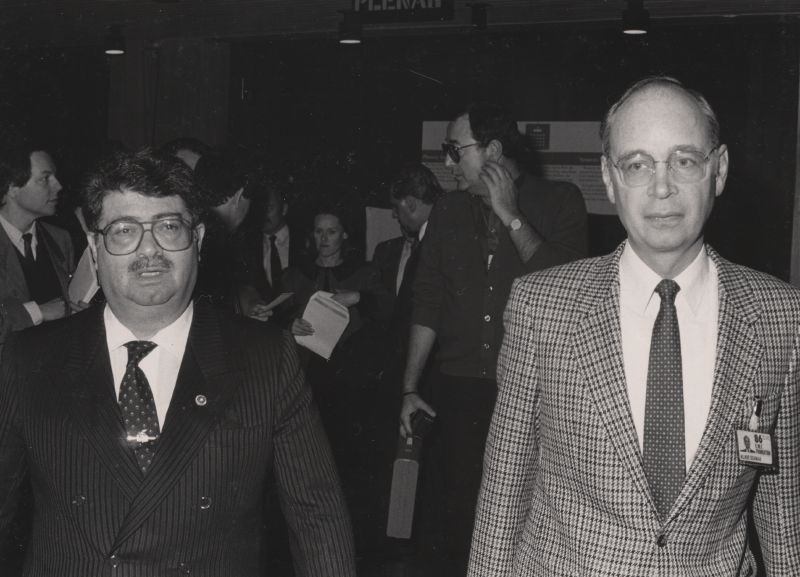

From electrical engineering to national office
Born in Malatya in 1927, Özal graduated in electrical engineering from Istanbul Technical University in 1950. His official presidential biography records work in electricity administration, the State Planning Organisation and the World Bank. He helped prepare the January 1980 economic programme, served as deputy prime minister for economic affairs under the government formed after the September 1980 military intervention, and resigned in 1982. He founded the Motherland Party, ANAP, in 1983 and became prime minister after that year’s election. His presidency ran from 9 November 1989 until his death on 17 April 1993. [1] This chronology places reform within both military and elected civilian governments.
What changed in the economy?
The reform programme shifted emphasis from import substitution toward exports, market incentives and greater international integration. An IMF retrospective by Anne Krueger highlights the export expansion and recovery of growth, but also the return of high inflation and weaknesses in fiscal discipline. [2] This gives a more balanced picture than treating liberalisation as a completed transformation with uniformly beneficial results. Özal helped change the direction of economic policy; he did not abolish the state’s economic role or permanently solve macroeconomic instability. The programme’s origins in 1980 also mean it should not be dated solely to his 1983 election victory.
Kurdish background and political identity
Human Rights Watch described Özal as being of partial Kurdish origin and credited him with helping weaken taboos surrounding Kurdish identity. [3] That is sufficient to explain why his background matters here without inventing a precise family percentage or treating ancestry as proof of a particular programme. A Turkish president with Kurdish ancestry was not thereby the elected representative of a separate Kurdish state or of every Kurdish political tendency. Claims that he was the first senior politician ever to discuss Kurdish identity, or a uniquely measurable highest-ranking Kurd, obscure earlier Kurdish political figures and need definitions and evidence that such superlatives usually lack.
The 1991 language-law change and its limits
Human Rights Watch’s 1999 report credited Özal with pushing repeal of Law 2932 in 1991, removing that law’s prohibition on Kurdish publishing. It also documented continuing restrictions in education, broadcasting and party activity in the period the report examined. [3] Repealing one law was therefore consequential without making Kurdish an official language or securing every cultural right. The distinction is important: a legal opening for expression can coexist with other prohibitions and continued conflict. Those historical restrictions should be dated to the report’s period, rather than presented as a current account of Turkish law.
Indirect contacts and the 1993 ceasefire
Cengiz Çandar’s TESEV report describes the 1992–1993 contacts involving Özal, Jalal Talabani and Abdullah Öcalan as indirect and mediated. It links them to the PKK’s March 1993 unilateral ceasefire and describes Özal’s death as a serious blow to the initiative. The report records the killing of 33 unarmed soldiers on the Elazığ–Bingöl road on 24 May as ending the ceasefire without meaningful progress. [4] This account includes retrospective participant testimony and should be read with that source character in mind. A unilateral ceasefire and messages through an intermediary were an opening, not a signed bilateral peace treaty or proof that all state institutions supported negotiations.
Death, allegations and an unfinished legacy
Özal died in office on 17 April 1993. [1] Allegations about his death later led to a prosecution of retired general Levent Ersöz. Anadolu reported in March 2016 that the Court of Cassation upheld Ersöz’s acquittal while removing part of the lower court’s reasoning about poisoning. [5] That procedural outcome should not be converted into proof of assassination or an uncomplicated forensic finding settling every question. For Kurdish history, Özal’s importance lies in identifiable actions and contested possibilities: the language-law opening and attempted political contacts alongside the limits of his authority. His death interrupted an initiative; the claim that he would certainly have achieved peace remains a counterfactual.
Sources and further reading
- Presidency of the Republic of Türkiye, Turgut Özal: official biography, education, economic posts, ANAP and presidential dates.
- Anne O. Krueger, Perseverance in a Good Cause: The Benefits of Turkish Economic Reform, IMF, 6 May 2004; historical discussion of the 1980s reforms.
- Human Rights Watch, Turkey: Violations of Free Expression in Turkey (1999), section IX, Restrictions on the Use of the Kurdish Language: historical background and the 1991 repeal.
- Cengiz Çandar, Leaving the Mountain: How May the PKK Lay Down Arms? (TESEV, English edition March 2012), pp. 56–57, indirect contacts on behalf of the president.
- Anadolu Ajansı, 22 March 2016: Ersöz acquittal upheld, with part of the lower court’s reasoning removed.
- World Economic Forum, Özal and Klaus Schwab, Annual Meeting 1986; image record and CC BY-SA 2.0 licence, Wikimedia Commons.