Mosul’s history joins the Tigris, regional trade, diverse communities and the fate of a much larger Ottoman province. Its recent recovery includes monuments formally inaugurated in September 2025.
_21.jpg)
City, river and ancient Nineveh
Mosul, called al-Mawsil in Arabic and Mûsil in Kurdish, is the centre of Iraq’s Nineveh Governorate. The Old City occupies the western bank of the Tigris, opposite ancient Nineveh’s archaeological remains. The modern city, its governorate and the former Ottoman province represent different geographical scales. Iraq’s State Board of Antiquities and Heritage submitted the Old City to UNESCO’s World Heritage Tentative List in August 2018; a tentative listing is a proposal for consideration, rather than an inscription on the World Heritage List. [1]
A city shaped by buildings and communities
The heritage submission highlights the twelfth- and thirteenth-century Zangid period, medieval streets and religious buildings, followed by Ottoman houses, bazaars and courtyards. Local alabaster, often called Mosul marble, gave carved doorways, windows and arcades a distinctive appearance. Mosques, churches, shrines, schools and domestic architecture together expressed the city’s cultural diversity. [1] Their significance extends beyond monumental façades to the neighbourhoods and everyday activities around them.
Regional trade and Kurdish connections
Historian Sarah Shields places regional production at the centre of nineteenth-century Mosul’s economy. Urban crafts exchanged manufactures for pastoral and agricultural products, connecting city merchants with the surrounding countryside and neighbouring provinces. Kurdish-speaking communities belonged to this wider commercial and cultural region alongside speakers of Arabic, Turkish, Syriac and Armenian. [2] This history explains Mosul’s connections with Kurdish society through markets, migration and political relations, without reducing a mixed region to a single identity.
The Ottoman province and the Mosul question
After the First World War, the dispute between Turkey and Britain concerned a former imperial province, extending far beyond the city. Shields’s study of the League of Nations inquiry shows that residents weighed security, commerce, religion and government, as well as ethnic affiliation. The commission recommended attachment to Iraq under continued mandatory oversight, with Kurdish appointments and Kurdish-language services in administration, education and justice. [2] These recommendations illuminate why Mosul’s settlement mattered to Kurdish political history.
Occupation, battle and civilian loss
ISIL took Mosul in June 2014. The campaign to retake the city and surrounding Nineveh areas began on 17 October 2016; eastern Mosul was declared retaken on 24 January 2017, and victory over the city announced on 10 July. Iraqi forces, Kurdish Peshmerga and other formations participated, with international air support. UNAMI/OHCHR documented ISIL killings, human shields and attacks on fleeing civilians, as well as alleged violations by government-associated forces and civilian harm from airstrikes. It recorded at least 2,521 civilians killed and 1,673 wounded across Nineveh during the campaign, explicitly describing these as minimum figures. [3]
Reconstruction through September 2025
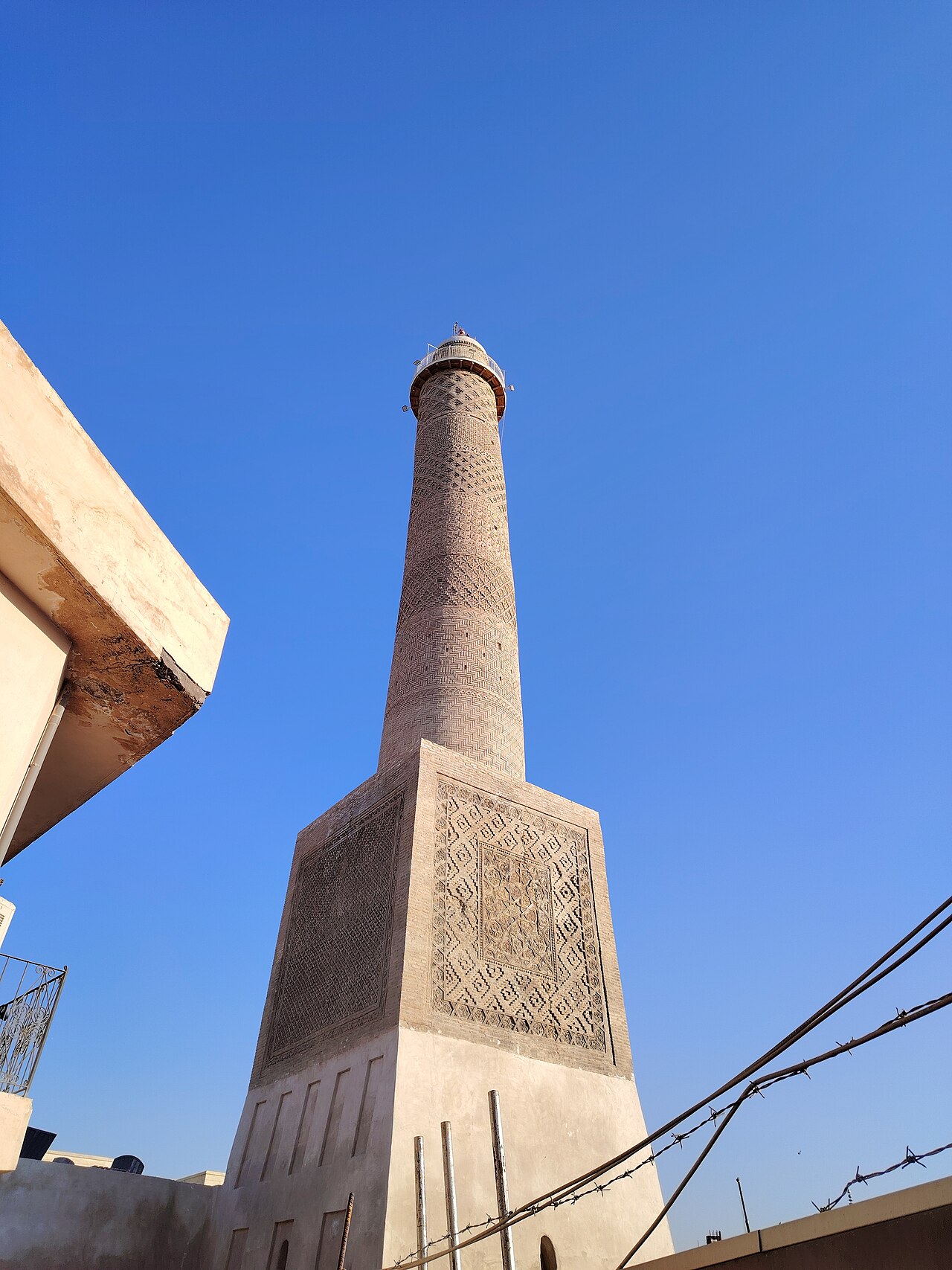
On 1 September 2025, Iraq formally inaugurated the rehabilitated al-Nouri Mosque complex, al-Saa’a Convent and al-Tahera Church. UNESCO’s own account identifies these as outputs of Revive the Spirit of Mosul, with UAE support, and describes separate EU-supported work on historic houses and restoration skills. [4] The reopenings mark specific achievements in cultural recovery. They do not establish that every damaged home has been repaired or every displaced community has returned.
Sources and further reading
- Iraqi State Board of Antiquities and Heritage, “Old City of Mosul,” UNESCO World Heritage Tentative List submission (17 August 2018).
- Sarah Shields, “Mosul Questions: Economy, Identity, and Annexation,” in The Creation of Iraq, 1914–1921 (Columbia University Press, 2004), pp. 50–60.
- UNAMI/OHCHR, Report on the Protection of Civilians in the Context of the Ninewa Operations and the Retaking of Mosul City (2 November 2017), especially pp. 1–9.
- UNESCO, “A milestone for Mosul: Iraq inaugurates iconic landmarks rehabilitated by UNESCO” (3 September 2025; updated 4 September).