Mount Judi near Cizre brings together the Qur’anic flood narrative, traditions shared across religious communities and surviving evidence of Assyrian royal campaigns. Each preserves a different aspect of the mountain’s history.
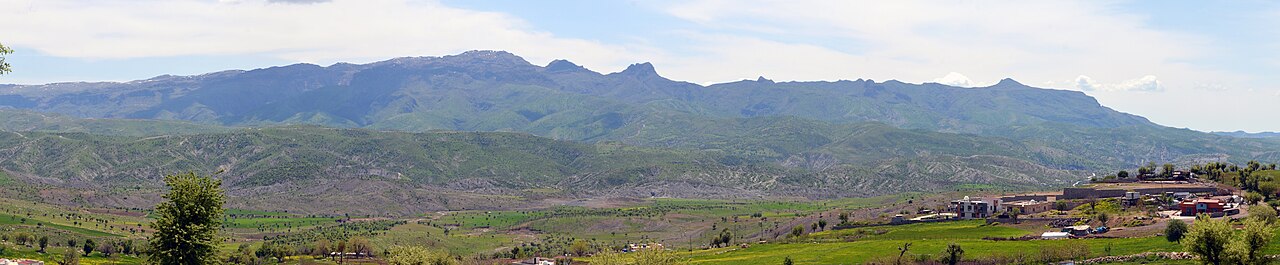

The mountain near Cizre
Mount Judi is called Çiyayê Cûdî in Kurdish and Cudi Dağı in Turkish. It stands in Şırnak province in southeastern Turkey, northeast of Cizre and near the Iraqi frontier. Hikmet Tanyu’s geographical account identifies four summits over 2,000 metres, with a highest point of 2,114 metres. He distinguishes the summit associated with Noah’s visitation at 2,017 metres. The mountain’s foundation includes Jurassic and Cretaceous limestone; streams descend from its southern slopes toward the Tigris. [1]
What the Qur’an says
Surah Hud 11:44 describes the floodwaters subsiding and the ship coming to rest on al-Judi. The following verses continue Noah’s exchange with God and, at 11:48, the instruction to disembark in peace and with blessings. [2] The mountain’s association with Noah is therefore rooted in a named place in the sacred text. Identifying that place in geographical and historical writing adds another layer of interpretation to the narrative.
A tradition across religious communities
William M. Brinner’s Encyclopaedia of the Qur’an article places Judi within a wider history of interpretation. He explains that Genesis refers to the plural “mountains of Ararat,” associated with the region of Urartu, while the Aramaic Targum Onkelos uses the mountains of Qardu. His discussion follows traditions that attached the Ark to Upper Mesopotamia and describes pilgrimage by Muslims, Jews and eastern Christians. [3] The familiar contrast between an Islamic Judi and a Christian Ararat simplifies a history in which several communities remembered the flood in the same broader region.
Noah, Cizre and the village of survivors
Turkey’s Culture Portal records local narratives connecting the mountain with Heştan, also rendered Haştan or Heştiyan, and with Cizre. Its entry, based on Şırnak’s 2012 cultural inventory, places these accounts under beliefs. It recounts variants in which eight or eighty people survived aboard the Ark and links the village name to those survivors. It also records the tradition locating Noah’s burial at Cizre. [4] These accounts document sacred geography and local remembrance. A traditional burial attribution is not an independently established identification of ancient human remains.
The Assyrian evidence
Grayson and Novotny’s edition of Sennacherib’s inscriptions dates his fifth campaign to 697 BCE and associates ancient Mount Nipur with Judi Dagh. Their introduction describes at least eight rock panels near Shakh and Hasanah: six completed and two prepared for engraving. The monuments depict a king before divine symbols and carry royal texts commemorating victories over mountain communities. Weathering makes details difficult to read, although the inscriptions largely repeat one another. [5] This is material evidence for Assyrian royal activity and self-presentation. It supplies a dated historical layer alongside the mountain’s flood traditions.
Sources and further reading
- Hikmet Tanyu, “Cûdî Dağı,” TDV İslâm Ansiklopedisi 8 (1993), pp. 79–80: geographical description.
- Qur’an, Surah Hud 11:44–49; Arabic text and Sahih International English translation.
- William M. Brinner, “Jūdī,” Encyclopaedia of the Qur’an, volume 3, edited by Jane Dammen McAuliffe (Brill, 2003), pp. 68–69.
- Turkish Ministry of Culture and Tourism, Culture Portal, “Tufan ve Cudi – Şırnak,” drawing on Şırnak Kültür Envanteri (2012); beliefs entry.
- A. Kirk Grayson and Jamie Novotny, The Royal Inscriptions of Sennacherib, King of Assyria (704–681 BC), Part 2 (Eisenbrauns, 2014), introduction p. 16; text 222 identifies the Judi Dagh inscriptions.