Saqqez is a mountain city in northern Kurdistan Province, Iran, with a historic bazaar quarter and nearby archaeological sites. It became internationally known as Jina Mahsa Amini’s hometown and the setting of her funeral procession and protests in September 2022.
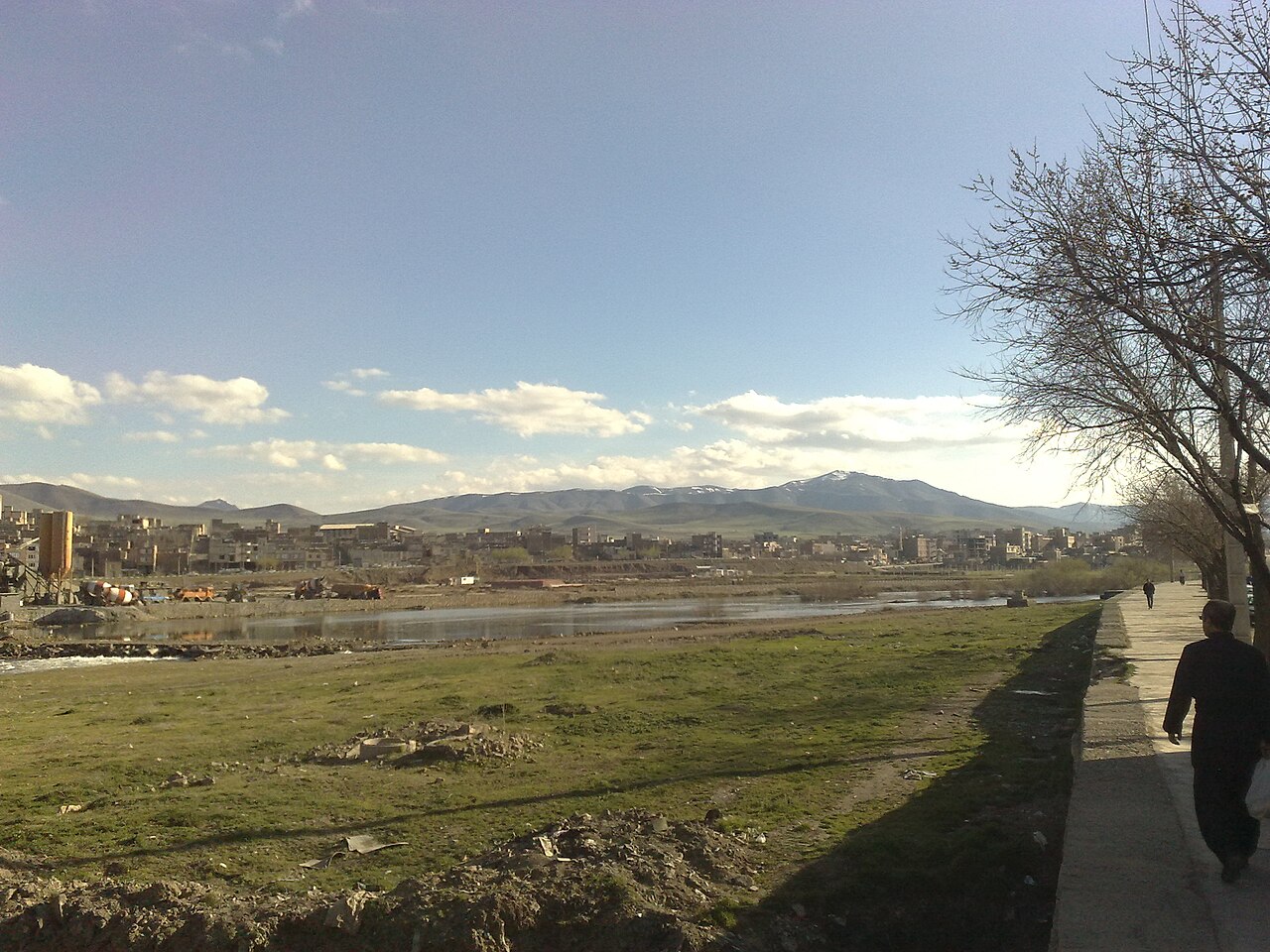

The city around its market
Saqqez lies in the Zagros highlands on routes linking Sanandaj, Miandoab and Baneh. Visit Iran identifies the old bazaar, Hajj Saleh Bath, Sheikh Mozaher Mosque and Two Minaret Mosque among its historic buildings, many clustered in the market quarter. [1] This older urban fabric gives the city a history beyond its recent international visibility. The 2013 river photograph places the built-up town against the surrounding hills; it records a particular city view, rather than a protest scene or a picture of Amini’s funeral.
Reading the Two Minaret Mosque
The Two Minaret Mosque stands on a stone platform built to accommodate sloping ground. Its timber-columned porch also serves as a summer prayer space, while the prayer hall uses four wooden columns. Visit Iran distinguishes a local story connecting the foundation with Nader Shah and Sheikh Hassan Molan Abad from dating based on the tiles, associated with the late Afsharid or early Zand period. [1] These different kinds of evidence should remain visible in the building’s history. A foundation tradition and a surviving decorative phase do not necessarily refer to the same moment.
Ziwiye: a site and a disputed treasure
Nearby Ziwiye belongs to the region’s archaeological history, but objects marketed as the “Ziwiye Treasure” require caution. The Met dates its decorated boss, object 53.47.1, to about the eighth–seventh centuries BCE and labels it “said to be from Ziwiye.” The museum explicitly notes that the claimed origins of many market objects cannot be verified. [2] Archaeologist Oscar White Muscarella, who participated in the 1964 excavation, distinguishes survey and excavation evidence from dealers’ accounts of the supposed hoard. [3] These objects cannot establish an unbroken history for the present city or prove every claim about its ancient identity.
A funeral procession in September 2022
Jina Mahsa Amini’s funeral took place on 17 September 2022. The UN fact-finding mission’s 2025 report records a gathering at Aychi cemetery followed by a procession through Enqelab Square toward Ghods Square near the governor’s office. [4] The funeral connected family mourning to public protest. In its September 2024 update, the mission reiterated its finding that physical violence in morality-police custody had led to Amini’s death and that the state bore responsibility for her unlawful death. [5] This is an investigative finding, and deserves clearer treatment than a list of competing assertions without their evidentiary status.
What the investigation documented in Saqqez
The mission’s account describes security-force deployment, the governor addressing protesters, and firing of metal-pellet ammunition, tear gas and water cannons after the crowd refused to disperse. It records a witness’s close-range shooting and lasting eye injury, and separately concludes that one victim was unlawfully killed with metal pellets. [4] Such documented incidents give Saqqez’s place in the protests a concrete history of people, locations and actions. The city’s significance rests both in that record and in its older streets, buildings and regional connections.
Sources and further reading
- Visit Iran, Two Minaret Mosque, Saqqez; city setting, market-quarter monuments, architecture and differing dating evidence.
- Metropolitan Museum of Art, Decorated boss, object 53.47.1; eighth–seventh centuries BCE and unverified Ziwiye provenance.
- Oscar White Muscarella, “Ziwiye,” Encyclopaedia Iranica (2017); excavation evidence and the disputed origins of market objects.
- UN Independent International Fact-Finding Mission on Iran, A/HRC/58/CRP.1 (2025), paras. 306–308 and 698–699, pp. 61–62 and 133; report hosted by Abdorrahman Boroumand Center.
- UN Independent International Fact-Finding Mission on Iran, update of 13 September 2024; findings on Amini’s death and state responsibility.