Sheikh Mahmud Barzanji turned religious and local authority in Sulaymaniyah into a bid for Kurdish government. His career moved through British appointment, the 1919 rising, exile and the contested kingdom proclaimed in 1922.
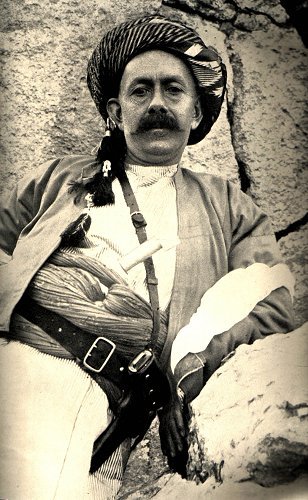


Religious authority and a political claim
Mahmud Barzanji, also known as Mahmud Hafid, belonged to Sulaymaniyah’s influential Barzanji religious family. Vedat Tüfekçi identifies him as Sheikh Said’s son and links his grandfather Kak Ahmad to the Qadiriyya Sufi order. The study gives alternative birth years, 1878 and 1881. [1] Family standing helped make him a political intermediary, but religious prestige, local leadership and a claim to rule Kurdistan were distinct forms of authority. His career shows how they could reinforce one another without producing universal Kurdish allegiance.
The postwar arrangement was contested
Ilhan Kilic’s archival study traces negotiations among British officers and Kurdish notables in late 1918. British officials sought an arrangement around Mahmud in Sulaymaniyah, while local leaders differed about protection, autonomy and their relationship to Iraq. [2] The administration emerged through bargaining after Ottoman withdrawal, rather than through a settled international recognition of an independent state. This explains a recurring tension: British authorities wanted a manageable local intermediary, while Mahmud pursued authority beyond the limits they were prepared to accept.
The rising and captivity of 1919
The British Library’s file description records the seizure of government in Sulaymaniyah on 25 May 1919 and British operations culminating in occupation of the valley in June. It also identifies correspondence about Mahmud’s imprisonment, sentence and possible relocation. [3] Tüfekçi describes his being wounded and captured at Bazyan during the June fighting. [1] A death sentence was commuted, and he was sent to India. [4] The sequence matters: rebellion in May, military defeat and capture in June, then trial and exile—not an arrest that had already ended his movement in May.
Return and the royal title in 1922
Richard Wilding’s account places the return within renewed British concern about Turkish influence and unrest. Mahmud promised to prevent Turkish entry into Sulaymaniyah and to avoid intervening in Kirkuk and Erbil. Wilding dates his departure from Baghdad to 20 September 1922 and arrival in Sulaymaniyah to 30 September. A decree announced a cabinet on 10 October; in November he assumed the title of king. [4] The contrast between the limits of the return agreement and the royal claim reveals why cooperation again became conflict. The title expressed a programme of Kurdish government, not secure recognition by all neighbouring powers.
The conflict continued beyond 1923
A single collapse date in July 1923 obscures the subsequent fighting. Tüfekçi describes a renewed government that July and the ultimatum and bombardment of Sulaymaniyah in May 1924. [1] The Qatar Digital Library catalogue for Air Vice-Marshal John Higgins’s 1924–26 command report identifies continuing ground and aerial attacks on Kurdish villages, punitive operations in Hawraman and border coordination against Mahmud. [5] These records connect war to settlements, migration and regional rivalries. A military report records the command’s priorities; it cannot, by itself, supply the experience of every family affected by bombing or displacement.
Later resistance and historical memory
Tüfekçi follows resistance through the later 1920s to submission in late 1931, and places Mahmud’s death on 9 October 1956 in Baghdad, followed by the transfer of his body to Sulaymaniyah. [1] His lasting significance lies in the attempt to turn a regional following into Kurdish government amid imperial and Iraqi state-building. That importance does not require declaring him the first person ever to imagine Kurdish self-rule, or reducing every later movement to his direct inheritance. His changing coalitions, governments and defeats are a substantial political history in their own right.
Sources and further reading
- Vedat Tüfekçi, “The Sheikh Mahmud Rebellion as Reflected in Ottoman Military Archives: A Struggle for Kurdish Independence under British Occupation”, International Journal of Kurdish Studies 11/2 (2025), pp. 628–664, DOI 10.21600/ijoks.1722635.
- Ilhan Kilic, Britain’s Kurdish Policy and Kurdistan 1918–1923, MPhil thesis, University of East Anglia (2018), especially pp. 30–31: postwar negotiations and differing expectations.
- British Library, IOR/L/PS/10/833/1, File 2879/1919 Part 1, “The Suleimanieh Outbreak” (1919–1921), archival catalogue description.
- Richard Wilding, “The Kingdom of Iraq and Sheikh Mahmud Barzanji’s Kingdom of Kurdistan”, Kurdistan Chronicle (30 December 2023): exile, the September return, cabinet and royal title.
- British Library, IOR/L/PS/20/C204, Iraq Command Report, April 1924–November 1926, John F. A. Higgins; Qatar Digital Library catalogue description used for the report’s scope and operations.