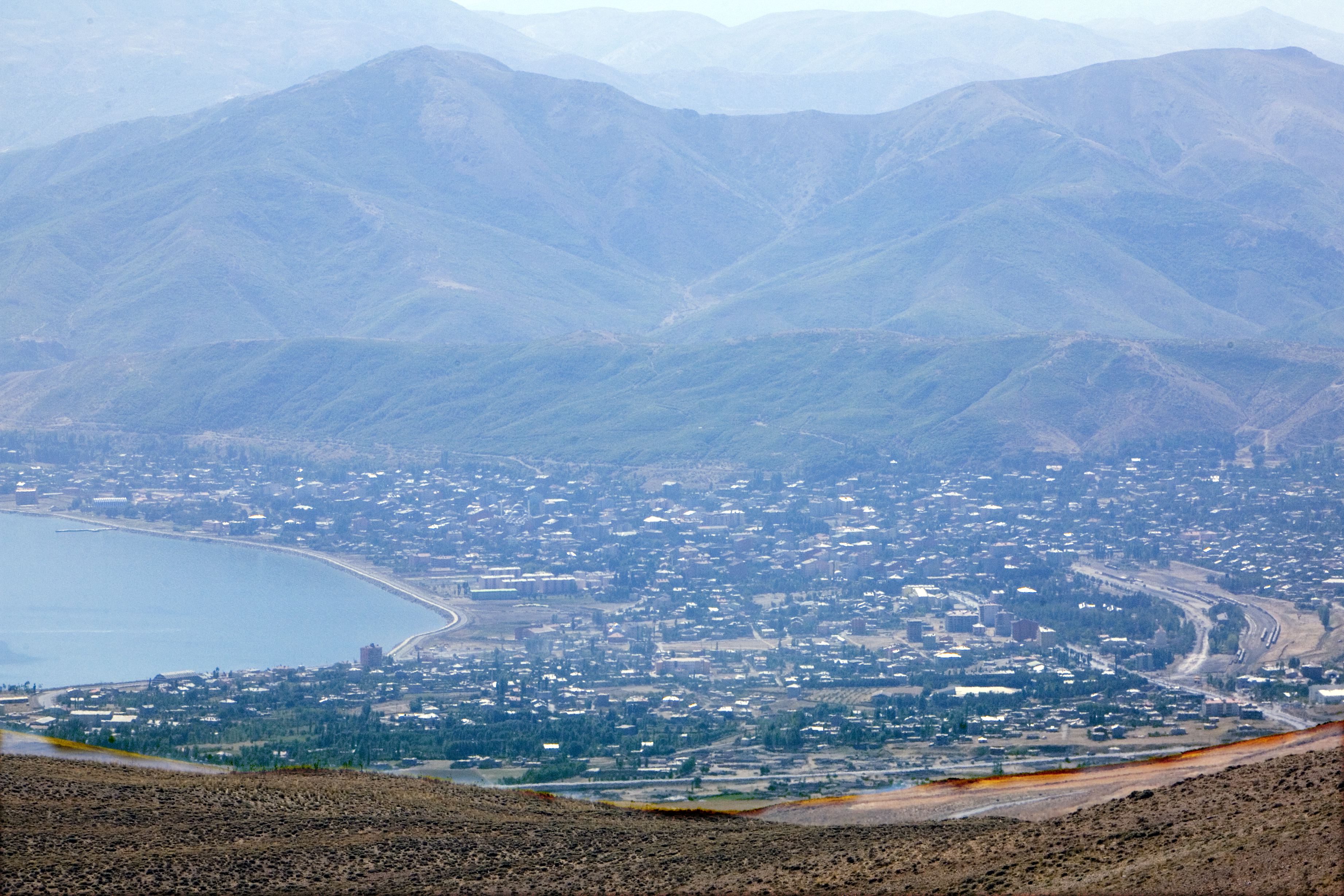
Tatvan, on Lake Van’s western shore in Bitlis province, developed around routes linking land and water. Its history includes an older harbour, modern shipping facilities and a wider landscape of religious buildings and volcanic lakes.
An older harbour and Kurdish households
The Tatvan Chamber of Commerce reproduces a passage from Evliya Çelebi’s Seyahatname describing the harbour, a substantial inn, customs collection from vessels and Kurdish households around the inn. It is a valuable historical description of a landing place connected to Van. [1] It also offers a more concrete starting point than treating Tatvan solely as a recent railway town: the harbour and overland passage had an earlier history, even though the present urban fabric developed much later.
District status and urban growth
The chamber’s historical account dates the creation of Tatvan district to 1936. Its initial centre was Kotum, now Küçüksu, before relocation to the present settlement; administrative buildings moved from Karşıyaka to Tuğ in June 1946. The account links later growth to transport, accommodation and settlement. [1] These changes help distinguish the history of the district’s administration from the development of the modern town.
A maritime base from the 1930s
The district administration’s shipping history traces the lake service to an organisation at Ernis in 1925. Operations began at Tatvan in 1935 after the earlier facilities proved inadequate. Workshops, warehouses, accommodation and other service buildings accompanied the move. The account records the operation’s transfer to Turkish State Railways in 1988. [2] This industrial and working history is part of the town’s lakeside landscape, alongside the better-known passenger view of the water.
Rail wagons across the lake
TCDD’s 2020 annual report explains that ferries provide the railway connection between Tatvan and Van. It records Sultan Alparslan entering service on 15 January 2018 and İdris-i Bitlisi on 26 July 2018, each with capacity for fifty wagons. [3] Their role is to bridge a break in the railway by carrying rolling stock across the lake. These dated investment records describe infrastructure; current passenger departure times require a separate timetable.
The district’s Christian architectural heritage
Özcan Yılmaz’s 2019 master’s study at Van Yüzüncü Yıl University identified three monasteries and ten churches in Tatvan district and examined their place in Armenian architecture. Its abstract lists villages including Göllü, Dibekli and Kıyıdüzü, as well as the Çağlayan neighbourhood. Fieldwork reached ten of the thirteen buildings; three could not be visited. [4] This is a district-wide inventory with stated limits, not a count of surviving churches within the town centre alone.
Nemrut and the protected landscape
The regional nature-conservation authority places Nemrut’s caldera west of Lake Van, across parts of Tatvan, Ahlat and Güroymak districts, about twelve kilometres from Tatvan. It records natural-monument designation on 31 October 2003 and describes permanent and seasonal lakes, hot springs and steam fissures. [5] The caldera and the town’s shore belong to different parts of the landscape: Tatvan faces Lake Van, while the smaller volcanic lakes lie above it.
Sources and further reading
- Tatvan Chamber of Commerce and Industry, Tatvan Hakkında: Evliya Çelebi passage and twentieth-century administration.
- Tatvan District Governorate, Tatvan’da Denizcilik: history of the lake shipping administration.
- Turkish State Railways (TCDD), 2020 Annual Report, p. 126: ferry procurement and service dates.
- Özcan Yılmaz, Bitlis Tatvan’daki Hıristiyan Dini Mimarisi, master’s thesis, Van Yüzüncü Yıl University, 2019: institutional abstract.
- Ministry of Agriculture and Forestry, 14th Regional Directorate, Nemrut Caldera natural-monument description.