Mitanni was a major Late Bronze Age kingdom centred on the upper Khabur. Royal letters, treaties and excavations reveal its power and cultural connections, while leaving important questions about language, geography and later ancestry unresolved.
A kingdom with several names
Mitanni, also written Mittani, appears in scholarship alongside Hanigalbat and Naharina. Eva von Dassow’s published chapter abstract places its formation in the upper Khabur region in the late sixteenth century BCE, among predominantly Hurrian-speaking populations incorporating immigrants from beyond the Zagros. During the fifteenth century it acquired an empire across northern Mesopotamia, Syria and eastern Anatolia, competing with New Kingdom Egypt. [1] These changing zones of power should not be drawn as the fixed borders of a modern nation-state.
Diplomacy in the Amarna letters
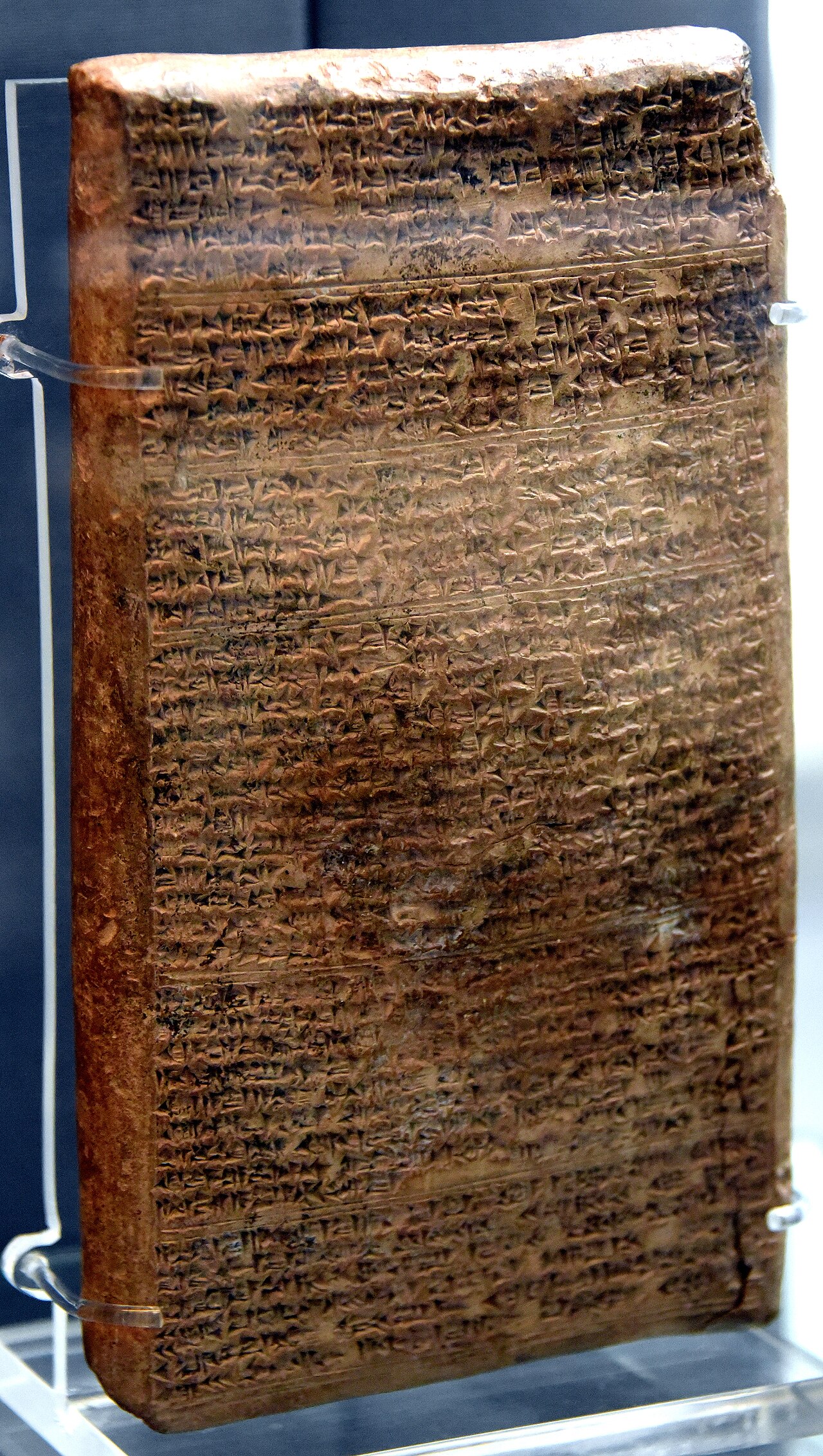
In EA 17, Tushratta addresses Amenhotep III as his diplomatic brother, recalls his sister Kelu-Heba’s marriage into the Egyptian court and requests continued friendship and exchanges of envoys. He also describes a struggle after Artashumara’s murder and claims victory over enemies from Hatti. Gifts include chariots, horses, jewellery and captive servants. [2] The letter records how a king presented his legitimacy and relationships; its military claims are not an independent campaign report. Royal marriage demonstrates diplomacy, not a modern national identity for an Egyptian queen.
Language is not the same as a dynasty
Hurrian, Akkadian diplomatic writing and the Indo-Aryan elements discussed in Mitanni studies are different categories of evidence. EA 17 is written in Akkadian. [2] Von Dassow’s abstract discusses the role attributed to Indo-Aryan speakers and chariotry, rather than establishing a complete census or a uniform ethnic ruling caste. [1] Windfuhr classifies Hurro-Urartian separately from Indo-European languages and warns against treating genetic tables as linguistic pedigrees. Kurdish belongs among Iranian languages; similarity of a grammatical feature or a place-name is insufficient to turn Hurrian into an earlier form of Kurdish. [6]
Treaties and a prolonged loss of power
The Hittite text catalogue distinguishes the paired Suppiluliuma–Shattiwaza compositions, CTH 51 and 52, with Akkadian and Hittite witnesses. [3] Later, Adad-nirari I’s inscription describes capturing Shattuara of Hanigalbat, returning him under oath and receiving tribute. It then presents Shattuara’s son Wasashatta as a rebel who sought Hittite assistance. [4] These Assyrian royal claims show why Mitanni’s decline cannot be reduced to one securely dated destruction around 1300 BCE. Hanigalbat’s later kings and wars require their own chronology.
Kemune: buildings and a later archive
At Kemune in the Kurdistan Region of Iraq, falling Mosul-reservoir water exposed a city investigated in January–February 2022 by Hasan Ahmed Qasim, Ivana Puljiz and Peter Pfälzner’s joint team. The university report tentatively identifies it as Zakhiku. Alongside the palace documented in 2018, excavation revealed fortifications, a large storage building and an industrial complex. Five vessels held over 100 cuneiform tablets, dated to the Middle Assyrian period after the destruction of the Mitanni-era buildings. The team protected the remains with sheeting and gravel before renewed flooding. [5] The archive should therefore not be casually labelled a collection of Mitanni royal correspondence.
Regional heritage and the limits of ancestry claims
Mitanni belongs to the ancient history of places where Kurds and other communities live today. That geographical connection is meaningful without asserting an unbroken national dynasty. Windfuhr stresses that language, ethnicity, culture and genetic groupings do not map neatly onto one another. [6] The sources here do not establish percentages of “Hurrian” Kurdish clan names, an exclusive genetic descent, or a documented line from Mitanni deities to present-day faiths. Excavation context, identifiable texts and historical linguistics provide firmer ground than resemblance alone.
Sources and further reading
- Eva von Dassow, “Mittani and Its Empire”, The Oxford History of the Ancient Near East III (2022), pp. 455–528, DOI 10.1093/oso/9780190687601.003.0029; published chapter abstract consulted.
- Amarna letter EA 17, BM 29792, lines 1–54; K. C. Hanson, transliteration and adapted translation after Mercer and Moran, with source notes.
- Hethitologie Portal Mainz, Catalogue of Hittite Texts, CTH 51–52: paired Suppiluliuma–Shattiwaza treaties and language witnesses.
- Adad-narari I 03, RIMA 1 A.0.76.3, especially lines 4–34; A. Kirk Grayson (1987), digital edition adapted by Jamie Novotny and Nathan Morello, ORACC/RIAo.
- University of Freiburg, “A 3400-year-old city emerges from the Tigris River”, 30 May 2022; joint excavation report, building phases, later tablet archive and conservation.
- Gernot L. Windfuhr, “Iran vii. Non-Iranian Languages (1): Overview”, Encyclopaedia Iranica XIII/4 (2006; updated 2018), pp. 377–386; language classification and cautions on genes, languages and ethnicity.