


The Socio-Cultural and Athletic Genesis of Arda Güler: An Exhaustive Analysis of Lineage, Identity, and Global Sporting Impact
- Mehmet Özdemir

- Feb 24
- 12 min read
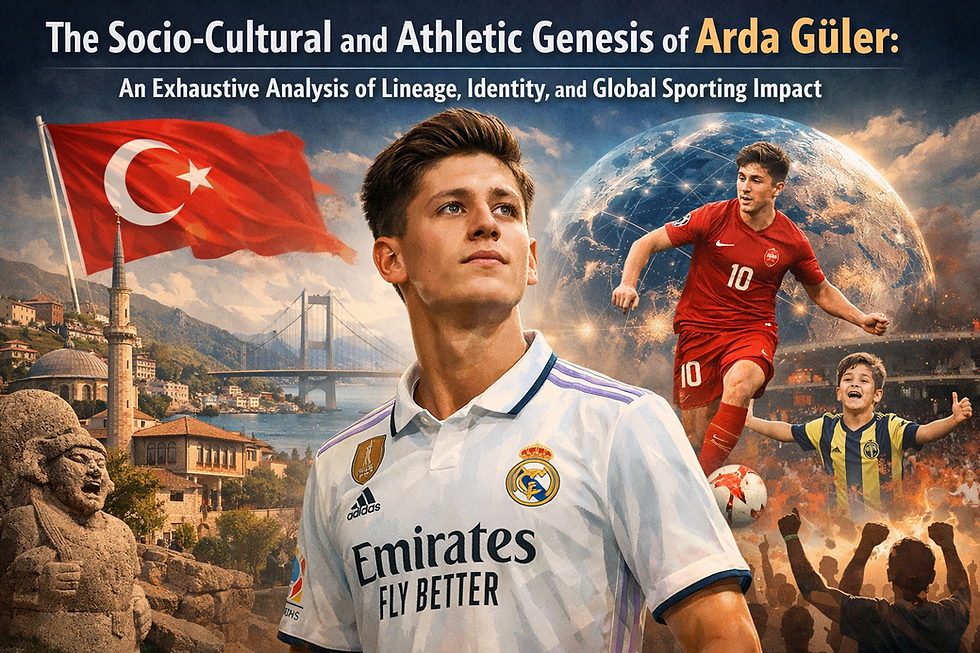
The ascent of Arda Güler from the domestic youth leagues of Ankara to the zenith of global club football at Real Madrid represents more than a traditional narrative of athletic talent. It serves as a complex intersection of demographic shifts, familial sacrifice, and the persistent negotiation of ethnic and national identity within the modern Turkish state. Born on February 25, 2005, in the Altındağ district of Ankara, Güler’s trajectory has been meticulously documented by international sports analysts and socio-cultural observers alike.
As he has transitioned from the "wonderkid" of Fenerbahçe to the first Turkish citizen to secure a UEFA Champions League title with Real Madrid, he has become a focal point for questions regarding heritage, particularly the recurring inquiries into whether his background is Turkish or Kurdish. This report provides an exhaustive investigation into Güler’s genealogical roots, his childhood development in the socio-economic context of Ankara, and a comprehensive deconstruction of the ethnicity claims that have circulated in digital and media spheres.
Socio-Economic Origins: The Altındağ Crucible
To understand the professional composure and technical maturity often attributed to Arda Güler, one must first analyze the environmental conditions of his upbringing in Ankara's Altındağ district. Altındağ is historically characterized as a working-class region, a site of significant internal migration where families from rural Anatolia settled in search of urban opportunity. For the Güler family, this urban setting was the backdrop for a lifestyle defined by modest means and a singular commitment to athletic development.
The household was led by Ümit Güler, a former corner shop operator, and Serap Güler, a homemaker who provided the family's emotional foundation despite enduring chronic heart disease. The economic reality of the family was one of precariousness; Ümit Güler’s retail business eventually faced bankruptcy, a development attributed to the total prioritization of Arda’s training and travel requirements. This sacrifice is emblematic of a specific Turkish familial archetype where the success of the child is viewed as a collective enterprise, requiring the liquidation of traditional assets to fund the pursuit of elite sports.
Ümit Güler acted as his son’s first technical instructor, transforming their small garden into a rigorous training ground. Recognizing that a dominant left foot could provide a competitive advantage in professional football, Ümit encouraged Arda to practice exclusively with his left side, even setting up makeshift goals against apartment walls to refine his accuracy. This early intervention by the father is a critical data point in understanding Güler's current technical profile, which is characterized by a "superb first touch" and an ability to navigate "tight spaces" with surgical precision.
Household Profile | Detail | Significance |
Father | Ümit Güler | Primary coach; sacrificed business for career. |
Mother | Serap Güler | Emotional support; faced health challenges. |
Socio-Economic Status | Working-Class | Influenced resilience and "grounded" mentality. |
Initial Training | Garden/Street | Developed technical agility in confined urban spaces. |
Genealogical Investigation: Paternal Roots in Bolu-Mengen
While Arda Güler is an Ankara native by birth, his paternal lineage is deeply rooted in the Western Black Sea region of Turkey, specifically the Mengen district of Bolu province. This geographic origin is essential for deconstructing ethnicity claims, as Bolu is historically and demographically a stronghold of Turkic identity, distant from the Kurdish-majority regions of Southeastern Anatolia.
The Güler family hails specifically from the village of Hayranlar, situated within the Gökçesu belde (sub-district) of Mengen. Hayranlar is a small, traditionally agrarian settlement consisting of roughly 35 households, where Arda’s grandparents, Mehmet Ali and Adiye Güler, continue to reside. The demographic structure of this region is predominantly of Oghuz Turkic descent, often classified as "Manav" or "Yörük" Turks, groups that have inhabited the Western Black Sea and Marmara hinterlands for centuries.
The cultural heritage of Mengen—famed for producing the culinary staff of Ottoman palaces—emphasizes a tradition of craftsmanship and discipline, values that are reflected in the disciplined public persona Güler maintains in Madrid. His grandparents recall that even during childhood visits to the village, Arda’s singular focus was on football, often enlisting his grandmother as a makeshift goalkeeper in the village square. This deep-rooted connection to a traditional Turkic village environment further situates his identity within the historical core of the Turkish peasantry and middle class, rather than a minority ethnic enclave.
Geographic Detail | Location | Demographic Context |
Birthplace | Altındağ, Ankara | Urban, working-class, diverse. |
Paternal Village | Hayranlar, Mengen, Bolu | Oghuz Turkic heartland; small agrarian community. |
Regional Sub-district | Gökçesu | Historically stable population; minimal migration from SE. |
Maternal Lineage and the Caucasian-Turkic Connection
The investigation into the maternal side of the family, particularly the roots of Serap Güler, introduces a more nuanced layer to Arda’s ethnic composition. Serap Güler’s family is linked to the Ficiroğulları tribe (aşiret), specifically the Karaaslan and Seçkin branches. Historical records and local genealogical analysis indicate that the Ficiroğulları have long-standing ties to Central Anatolia, with significant concentrations in Yozgat—specifically the Yerköy and Şefaatli districts—and Ankara.
The Ficiroğulları lineage is categorized as "Kafkas göçmeni Türkler" (Caucasian immigrant Turks). This refers to the massive nineteenth-century migrations of Turkic and Muslim groups (such as Circassians, Abkhazians, or Dagestanis, who often assimilated into the broader Turkish national identity) fleeing Russian imperial expansion in the Caucasus. These groups were systematically settled by the Ottoman administration in Central Anatolian provinces like Yozgat and Ankara to stabilize the population and provide a loyalist demographic core.
The identification of the Ficiroğulları as Caucasian immigrant Turks is a pivotal finding in addressing the "Kurdish or not" inquiry. Caucasian immigrant communities in Turkey are distinct from Kurdish ethnic groups in terms of linguistic roots, historical migration patterns, and socio-political alignment. While both groups are predominantly Muslim, the Ficiroğulları represent a specific Turkic-Caucasian synthesis that is integral to the "Anatolian mosaic" but remains separate from the Kurdish ethnic narrative. The dispersal of this lineage across the Yerköy and Şefaatli districts of Yozgat aligns with the standard settlement history of these immigrant groups in the late 19th century.
Maternal Lineage | Detail | Historical Origin |
Tribe Name | Ficiroğulları | Caucasian Immigrant Turk (Kafkas Göçmeni). |
Primary Branches | Karaaslan, Seçkin | Settled in Yozgat and Ankara. |
Key Locations | Yerköy, Şefaatli | Central Anatolian districts with heavy immigrant history. |
Deconstructing the Kurdish Ethnicity Claims: Media vs. Reality
The assertion that Arda Güler is of Kurdish ethnicity persists primarily in social media forums and unverified digital commentary. These claims often stem from a broader phenomenon in Turkish public life where successful figures are "claimed" by different ethnic groups to enhance their cultural capital or as part of a competitive nationalist discourse. In the case of Güler, the Kurdish claim appears to be a result of several converging factors: the popularity of the name "Arda" across multiple demographics, the general diversity of Ankara's population, and specific incidents that have been interpreted through an ethnic lens.
One such incident involved allegations that Güler refused to shake the hand of Deniz Undav, a German-born player of Kurdish/Ezidi heritage, during an international fixture. While such rumors frequently circulate on platforms like Reddit or X (formerly Twitter), they often lack context or are debunked by video evidence showing routine sportsmanship. Nevertheless, these narrative fragments contribute to an online environment where ethnic identity is superimposed onto athletic interactions, regardless of the player's actual heritage.
Empirical evidence from the following areas contradicts the Kurdish hypothesis:
Topographical Demographics: His paternal roots in Bolu and maternal roots in Yozgat are in provinces with historically low Kurdish populations compared to the Southeastern Anatolian regions (e.g., Diyarbakır, Mardin, Van).
Linguistic and Cultural Signifiers: The family's tribal affiliation (Ficiroğulları) and village origin (Hayranlar) are documented as Turkic and Caucasian-immigrant, respectively, categories that are socio-linguistically distinct from Kurdish.
Self-Identification: Güler and his family have consistently identified as Turkish nationals and have embraced the national symbols of the Turkish Republic. While Kurdish-origin players can and do represent Turkey, Güler's background shows no traditional markers of Kurdish identity, such as Eastern regional residency or Kurdish linguistic usage in the home.
Professional Documentation: Major biographical sources and official club registries from Fenerbahçe and Real Madrid list his nationality as Turkish, and genealogical research in Turkish databases identifies his "aslen" (original) home as Bolu.
The persistence of the rumor may also be linked to the "Mesut Özil" comparison. Özil, who played for Germany but is of Turkish descent, faced intense scrutiny over his identity. In contrast, Güler is a "pure" product of the Turkish domestic system, which makes him a more straightforward symbol of Turkish national pride, leading to counter-claims by those who wish to complicate the "national star" narrative.
Professional Evolution: The Gençlerbirliği and Fenerbahçe Years
The technical development of Arda Güler was facilitated by the Gençlerbirliği academy, an institution in Ankara famed for its meritocratic and disciplined approach to youth training. Joining the academy in 2014, Güler spent five formative years in a system that emphasized ball control and vision over raw physical power. His discovery by Fenerbahçe in February 2019 was a pivotal moment; at only 13 years old, he was scouted during a match against Osmanlıspor, leading to an immediate recruitment by the Istanbul-based powerhouse.
His progression at Fenerbahçe was rapid, moving from the U-15 to the U-19 team within three years. During the 2020-21 season, his performance in the U-19 Play-Offs—where he scored three goals and provided an assist in a single quarterfinal match—solidified his status as the club's premier prospect. This earned him a professional contract in January 2021 and a senior debut in August of that year in a UEFA Europa League match against HJK Helsinki.
The symbolic importance of Güler's tenure at Fenerbahçe was cemented when he was awarded the number 10 jersey following the departure of Mesut Özil. In the context of Turkish football, the number 10 is reserved for the "maestro" and carries the weight of past legends like Alex de Souza and Jay-Jay Okocha. By becoming the youngest goalscorer in Fenerbahçe’s league history at just 17, Güler not only met these expectations but ignited a bidding war among Europe's elite clubs, including Bayern Munich, Liverpool, and Barcelona.
Club Career Phase | Appearances | Goals | Key Achievement |
Fenerbahçe U-19 | 30 | 14 | Top scorer in 2020-21 Play-Offs. |
Fenerbahçe (Senior) | 51 | 9 | Turkish Cup winner (2023); MOTM in final. |
Real Madrid (2023-) | 69 (Total) | 15 | Youngest Turk to score in La Liga. |
Integration into Real Madrid and the Global Elite
Güler's transfer to Real Madrid in July 2023 for a fee of €20 million—plus an additional €10 million in potential bonuses—was a landmark event for Turkish sports. His decision to join Real Madrid over Barcelona was influenced by a personal appeal from club figures and the opportunity to train under Carlo Ancelotti. Despite early setbacks due to injury, his debut season in 2023-24 saw him capture the La Liga title and the UEFA Champions League, becoming the first Turkish international to win the latter with the club.
At Real Madrid, Güler has been utilized as a versatile attacking midfielder or winger, with Ancelotti praising his "vision" and "composure beyond his age". His ability to score from long range, particularly with his signature left-footed strike, has drawn comparisons to established superstars, yet his teammates and coaches emphasize his humility and "grounded personality," traits often credited to his religious and familial upbringing.
The Spanish media has frequently debated his playing time, with some outlets reporting on "mobbing" or ego clashes within the star-studded Madrid dressing room. However, Güler has consistently denied these reports, maintaining a professional focus that has endeared him to the "Madridistas". His integration into the team, symbolized by Luka Modrić reportedly "handing over the shirt" to him on the team bus, suggests a long-term plan to position him as a central pillar of the "new generation" at the Santiago Bernabéu.
Statistic | Fenerbahçe (2021-23) | Real Madrid (2023-Present) |
Minutes Played | 1,924 | 3,212 |
Goals | 9 | 15 |
Assists | 12 | 14 |
Yellow Cards | 3 | 3 |
Major Trophies | Turkish Cup | Champions League, La Liga, UEFA Super Cup. |
National Identity and the International Stage
Güler’s role in the Turkish national team is perhaps the most significant indicator of his status as a "national" rather than "ethnic" icon. Making his senior debut at age 17 in November 2022 against the Czech Republic, he quickly became the face of the squad. His performance during UEFA Euro 2024 was particularly historic; his goal against Georgia made him the first teenager to score on his European Championship debut since Cristiano Ronaldo in 2004.
The national team provides a platform where Güler’s identity is unified under the Turkish flag. In Turkey, the national team is often one of the few institutions that can temporarily bridge political and ethnic divides. Güler’s success is seen as a victory for the "Turkish school" of football, as he is a product of local academies rather than the "Almancı" (German-Turk) diaspora. This has made him a uniquely potent symbol for the Turkish Football Federation (TFF) and the domestic sporting establishment.
National Team Metric | Value | Record/Status |
Senior Caps | 26 | As of late 2025. |
Senior Goals | 6 | Includes Euro 2024 goals. |
Debut Age | 17 years, 8 months | One of the youngest in history. |
Euro 2024 Performance | 1 Goal, Player of the Match | Historic debut goal. |
Economic Impact and Market Valuation
The financial dimensions of Arda Güler's career reflect his status as a premier global asset. His market valuation has seen an exponential rise, with current estimates placing his worth near €90 million, making him the most valuable Turkish player in history. This economic value is not just a reflection of his on-field performance but also his massive social media following and his "soft power" as a cultural ambassador for Turkey in the Spanish-speaking world.
His salary at Real Madrid is estimated at approximately £4.38 million ($5.6 million) annually, providing a weekly wage that places him comfortably among the upper echelon of young European stars. Furthermore, his insistence on a transfer fee that exceeded his release clause at Fenerbahçe ensured that his former club received a substantial financial windfall, a gesture that enhanced his reputation as a "loyal son" of Turkish football.
Financial Metric | Amount (GBP/USD) | Source/Context |
Annual Salary | £4,385,178 / $5,667,053 | |
Weekly Wage | £84,330 / $108,982 | |
Market Valuation | €90,000,000 | Record for a Turkish player. |
Transfer Fee | €20,000,000 + bonuses | Surpassed release clause. |
Cultural and Religious Identity: The "Quiet Devotion"
A recurring theme in the profiles of Arda Güler is his adherence to traditional Turkish and Islamic values. Described as a "practicing Muslim," Güler is noted for his modesty and his avoidance of the "extravagant lifestyle" typically associated with young footballers in Europe. This "grounded personality" is credited to his parents, Ümit and Serap, who instilled a sense of "quiet devotion" and respect for elders.
This cultural alignment is particularly evident in his public interactions. Whether it is his heartfelt messages to his mother during matches or his composed responses to media pressure, Güler embodies a specific "Turkish gentleman" (beyefendi) archetype. This has made him immensely popular among a broad spectrum of the Turkish public, including conservative families who see him as a model for their own children. His relationship with Duru Nayman, a professional basketball player for Galatasaray, further integrates him into the elite Turkish sporting community, creating a high-profile but relatively scandal-free public image.
Synthesis: Identity, Ethnicity, and the Future
The exhaustive tracing of Arda Güler’s background reveals a heritage that is deeply embedded in the historical and demographic core of Turkey. His paternal roots in the Hayranlar village of Bolu connect him to the Oghuz Turkic peasantry of the Western Black Sea, while his maternal roots in the Ficiroğulları tribe of Yozgat identify him with the Caucasian-Turkic migrant communities that helped shape Central Anatolia in the late Ottoman era.
The claims of Kurdish ethnicity lack genealogical and geographic foundation. While they reflect the complex and often contentious nature of identity politics in the Middle East, they do not align with the documented history of the Güler, Karaaslan, or Seçkin families. Arda Güler is, in both legal nationality and ancestral ethnicity, a Turk who represents the synthesized "Anatolian" identity of the 21st century—a blend of native Turkic elements and assimilated immigrant groups from the Caucasus.
As he continues his career at Real Madrid, Güler’s greatest challenge will be maintaining this "grounded" identity amidst the global pressures of the Santiago Bernabéu. However, his history of resilience—from the makeshift goals of Altındağ to the high-stakes matches of Euro 2024—suggests a maturity that is well-equipped to handle the spotlight. He remains not only a premier sporting talent but a vital symbol of national cohesion for Turkey, a role he fulfills by consistently prioritizing his craft and his family over the divisive debates of ethnic identity.
Summary of Background | Detail | Source Verification |
Ethnicity | Turkish (Anatolian Turkic / Caucasian Turk synthesis) | |
Nationality | Turkish | |
Paternal Home | Bolu, Mengen, Hayranlar Village | |
Maternal Home | Yozgat / Ankara (Ficiroğulları lineage) | |
Religion | Practicing Muslim | |
Social Origin | Working-class Ankara (Altındağ) |
In the final analysis, the story of Arda Güler is a testament to the fact that while ethnicity and nationality are often subjects of intense public debate, for the individual, they are often secondary to the values of discipline, family, and excellence. Güler’s identity is constructed not from the rumors of social media, but from the sacrifices of a corner shop owner in Ankara, the resilience of a mother in Hayranlar, and the technical mastery honed in a small Turkish garden. As the "Turkish Diamond" continues to shine in Madrid, he does so as a definitive representative of the modern Turkish Republic and its diverse but unified heritage.


Comments