Akre’s mountainside houses and Newroz torches are familiar Kurdish cultural images. Local research, a community letter and a church survey also reveal a town with a layered history beyond the festival.
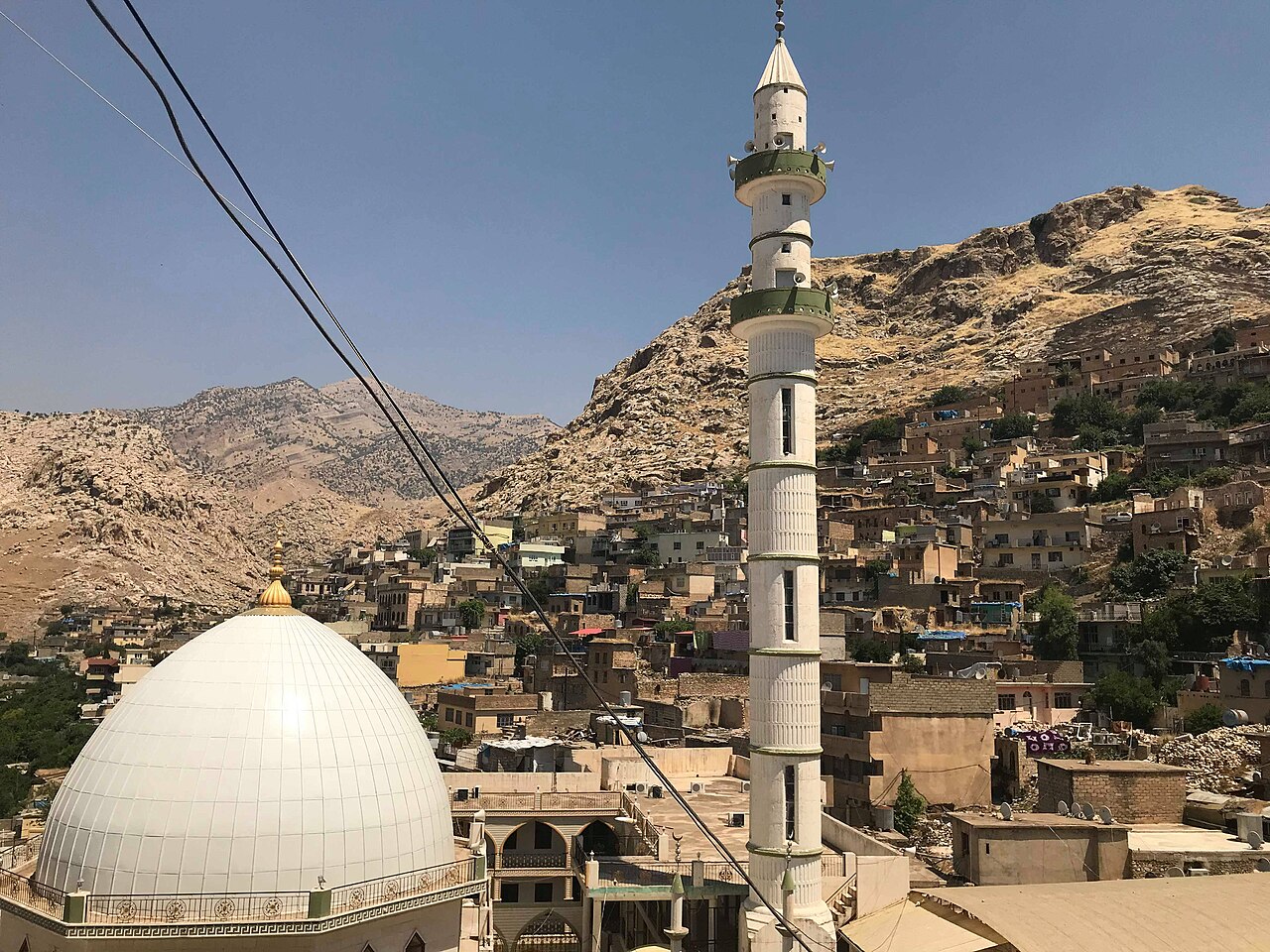

Where Akre is, and how its names appear
Akrê in Kurdish and Aqrah or Aqra in other sources name the town east of Duhok in Iraqi Kurdistan. Its old neighbourhoods climb a steep rocky slope, with a plain to the south. The Mesopotamia heritage survey locates Aqrah west of the Great Zab and approximately 96 kilometres east of Duhok. This is not Acre or Akko on the Mediterranean: similarly written place names can lead to the wrong historical references. [1] [2]
The citadel and the value of local memory
Kela Akrè is the rocky hillfort above the town. A 2022 University of Duhok study by Jambally A. Mohammed and Aihan Jamal documents its relationship with the lower settlement through oral-history interviews. The authors explain that written and archaeological documentation is limited. Their project records memories of structures, uses and relationships between monuments. This makes local testimony valuable, while requiring a distinction between remembered events, inherited stories and securely dated remains. An ancient-looking setting alone does not prove a precise foundation year or an unbroken account of its earliest inhabitants. [3]
A seventeenth-century letter from the Jewish community
The Posen Library publishes an anonymous seventeenth-century letter to the community of ‘Akron, identified as Akre, translated by Jeffrey M. Green. It discusses the relationship between community leaders and residents, shared contributions to ransom, pressure from rulers and decisions over remaining or leaving. This is a specific historical voice, rather than a vague assertion that minorities once lived here. The accompanying introduction identifies Muslim, Christian and Jewish neighbourhoods and Jewish occupations including weaving, silversmithing and trade. The letter concerns one community’s arrangements; it is not a census of the whole town. [2]
Christian heritage on the cliff
The Mariam al Adra cathedral provides another tangible connection to the town’s past. Mesopotamia’s survey distinguishes an attestation in a 1695 manuscript from an unknown initial construction date. It describes a later rebuilding in 1955 and abandonment during the 1963 war. Its photographs and architectural description record a three-nave church, columns and Syriac inscriptions. These are dated observations and historical accounts, not confirmation of the building’s condition or accessibility today. Akre’s heritage therefore includes religious communities whose buildings and memories require attention alongside the better-known festival landscape. [1]
Why Akre is called a capital of Newroz
Newroz marks spring and the new year and has a strong Kurdish public and national meaning. Akre’s torch processions, hillside fires, music and gatherings have made the town a prominent centre of celebration. The KRG’s record of the prime minister’s visit on 20 March 2024 documents one particular event and official aspirations for its future prominence. Calling Akre a capital of Newroz expresses cultural recognition; it is not an independently measured ranking of every festival. UNESCO’s multinational listing recognises a shared living tradition, not Akre’s old town as a World Heritage site. [4] [5]
Kawa: a living legend, not a dated founding record
Kurdish Newroz celebrations commonly invoke Kawa the blacksmith and resistance to the tyrant Zahhak. The wider epic tradition has different tellings. Mahmoud Omidsalar’s study of the Shahnameh explains Kawa’s refusal to endorse the king’s justice, his leather-apron banner and his support for Fereydun. These literary episodes illuminate why the story can carry ideas of resistance; they do not establish an archaeological date for Akre or prove that a modern procession has continued unchanged since antiquity. [6]
A town to understand beyond one evening
The hillside, citadel, neighbourhood histories and surviving religious heritage give Akre significance throughout the year. For festival research, distinguish a dated report from an annual guarantee: AP’s March 2026 reporting describes torch-bearing celebrations held in more muted circumstances. Programme, access and crowd estimates must be checked for the particular year. The photograph above is dated 2019 and shows the built setting, rather than claiming to document a current event. [1] [3] [7]
Sources and further reading
- Mesopotamia, “The Mariam Al Adra Cathedral in Aqrah”: location, architectural survey, photographs from July 2017 and documented building history.
- Anonymous, “Letter to the Community of ‘Akron (Kurdistan)”, seventeenth century, translated by Jeffrey M. Green, The Posen Library, vol. 5; source and editorial introduction.
- Jambally A. Mohammed and Aihan Jamal, “Community-based Approach to Collection of Oral History for Documentation of Kelaakrè, an Ancient Citadel in Kurdistan”, Journal of Duhok University 25/1 (2022), pp. 1–12; study abstract and research scope.
- Kurdistan Regional Government, record and transcript of the prime minister’s Newroz address in Akre, 20 March 2024; an official account of that event.
- UNESCO, multinational Nowruz nomination file 02097 and 2024 inscription; living cultural heritage shared by participating countries, including Iraq.
- Mahmoud Omidsalar, “Kāva”, Encyclopaedia Iranica XVI/2 (2013), pp. 130–132, updated 2016: epic narrative and its variants.
- Associated Press, “Kurds in northern Iraq celebrate the new year festival of Nowruz, in photos”, 20 March 2026: contemporary coverage from Akra.