Amedi, also called Amadiya, occupies a steep-sided rock plateau in the Kurdistan Region of Iraq. Its history connects the Bahdinan principality, Parthian reliefs, medieval gateways and the memories of Muslim, Christian and Jewish residents.
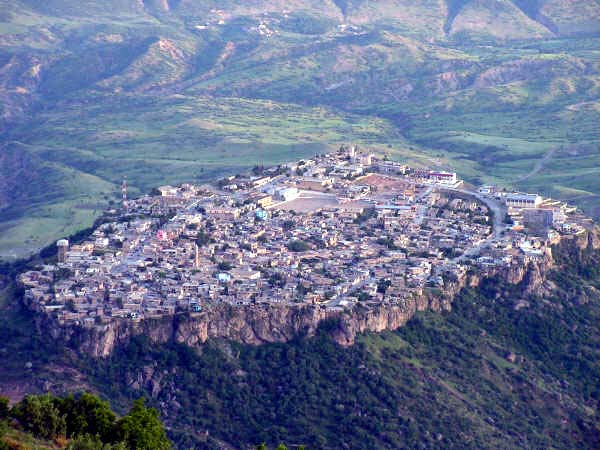

A town shaped by its plateau
Amedi—Amêdî in Kurdish, al-Amadiya in Arabic—is in Duhok Governorate, in the Kurdistan Region of Iraq. Its compact built area occupies an oval plateau with steep limestone edges. Iraq’s 2011 submission to UNESCO describes the platform as under one square kilometre and approximately 450 metres above the surrounding area. This is a measure of local relief, not elevation above sea level. The setting helped defence and constrained later building, streets and access. [1]
Ancient remains and a mistaken identification
Pre-Islamic occupation is visible in rock reliefs along the western approach. Zainab Bahrani and colleagues documented three reliefs in 2013 and revisited them in 2018, interpreting them as Parthian and discussing the limits of reconstructing eroded carvings. Their study explicitly rejects identifying this town with the Neo-Assyrian Amedi associated with modern Diyarbakır. Similar names do not establish the same place. Medieval accounts connect the name Amadiya with Imad al-Din Zangi and a twelfth-century stronghold on an earlier site called Ashib. These are distinct stages of evidence, not proof of an exact foundation in 3000 BCE. [2]
The Bahdinan principality and its end
Amir Hassanpour relates the hereditary principality to Baha al-Din from Shamdinan and the decline of Zangid power in the thirteenth–fourteenth centuries. His account places Amedi within conflicts involving neighbouring Kurdish rulers as well as the Ottoman and Safavid states. It records Muhammad Pasha of Rawanduz’s capture of Amedi and Aqra in 1832, a restoration of Bahdinan authority, and Ottoman abolition in 1842. Other accounts commonly use 1843 for the emirate’s end; citing the chronology avoids presenting every stage as one undisputed event. Bahdinan also names a region and a Kurmanji dialect grouping, rather than only a ruling family. [3] [7]
Two gates, not two names for one gate
The western Mosul Gate is also called the Bahdinan Gate. Its cliffside staircase passes the ancient reliefs. The eastern Zibar, or Zebari, Gate was a separate entrance. Columbia’s current catalogue dates the Mosul Gate to approximately 1233–1259; its earlier preliminary report discussed a twelfth-century date. The distinction between evolving architectural interpretations should remain visible. The gate’s medieval carved masonry is also separate from the much older cliff reliefs. Matthew Teller’s 2019 reporting discusses the demolition of the eastern gate for road access and misplaced carved blocks in earlier rebuilding of the western gate. [2] [4] [7]
Learning, mosque and minaret
The Qubahan Medrese lies below the citadel’s northwestern side, accessible historically from the western gate. Columbia’s survey says its construction circumstances remain uncertain, potentially between the twelfth and sixteenth centuries. A claim that one named ruler founded every surviving part is stronger than the evidence. The Great Mosque’s present prayer hall is a twentieth-century reconstruction over an earlier building. The separate minaret is probably sixteenth-century; its dedicatory panels were left blank, limiting precise attribution. Medieval wooden furnishings from Amedi are preserved in the Iraq Museum. [5] [6]
Muslim, Christian and Jewish histories
Teller’s field reporting records Christian residents, the former Jewish quarter and memories of neighbours who left for Israel in the early 1950s. His interviews include Kamiran Islam’s recollection of Jewish worship at the Hazana shrine and the concerns of librarian Shavin Ismael about preserving a town people still inhabit. These voices make community history more concrete than a claim of timeless, conflict-free coexistence. They are testimony published in 2019, not a current census or evidence that every resident had the same experience. [7]
Conservation and UNESCO status
Amedy city was submitted by Iraq to UNESCO’s Tentative List on 2 February 2011. The official record remains a tentative entry, which is not inscription on the World Heritage List. The submission combines cultural and natural arguments, but its historical identifications still need comparison with archaeological scholarship. Conservation concerns include gateways, carved rock, older houses and the needs of a living town. Teller’s interviews document residents’ demands for infrastructure, work and preservation together; successful conservation must address all of those needs. [1] [2] [7]
Sources and further reading
- UNESCO World Heritage Centre, “Amedy city”, Iraq’s Tentative List submission, 2 February 2011, reference 5601: official listing status, setting and nomination arguments.
- Zainab Bahrani, with Haider Almamori, Helen Malko, Gabriel Rodriguez and Serdar Yalcin, “The Parthian Rock Reliefs and Bahdinan Gate in Amadiya/Amedi”, Iraq 81 (2019), pp. 47–62, especially p. 47 n. 1 and pp. 49–52; DOI 10.1017/irq.2019.4.
- Amir Hassanpour, “Bahdīnān”, Encyclopaedia Iranica III/5 (1988), p. 485, updated 2016: regional names, formation of the principality and nineteenth-century conflicts.
- Matthew Peebles, “Mosul Gate”, Columbia University Mapping Mesopotamian Monuments (2020; current catalogue): western portal, relief approach and date ca. 1233–1259.
- Matthew Peebles and Helen Malko, “Qubahan Medrese”, Columbia University Mapping Mesopotamian Monuments (2020): location, survey and construction uncertainty.
- Matthew Peebles, “Amadiya/Amedi Mosque and Minaret”, Columbia University Mapping Mesopotamian Monuments (2020): reconstruction, uncertain minaret attribution and medieval furnishings.
- Matthew Teller, “Amedi: Citadel of Culture”, AramcoWorld, 5 July 2019: on-site reporting and interviews with residents and conservation specialists; photographs by George Azar.
- Duhokamn, Amedy, dated 13 September 2006, via Wikimedia Commons; released into the public domain by its creator.