Bachtyar Ali is a novelist, poet and essayist from Sulaymaniyah whose Sorani writing has reached readers through translation. His books explore violence, memory and imagination; their publication history also reveals the work of translators, editors and publishers.
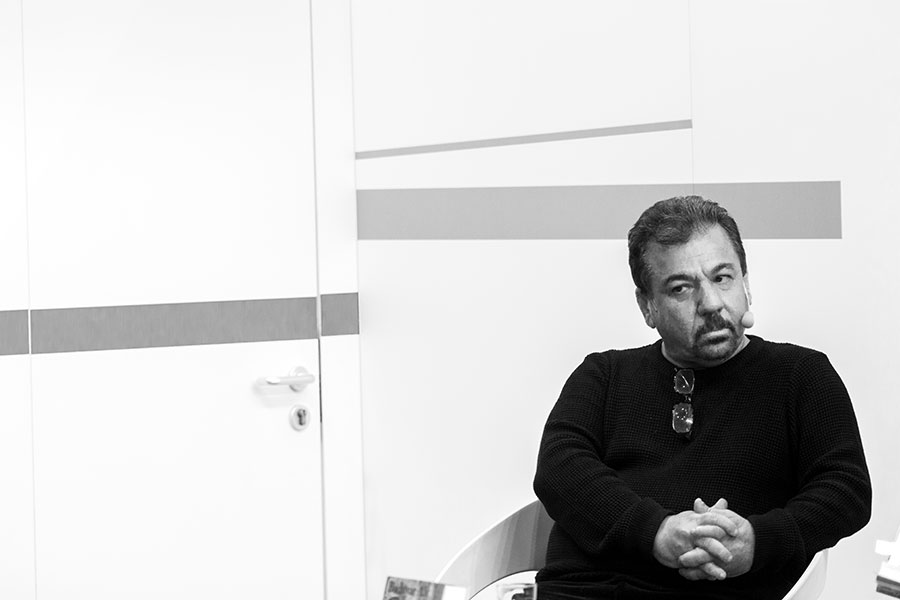

A writer across forms and languages
Bachtyar Ali is also rendered Bakhtiyar Ali or Baxtyar Alî; in Sorani his name is بەختیار عەلی. His literary agency gives his birth as 1966 in Sulaymaniyah and identifies fiction, essays and poetry as his range. [1] Literaturhaus Dortmund’s biographical notice connects his earlier life with geology studies and student protest, and dates the poetry collection Gunah w Karnaval to 1992. [4] This is a literary career with several forms, rather than a novelist appearing only when an English translation became available.
One novel, two titles
Ghazalnus and the Gardens of Imagination and I Stared at the Night of the City are not two separate novels. In the New York Kurdish Cultural Center’s edited account of a November 2023 discussion, translator Kareem Abdulrahman explains the change from the Sorani title to an English title taken from a chapter. He identifies the Kurdish publication with 2008 and describes the eventual Periscope publication in 2016. [2] Tracking title and language together avoids counting a translation as another original book.
The Last Pomegranate Tree: memory as a narrative problem
Archipelago’s English edition, translated by Abdulrahman, was published on 24 January 2023. The publisher’s synopsis follows Muzafar-i Subhdam, a former peshmerga prisoner searching for his son after twenty-one years of confinement, and a story involving three boys called Saryas. [3] That premise makes naming, recognition and loss central to the narrative. The publisher presents the novel through the aftermath of dictatorship and Kurdish conflict. Its characters and imaginative structure should be read as fiction, not as a documentary record of individual historical people.
Translation required sustained collaboration
Abdulrahman describes working with Ali over ambiguous Sorani words, including distinctions between imagination and the imaginary, and between truth and reality. Melanie Moore acted as a close English-language reader, while publishers’ editing and delays also shaped the route to publication. [2] This gives translators and editors an identifiable part in the books’ reception. It also provides a more concrete explanation of international circulation than saying that one writer single-handedly brought an entire literature into existence.
Awards need names and dates
The Nelly Sachs Prize was awarded to Ali in 2017; Literaturhaus Dortmund’s notice discusses persecution, conflict and humanity in the jury’s reading of his work. [4] Heidelberg’s announcement identifies him as recipient of the 2023 Hilde Domin Prize for Literature in Exile, with its presentation arranged for March 2024. [5] Stanford’s later visitor record confirms the March 2024 honour. [6] Award year and ceremony year are therefore different here. Prizes document recognition; they do not turn the judgment greatest novelist into an established historical fact.
A continuing literary conversation
Stanford records Ali as an international visitor in April 2025 and lists translations into Persian, Arabic, Turkish, German, Italian, French and English. [6] His agency’s catalogue also includes essay work such as The Dictator’s Smile alongside novels and poetry. [1] Readers can therefore approach him through fiction, political reflection and the specific choices made in translation. Attention to those works is more informative than asking whether a language needed one celebrated author to prove its literary capacity.
Sources and further reading
- MertinWitt literary agency, Bachtyar Ali; author biography and catalogue, including poetry and The Dictator’s Smile.
- New York Kurdish Cultural Center, Kareem Abdulrahman, Translator; edited account of the Kurdish Book Club discussion, 4 November 2023.
- Archipelago Books, The Last Pomegranate Tree; edition record, translator credit and publisher’s synopsis, publication 24 January 2023.
- Literaturhaus Dortmund, Nelly-Sachs-Preis 2017; biographical notice and attributed jury assessment.
- City of Heidelberg, Hilde-Domin-Preis 2023: Preisverleihung an Bachtyar Ali am 12. März, 23 February 2024.
- Stanford Humanities Center, Bachtyar Ali; international visitor record, April 2025.
- Udoweier, Bachtyar Ali at the Frankfurt Book Fair, 14 October 2017; Wikimedia Commons, CC BY-SA 4.0.