Batman grew around İluh, oil production and the railway. Its history also includes Kurdish social change, displacement and the transformed heritage of its province.
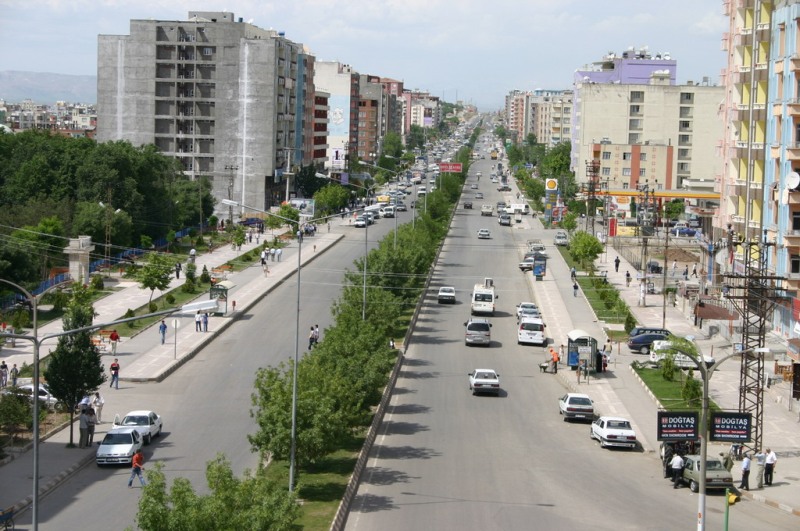

A city on the Batman plain
Batman, also known in Kurdish as Êlih or Îluh, lies in southeastern Turkey in the Tigris basin. The provincial cultural directorate locates its central district on the Batman plain between the Tigris and the Batman and Garzan tributaries, with Raman’s hills to the south. Its urban history grew out of İluh village. The names of the city, river, central district and province refer to connected but different geographical units; a provincial statistic should not automatically be treated as a city population figure. [1] [2]
Oil and transport changed the settlement
Oil exploration on Mount Raman connected this small settlement to state industrial investment. Anthropologist Zeynep Oguz describes early traces found in 1940, when extraction was still commercially difficult. Economic production at Raman-8 began in 1948. The cultural directorate dates the arrival of the Haydarpaşa–Kurtalan railway at Batman to 1944. Together, transport, production and refining helped create a town drawing workers and families from the surrounding region. The development was a process across several decades, involving housing, institutions and new inequalities as well as industrial facilities. [1] [2] [3]
Municipality, district and province
The provincial history records 4,713 inhabitants in the 1955 census and the establishment of a municipality on 2 November that year. District status followed on 2 September 1957. Law 3647, dated 16 May 1990, created Batman province. Hasankeyf and Gercüş were transferred from Mardin, while Beşiri, Kozluk and Sason came from Siirt. These administrative changes explain why an ancient settlement or rural district within today’s province need not share the modern city’s short industrial chronology. [1] [4]
What the refinery figures mean
Tüpraş dates the opening of Batman Refinery to 1955. Its current company information gives annual crude-processing capacity as 1.4 million tonnes after expansion investments completed in 2019. It reports 711,000 tonnes actually processed in 2025. Capacity and annual throughput measure different things. The company also describes railway exchanges with other refineries: local refining belongs to a wider supply network. The surrounding province retains agricultural and pastoral livelihoods, including grain, lentils, cotton, livestock and fruit production, alongside its oil economy. [5] [6]
Kurdish society, migration and unequal development
Oguz’s research examines how industrial schooling and the contrast between the petroleum complex and poorer surroundings shaped Kurdish political consciousness. Her account follows particular people and institutions rather than treating oil as an automatic source of prosperity. Later urban growth also involved forced displacement. TESEV researchers Ayşe Betül Çelik and Dilek Kurban conducted Batman fieldwork in June–July 2005, interviewing displaced residents, officials, lawyers and civil organisations and visiting urban neighbourhoods and partial-return villages. Their work frames housing, livelihoods, compensation and obstacles to return as central questions in understanding the city. [2] [7]
Malabadi Bridge belongs to a wider regional route
Malabadi crosses the Batman River at Çatakköprü, in Silvan district of Diyarbakır province, near the provincial boundary. Turkey’s UNESCO Tentative List submission dates its inscription to 1147 and names the Artuqid patron Temür-tash, son of Ilghazi. It gives the great pointed arch a span of 40.86 metres. The bridge is relevant to Batman’s regional setting, but it should not be located in the modern city centre. Its 2016 submission is a Tentative List entry, a different status from World Heritage inscription. [8]
Hasankeyf after the Ilısu project
Hasankeyf is a separate town and district within Batman province. The Ilısu reservoir transformed the lower historic town’s setting; selected monuments were relocated to the new cultural park, while the upper town remained outside the reservoir. DSİ documents these moves in its 2021 account. The museum directorate lists relocated buildings and describes collections from Hasankeyf and regional rescue excavations, including Hallan Çemi, Gre Amer and Sumaki Höyük. An account of the province’s heritage must now distinguish original sites, relocated monuments and museum objects. The industrial city, ancient river settlements and present-day displays each preserve different parts of this history. [9] [10]
Sources and further reading
- Batman Provincial Directorate of Culture and Tourism, “Genel Bilgiler”: plain, railway and provincial administration.
- Zeynep Oguz, “The Unintended Consequences of Turkey’s Quest for Oil,” MERIP (20 October 2020): original anthropological and historical research.
- Turkish Petroleum, 2015 Annual Report, Batman District Management: economic production at Raman-8 in 1948.
- Batman Provincial Directorate of Culture and Tourism, “Tarihçe”: 1955 census and municipality, 1957 district and 1990 province.
- Tüpraş, refinery and company history: 1955 opening, 2019 capacity expansion and 2025 Batman throughput.
- Batman Governorate, “Batman Tarım ve Orman”: agricultural and pastoral production, with data periods identified.
- TESEV, Coming to Terms with Forced Migration (English edition, 2007), fieldwork introduction and Batman chapters by Ayşe Betül Çelik and Dilek Kurban, pp. 169–171, 205–255.
- Permanent Delegation of Turkey to UNESCO, The Malabadi Bridge (13 April 2016): primary Tentative List submission.
- DSİ, account of the Iraqi delegation’s Hasankeyf visit (25 June 2021): upper town and relocated monuments.
- General Directorate of Cultural Heritage and Museums, Hasankeyf Museum Directorate: institutional history, rescue collections and monument relocation.
- Ferhat 72, Batman city photograph, first uploaded 6 December 2006; released into the public domain.