Sanandaj’s Dar ul-Ihsan is both a mosque and a madrasa. Its early nineteenth-century foundation, later enlargement and repairs reveal a changing institution rather than a monument completed in a single moment.

An Ardalan foundation in Senne
Dar ul-Ihsan, also known as Sanandaj’s Jameh Mosque, belongs to the architectural history of Senne, the Kurdish city of Sanandaj. Amanullah Khan Ardalan commissioned the mosque and madrasa during the reign of Fath-Ali Shah Qajar. The combined name matters: the institution provided spaces for religious learning as well as congregational prayer. Seyyed Kamyar Naqshbandi’s architectural thesis approaches these spaces through their functions and historical setting, rather than treating the complex simply as a picturesque tiled landmark. [1] [2]
The ruler behind the building
Pierre Oberling’s study places Amanullah Khan within the Kurdish Ardalan ruling family and its long relationship with Iranian governments. The Ardalan governors held a partly autonomous frontier position; their authority was neither identical to an independent modern state nor merely a generic provincial administration. Oberling describes Amanullah’s investment in land, agriculture, gardens and fortifications, alongside his connections to Fath-Ali Shah’s family. The mosque can therefore be understood within a wider programme of local patronage and political representation. Kurdish regional history and the Qajar setting are both relevant to the building. [3]
Why a single completion date is misleading
Naqshbandi, Zahra Ahari and Hadi Safaeipour’s 2024 study compares architectural and documentary evidence. Its Persian abstract dates the first phase to 1226–1232 AH, approximately 1811–1817 CE, and links enlargement of the prayer hall to a congregational-mosque role acquired in 1229 AH. The English abstract mislabels lunar dates as “SH”; the Persian calendar labels are followed here. This sequence challenges a single completion date of 1812. [1]
Repairs, a street and the present footprint
The study connects deterioration with endowment-administration problems and dates minaret reconstruction to 1343 AH, approximately 1924–1925. Street construction removed a small southern section in 1311 SH, approximately 1932–1933; reorganisation continued to 1314 SH, followed by national listing in 1327 SH. The surviving building consequently incorporates later interventions. [1]
Reading the photographed interior
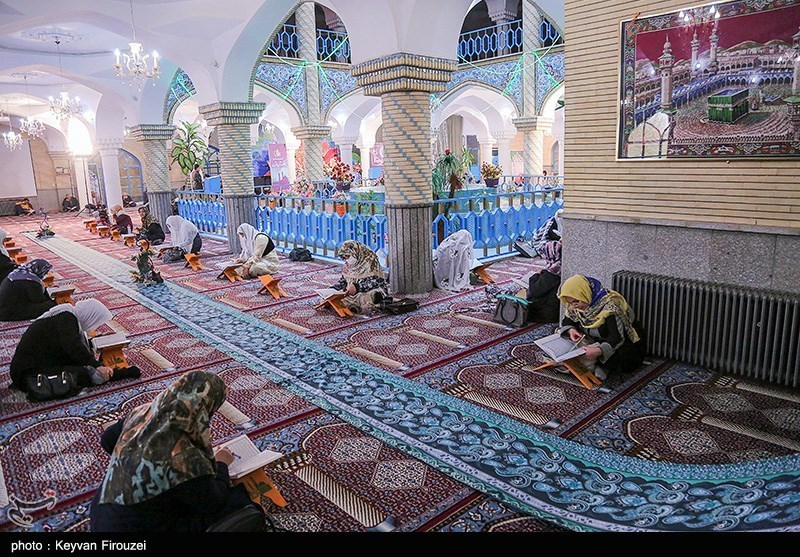
The 2022 photograph shows people reading from books on wooden stands, patterned carpets, spiral stone columns and tiled arches. A blue partition divides part of the interior. These visible details connect architectural space with recorded use on a particular day. They do not establish the age of every furnishing or the current arrangements. Looking at the dated photograph alongside the architectural research makes the article useful both for readers interested in ornament and for those asking how prayer, learning and later adaptation occupied the same building. [4]
Sources and further reading
- Seyyed Kamyar Naqshbandi, Zahra Ahari and Hadi Safaeipour, “Dar-ul-Ihsan Mosque and Madrasa of Sanandaj: Original Design and Architectural Alterations,” Iranian Architectural Studies 12/24 (2024), pp. 27–53. Persian and English abstracts; DOI 10.22052/jias.2024.252775.1191. Dates here follow the Persian abstract’s calendar labels.
- Seyyed Kamyar Naqshbandi, “Re-identifying the Dar-ul-Ihsan Mosque and Madrasa of Sanandaj,” MA thesis, Shahid Beheshti University, 1397 SH / 2018; research summary on Asmaneh.
- Pierre Oberling, “Banī Ardalān,” Encyclopaedia Iranica III/7 (1988), pp. 693–694, updated 2016: Ardalan government and Amanullah Khan’s patronage.
- Keyvan Firouzei, Dar ul-Ihsan Mosque interior, 11 April 2022; CC BY 4.0 photograph, Wikimedia Commons.