Erbil’s citadel combines a deep archaeological mound with later homes and streets. Its significance includes both material evidence and the lives of former residents.
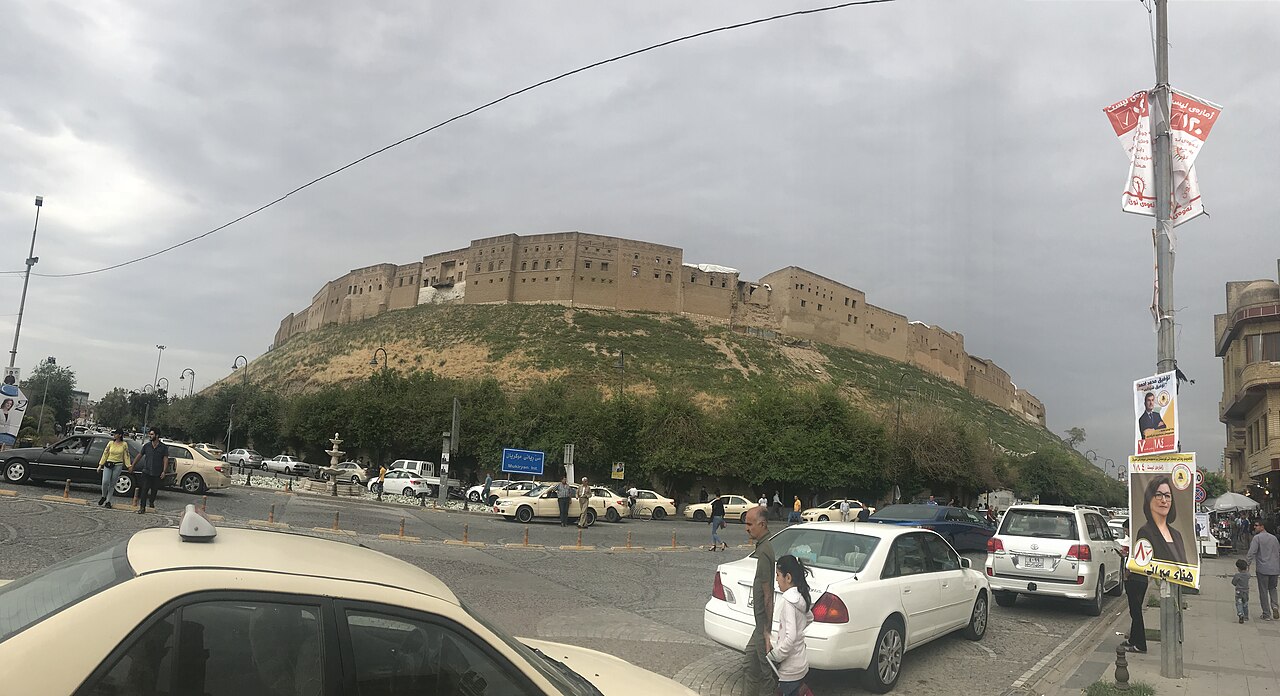

A mound within a living city
Erbil Citadel stands at the centre of Hewlêr/Erbil in the Kurdistan Region of Iraq. Its elevated ground is a tell: accumulated buildings, debris and occupation deposits, rather than simply a natural hill supporting one ancient castle. UNESCO inscribed the 15.6-hectare property in 2014 under criterion (iv), recognizing its archaeological mound and surviving Ottoman-period urban form. Its significance is therefore more specific than an unqualified claim to be the “oldest inhabited place on Earth.” Ancient settlement, continuity of particular buildings and continued residential occupation are separate historical questions. [1] [2]
What the archaeological evidence establishes
The excavation team’s 2016 account reports Ubaid-period potsherds, dated approximately 5300–4500 BCE, from the citadel mound. It distinguishes this evidence from a proposed earlier Halaf settlement, which had not been demonstrated there, and from discoveries at neighbouring sites. Boreholes in 2008 identified cultural deposits extending 22 metres below the centre. These cores indicate considerable depth, not a completely excavated sequence. Written evidence connects Erbil with ancient Arbela and its Assyrian religious importance; proposals to locate the temple of Ishtar are research questions, not an exposed temple available for inspection. [2]
Houses, courtyards and changing streets
The apparent outer wall is largely a line of tall houses that replaced earlier fortifications. ICOMOS’s 2014 survey describes predominantly nineteenth- and early twentieth-century homes, with some eighteenth-century examples. Courtyards, open-fronted iwans, porticoes, fired-brick masonry and timber roofs shaped domestic space. The fan-like lanes lead from the southern Grand Gate. A road cut through the fabric in 1958, and gate demolitions and reconstructions complicate any claim that every visible feature is ancient. The bathhouse dates to 1775 but underwent later alterations; buildings preserve construction histories, not a single frozen date. [1] [3]
Excavation and reconstruction are different activities
Exploratory trenches in 2011–12 investigated nineteenth-century Grand Gate foundations, while subsequent archaeological work examined other parts of the mound. Such targeted work should not be described as excavation of the entire citadel. Luca Colliva and Serenella Mancini’s 2021 ceramic study explicitly connects pottery finds with their archaeological stratigraphy. Recording the level and context of a fragment helps researchers distinguish successive occupations. Reconstruction, by contrast, makes decisions about a building’s presentation; its evidential basis needs evaluation rather than treating a restored entrance as untouched ancient masonry. [2] [3] [4]
The people displaced from the citadel
The 2014 ICOMOS evaluation records the evacuation of residents in 2006 and questions claims of unbroken occupation. UNESCO likewise acknowledges discontinuity in the settlement’s social and functional integrity, while noting former residents’ gatherings and Friday prayers. This history belongs alongside architectural conservation. In a 2022 urban-preservation study, Mohammed Qasim Abdul Ghafoor Al Ani argued for resettlement and integration with the surrounding city rather than reducing the citadel to a museum. That is a scholarly proposal, not evidence that such resettlement has been completed. [1] [3] [5]
Conservation is continuing work
UNESCO identifies the High Commission for Erbil Citadel Revitalization as the site authority and Erbil Municipality as responsible for its buffer areas. Its 2021 conservation review documented continuing monitoring, emergency preservation, archaeological investigation and staff training. It also listed concerns about unstabilized mound slopes, the legal framework and insufficient participation by former inhabitants and civil society. These are dated assessments, not a claim that every problem remains unchanged today. The citadel’s future depends on safeguarding buried evidence, maintaining historic houses and making room for the communities whose memories give the place meaning. [1] [6]
Sources and further reading
- UNESCO World Heritage Centre, Erbil Citadel, property 1437: 2014 inscription under criterion (iv), urban fabric, integrity and management responsibilities.
- Dara Al Yaqoobi and colleagues, “Archaeological investigations on the Citadel of Erbil: Background, Framework and Results,” in The Archaeology of the Kurdistan Region of Iraq and Adjacent Regions (Archaeopress, 2016), pp. 1–10: pottery, boreholes and excavation objectives.
- ICOMOS, Evaluations of Nominations of Cultural and Mixed Properties (2014), Erbil Citadel, printed pp. 79–87: houses, gates, evacuation and assessment of continuity claims. This advisory evaluation is distinct from the Committee’s eventual inscription.
- Luca Colliva and Serenella Mancini, “Lo studio del corpus ceramico della cittadella di Erbil e dei contesti archeologici di ritrovamento: risultati preliminari,” Vicino Oriente 25 (2021), pp. 143–165, DOI 10.53131/VO2724-587X2021_7. University of Bologna record and abstract: ceramics and stratigraphic context.
- Mohammed Qasim Abdul Ghafoor Al Ani, “The role of urban preservation to achieve sustainable urban development – Preserving Erbil Citadel as case study,” Acta Scientiarum Polonorum Administratio Locorum 21(1) (2022), pp. 15–24, DOI 10.31648/aspal.7037: argument for residential and urban reintegration.
- UNESCO, State of Conservation of Properties Inscribed on the World Heritage List, WHC/21/44.COM/7B (2021), Erbil Citadel, printed p. 51 onward: conservation actions and identified concerns.
- Sarbast.T.Hameed, Panoramic Arbil Citadel, 3 May 2018, Wikimedia Commons, CC BY-SA 4.0.