Shanidar Cave in the mountains of Iraqi Kurdistan preserves evidence of Neanderthal lives, deaths and later human activity. Its importance comes from the combination of skeletal remains, carefully studied sediments, stone tools and food residues—notable discoveries that continue to change with new research.

A deep site, investigated again
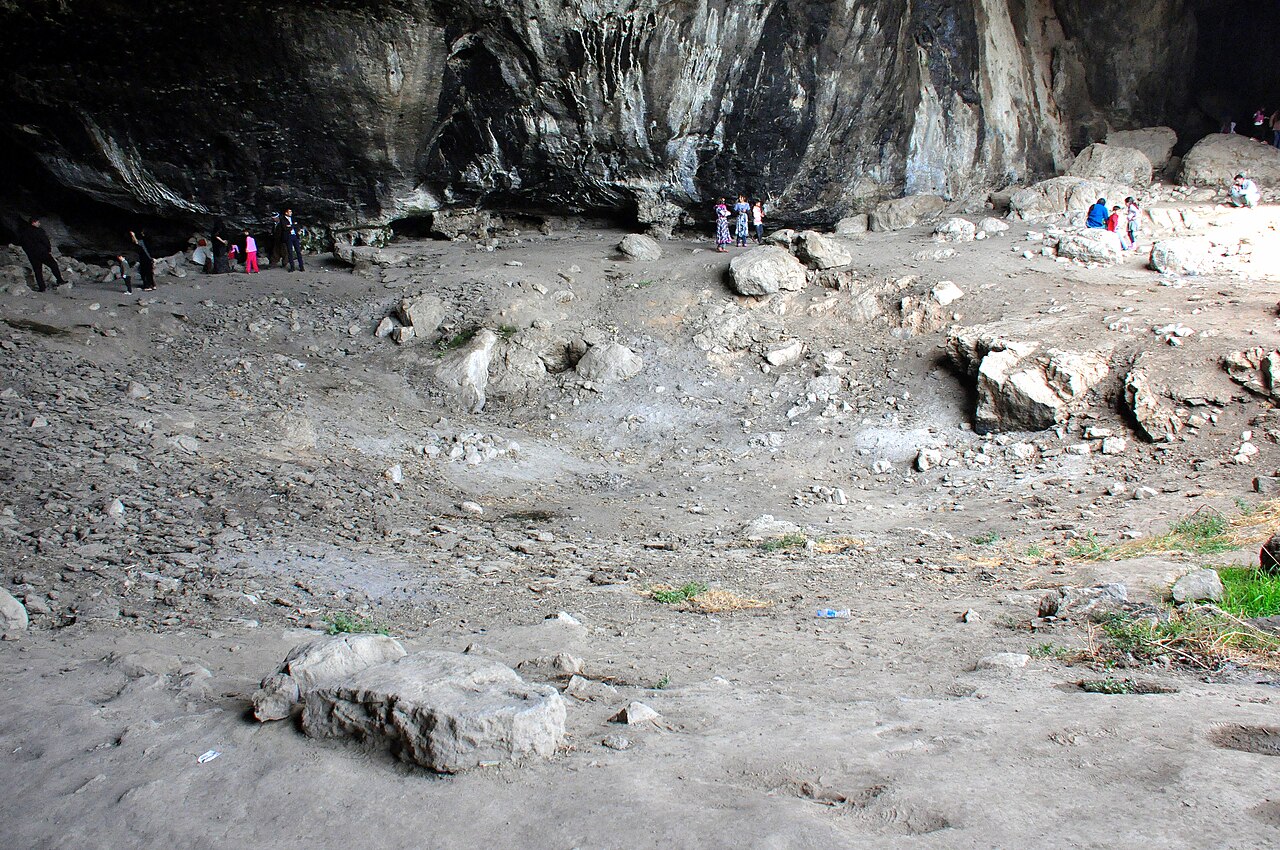
Shanidar lies in the Zagros Mountains at approximately 740 metres above sea level. Ralph Solecki’s mid-twentieth-century excavations exposed a deep sequence of occupation, including Neanderthal remains, Upper Palaeolithic artefacts and a later prehistoric cemetery. In 2011 the Kurdistan Regional Government approached Graeme Barker about renewed investigation. Initial fieldwork in 2014 was interrupted by the Islamic State threat, and excavations resumed in 2015. The project examined an extension of Solecki’s trench, recording sediments formed by water movement, wind and roof collapse alongside traces of human activity. [1] Understanding those processes is essential to interpreting how objects and bodies came to rest.
Shanidar 1 and survival with impairment
Shanidar 1 survived major physical injuries, including damage to the left eye region and the loss of the right forearm and hand. Erik Trinkaus and Sébastien Villotte’s 2017 study also documented substantial bony growths in the ear canals. They interpreted the narrowing and obstruction as evidence of serious hearing loss, adding another sensory impairment to the individual’s difficulties. They argued that survival under these conditions strengthens the case for social support among Neanderthals. [2] This is an interpretation grounded in an individual skeleton and its healed and degenerative changes.
Shanidar Z and deliberate placement of the dead
A 2020 report described articulated remains beside the earlier Shanidar 4 burial group. The skull was severely crushed, but the upper body retained anatomical relationships; the left hand lay below the head. Microscopic examination of the surrounding sediment and the shape of the feature containing the bones helped the team distinguish body placement from later rockfall or flowing sediment. The authors argued for deliberate burial. [3] The body’s position, the deposits around it and its relationship to neighbouring remains provide evidence beyond the skeleton alone.
What happened to the flower-burial interpretation?
Pollen clumps around Shanidar 4 led to the proposal that flowers had been placed with the dead. Chris Hunt and colleagues revisited this evidence in 2023. Their palynological assessment suggested that nesting solitary bees probably introduced at least some of the pollen, while allowing for other mechanisms. They continued to emphasise the significance of the clustered, deliberately placed remains. [4] The explanation for the pollen and the evidence for how bodies were deposited are related questions with different supporting observations.
Preparing plants before farming
Ceren Kabukcu and colleagues examined charred food fragments from Shanidar and Franchthi Cave. At Shanidar, five Upper Palaeolithic fragments contained crushed pulses; some also preserved probable mustard or pistachio tissues. A separate Middle Palaeolithic fragment contained pulse and grass remains. Microscopy supported preparation involving crushing or pounding and, in the wider study, soaking and heating. [5] Keeping the layers separate matters: the single older fragment and the later group represent different archaeological contexts. Together they make plant processing part of the cave’s history alongside hunting and stone-tool use.
Shanidar A: findings published in October 2026
The publisher’s account of Emma Pomeroy and colleagues’ new study describes Shanidar A beneath the torso of Shanidar Z. The recovered material includes a right hand, ribs, a left shoulder blade and teeth. A roughly 15-millimetre hole in the shoulder blade, with fractures and displaced bone, was interpreted as an injury around the time of death, possibly from a wooden spear entering from the front. The cause—hunting accident or violence—remains unresolved. A tooth split during life and subsequently worn also suggested survival after a severe mouth injury, which the authors linked to possible care. [6] The report adds a new individual and new questions to a site already central to research on Neanderthal social lives.
Sources and further reading
- Tim Reynolds et al., New investigations at Shanidar Cave, Iraqi Kurdistan, Antiquity Project Gallery 89(348), 2015.
- Erik Trinkaus and Sébastien Villotte, External auditory exostoses and hearing loss in the Shanidar 1 Neandertal, PLOS ONE 12(10), 2017, e0186684.
- Emma Pomeroy et al., New Neanderthal remains associated with the flower burial at Shanidar Cave, Antiquity 94(373), 2020, pp. 11–26.
- Chris O. Hunt et al., Shanidar et ses fleurs? Reflections on the palynology of the Neanderthal Flower Burial hypothesis, Journal of Archaeological Science, 2023, doi:10.1016/j.jas.2023.105822; abstract and Cambridge repository record.
- Ceren Kabukcu et al., Cooking in caves: Palaeolithic carbonised plant food remains from Franchthi and Shanidar, online 23 November 2022; Antiquity 97(391), 2023, pp. 12–28.
- Nature Portfolio, Possible fatal spear wound in Shanidar Cave Neanderthal remains, 16 October 2026; publisher’s account of Pomeroy et al., Scientific Reports 16, 30042, doi:10.1038/s41598-026-69193-z.