Gholamreza Rashid Yasemi combined poetry, literary criticism, translation and historical writing. His book on Kurdish connections with Iran belongs to the intellectual setting of the 1930s and has also drawn criticism for its nationalist and racial framework.


From Gahvareh to literary Tehran
Rashid Yasemi came from Gahvareh in the Kermanshah region and a family with strong literary and artistic connections. Mustafa Çiçekler’s scholarly biography identifies his father as a poet, painter and calligrapher, and his maternal grandfather as Muhammad Baqir Mirza Khosravi, author of Shams va Toghra. After early education in Kermanshah, Yasemi attended Saint Louis in Tehran. His later work included literary journalism, teaching Islamic history and membership in Iran’s academy. He died in Tehran in 1951. This career encompassed several fields; the Kurdish history book was one part of it. [1]
The Daneshkada literary circle
Nassereddin Parvin places Yasemi among the contributors to Daneshkada, the Tehran literary monthly associated with Mohammad Taqi Bahar. Published from April 1918 to April 1919, it brought together articles, poems and translations by writers including Saeed Nafisi and Abbas Eqbal. Its programme sought literary innovation while retaining a relationship with classical forms. Yasemi’s participation therefore connects him to a debate about how Persian writing should respond to contemporary life. It is more informative to locate his work within that circle than to describe him only as an isolated pioneer. [2]
Translation and the circulation of scholarship
The Golha cultural archive records a broad body of translations, including European historical writing, Edward Browne’s literary history, Arthur Christensen’s Sasanian history and Middle Persian texts. It also lists his editorial work on poets such as Masud Saad Salman. [3] A library record supplies a concrete example: CiNii identifies Iran dar zaman-e Sasaniyan as Christensen’s work translated by Rashid Yasemi, and catalogues a 544-page Negah printing dated 1384 in the Iranian solar calendar, or 2005–2006. That is a later printing, not the translation’s first publication date. It shows how his translation continued circulating after his lifetime. [4]
Identifying the Kurdish history book
Kurd va payvastagi-ye nezhadi va tarikhi-ye u can be rendered as “The Kurds and Their Racial and Historical Connections.” Its terminology itself signals questions of origin, classification and historical belonging. CiNii holds separate records for a 246-page Tehran printing tentatively dated to the 1930s and a 268-page Amir Kabir edition dated 1363/1984–1985, marked second edition. The records include references and indexes. Readers comparing citations should check which printing is meant: pagination and publisher can differ. These catalogue records identify actual editions; they do not establish a ranking as the first modern academic Kurdish history. [5] [6]
A book within contested national histories
In his 2026 York University dissertation, Behnam Amini examines Yasemi’s work within Iranian nation-building. He describes a Ministry of Education commission in the 1930s and argues that the book used racial classification, language, religion, geography and anthropology to present Kurds as inseparable from Iranian history and identity. He also discusses Yasemi’s use of Eugène Pittard. This is Amini’s critical interpretation of the work and its setting. It demonstrates why the book’s historical influence should not be confused with universal acceptance of its arguments. Terms such as race and Aryan belong to the categories being examined, not to an established biological definition of Kurdish identity. [7]
Institutions, poetry and an assessable legacy
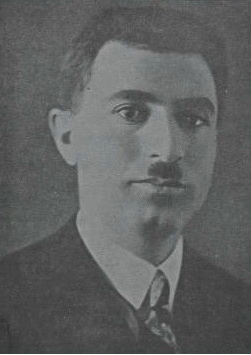
Mohammad Ali Jazayeri lists Yasemi among the participants at the first Farhangestan’s inaugural meeting in 1935. The academy developed and approved Persian terminology, placing his career within organized cultural policy as well as literary publication. [8] His legacy can therefore be approached through identifiable activities: criticism, poetry, editions, translations, teaching and a contested account of Kurdish history. The small portrait reproduced here is catalogued to the 1930s, with no identified photographer; it provides a historical image of the writer without pretending to record a particular lecture or publication event. [9]
Sources and further reading
- Mustafa Çiçekler, Reşîd-i Yâsemî, TDV İslâm Ansiklopedisi 35 (2008), p. 18; family, education, teaching, literary work and death.
- Nassereddin Parvin, Daneshkada, Encyclopaedia Iranica, 2002, updated 2013; journal dates, contributors and literary programme.
- Golha cultural archive, Rashid Yasami, Persian biography and bibliography of literary editions, historical translations and Middle Persian works.
- National Institute of Informatics, CiNii Books BB06210109: Christensen, Iran dar zaman-e Sasaniyan, Rashid Yasemi translation, Negah printing 1384/2005–2006, 544 pp.
- CiNii Books BC16002896: Kurd va payvastagi-i nizhadi va tarikhi-i u, Tehran, tentatively dated [193-?], 246 pp.; bibliographical references and index.
- CiNii Books BA12882658: same title, Amir Kabir edition, 1363/1984–1985, marked second edition, 268 pp.; holdings include University of Tokyo libraries.
- Behnam Amini, National Colonialism: Colonization and Decolonization in Kurdistan, York University PhD dissertation, January 2026, pp. 168–169 (PDF pp. 173–174): critical discussion of Yasemi and nationalist historiography.
- Mohammad Ali Jazayeri, Farhangestan, Encyclopaedia Iranica, 1999, updated 2013; inaugural meeting in 1935, participants and terminology procedures.
- Unknown photographer, Rashid Yasemi, portrait catalogued to the 1930s, reproduced from Shaknowran Nami; Wikimedia Commons public-domain record and source scan.