The Ulu Cami of Diyarbakır, or Mizgefta Mezin in Amed, brings prayer halls, teaching spaces and richly carved courtyard façades into one complex. Inscriptions and restoration research reveal construction and repair across several periods.
.jpg)
Finding your way around the complex
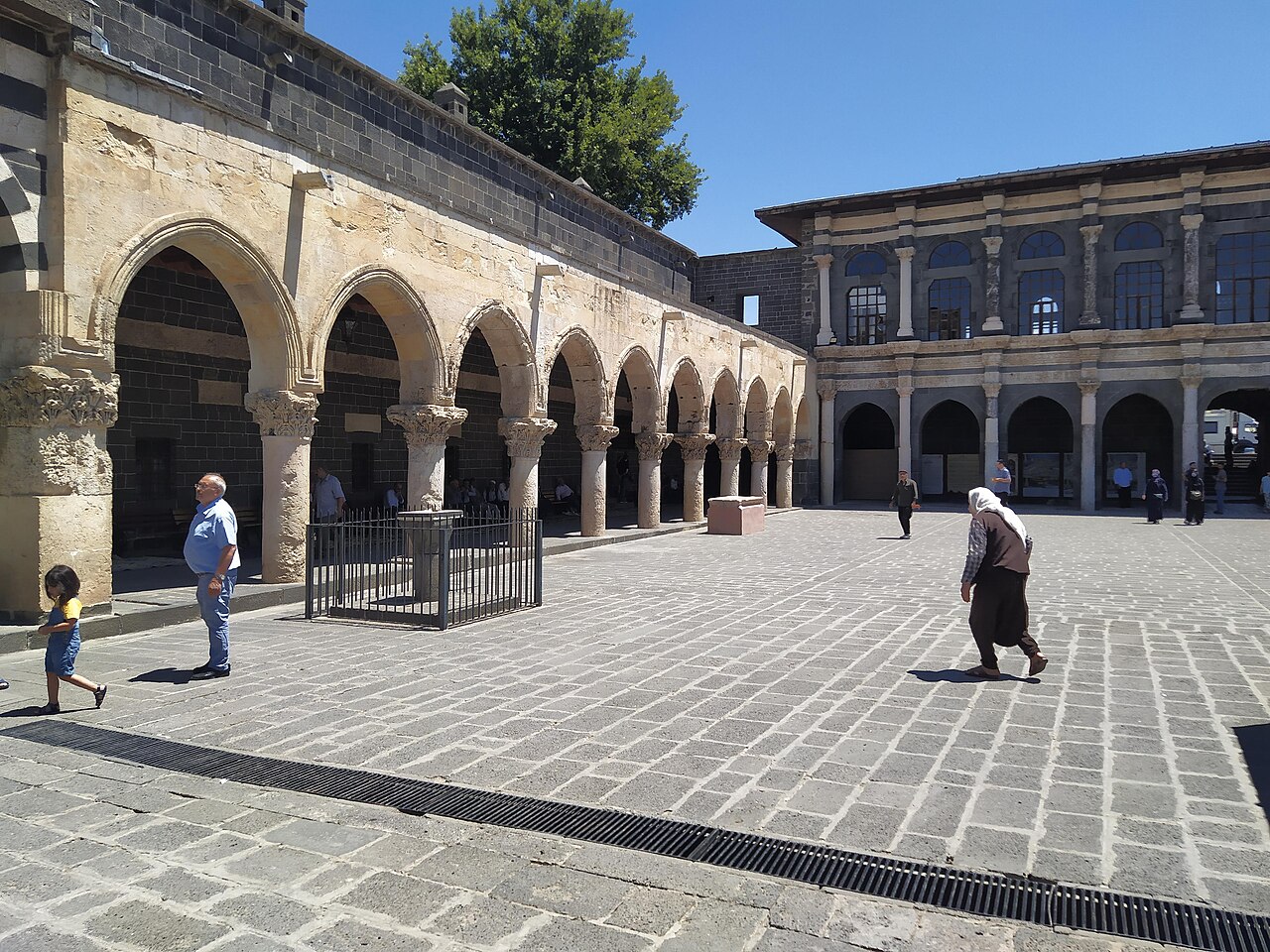
Columbia University’s Mapping Mesopotamian Monuments places the mosque within Diyarbakır’s old city walls and dates much of its visible form to the late eleventh or twelfth century. [1] Around the courtyard, the main Hanafi prayer hall occupies the south; two-storey wings stand to east and west; the Shafi‘i prayer space and Mesudiye madrasa are on the north. This arrangement makes the courtyard the point from which the different parts can be understood. The minaret rises beside the southern prayer hall, rather than from the centre of the open square. [7]
An earlier site, with disputed beginnings
The familiar story of a temple followed by a church simply converted into a mosque compresses a difficult archaeological question. Halifeoğlu and Assénat’s 2021 study examines discoveries made during restoration in 2012–2017: a colonnaded ancient structure, a Byzantine monument, earlier paving and foundations of the mosque. They discuss the tradition of a church dedicated to Saint Thomas, but also note Nasir-i Khusraw’s description of a church near the mosque. Their evidence does not securely identify every wall with a single conversion event. [3] İrfan Yıldız, presenting restoration findings in 2020, instead argues for an eighth-century mosque built in an earlier church complex, rather than a straightforward church conversion. This is his interpretation of the new evidence. [4]
Stonework that rewards a closer look
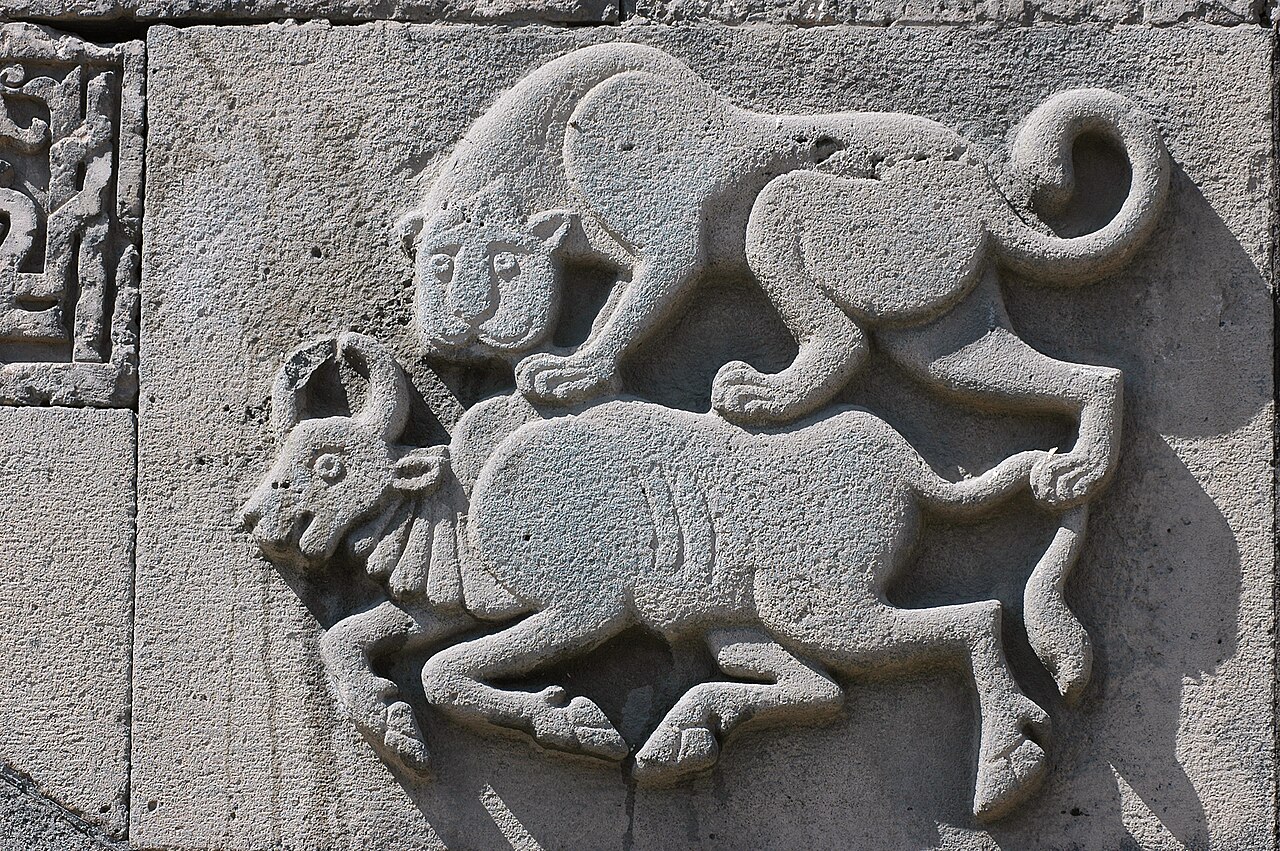
The arcades combine columns, carved capitals, friezes and Arabic inscriptions. Ertan Daş’s museum account identifies reused Roman and Byzantine material, alongside a building constructed and developed in the Islamic period. Dark basalt and occasional pale limestone bands contribute to the exterior’s contrasts. The prayer hall has three long aisles crossed by a wider central aisle toward the mihrab, an arrangement compared with Damascus’s Umayyad Mosque. At the eastern entrance, paired animal-combat reliefs add a different decorative register; the photograph below isolates a lion attacking a bull. Such details deserve separate attention from the broad label “ancient columns.” [2] [9]

Dates that identify particular work
The surviving inscription naming Malik Shah, dated 484 AH/1091–1092 CE, is a major chronological reference. Daş describes it as an inscription recording repair, rather than an original foundation text. He also cites Matthew of Edessa’s account of the damaging fire of 1115–1116. [2] Ahmet Çakmak’s architectural entry records later courtyard features: the fountain and the nearby raised prayer pavilion and pool belong to nineteenth-century work, associated with 1850. These are distinct from the medieval façades. The complex’s history is therefore clearer when individual elements are dated separately, instead of assigning everything visible to one Seljuk building campaign. [5]
Prayer, teaching and the city’s communities
Angela Lyn Andersen’s 2004 thesis studies the mosque as a centre of worship, civic activity and interaction. She connects its architecture with local materials and craftspeople, patronage and the city’s diverse population. Her discussion includes a distinct prayer area serving Kurdish Shafi‘i Muslims. [6] Hanafi and Shafi‘i here refer to Sunni legal traditions. The presence of different prayer and teaching spaces helps explain why this is a complex of buildings and social uses, rather than only a monumental courtyard. Its comparison with Damascus also involves the prestige patrons could communicate through architecture, not merely a copied ground plan. [6]
What restoration changed
Halifeoğlu and Assénat’s 2022 report examines the western maksurah and excavations behind it. The work uncovered walls, arches, column bases and other elements of different dates. Conservation involved documentation, drainage and reopening an earlier doorway. The authors also describe removing reinforced-concrete roofing and floor structures and replacing them with timber, with lead covering the roof. [7] The 2022 courtyard photograph and 2005 relief detail have their own dates and credits. Together they help readers recognize features discussed here; neither photograph by itself establishes the age of every stone or the mosque’s original layout. [8] [9]
Sources and further reading
- Columbia University, Mapping Mesopotamian Monuments, Diyarbakır Ulu Camii; site documentation, spring 2015; profile managed by Erhan Tamur and Matthew Peebles.
- Ertan Daş, Great Mosque (Ulu Cami), Discover Islamic Art, Museum With No Frontiers; layout, stonework, inscriptions and dating.
- Fatma Meral Halifeoğlu and Martine Assénat, The Great Mosque of Diyarbakır: a contribution to understanding the monumental development of a site from antiquity to the Arab conquest, Anatolian Studies 71 (2021), pp. 141–156, DOI 10.1017/S0066154621000089; author-uploaded text.
- İrfan Yıldız, Yeni Veriler Işığında Diyarbakır Ulu Cami, 24th International Symposium on Medieval and Turkish Period Archaeology and Art History Studies, 2020 abstract volume, pp. 102–103 (PDF pp. 117–118).
- Ahmet Çakmak, Diyarbakır Ulucamii, TDV İslâm Ansiklopedisi 42 (2012), pp. 96–97; architecture, prayer spaces and nineteenth-century courtyard features.
- Angela Lyn Andersen, The Diyarbakir Ulu Cami: Social History and Interaction at the Great Mosque, University of Victoria MA thesis, 2004; institutional archive and abstract.
- Fatma Meral Halifeoğlu and Martine Assénat, The Western Maksurah of the Great Mosque of Diyarbakir, Research and Excavation, Turkish Journal of Nature and Science 11(4) (2022), pp. 18–22, DOI 10.46810/tdfd.1097682.
- Radosław Botev, Great Mosque courtyard, 22 July 2022, Wikimedia Commons; Creative Commons Attribution 3.0 Poland.
- Dosseman, Great Mosque lion-and-bull relief, 26 September 2005, Wikimedia Commons; Creative Commons Attribution-ShareAlike 4.0.