Hakkari, known in Kurdish as Colemêrg, is both a provincial capital and the name of a wider historical mountain region. Its history connects Kurdish rulers, Assyrian communities, religious education, carved stone monuments and the changing Cilo landscape.

City, province and historical region
Geographer Metin Tuncel distinguishes Hakkari as an older regional name from Çölemerik, the central town, also encountered as Julamerk and Colemêrg. The historical region extended beyond today’s provincial and international boundaries. The present city developed near the Katramas stream, which joins the Zap valley. [1] A reference to Hakkari in a nineteenth-century account may therefore mean a much larger area than the modern municipality. Keeping those scales separate helps explain why descriptions of mountain communities, the emirate and today’s city do not always refer to the same territory.
How the emirate lost its authority
Hakkari’s Kurdish rulers operated within changing arrangements of local power and Ottoman administration. Fatih Gencer’s archival study examines hereditary rights to revenue and the nineteenth-century centralizing reforms that dismantled them. He records that Nurullah Bey remained in office as a local director after 1847, rebelled in 1848, and was removed as the process of suppressing the regional beys was completed in 1849. The authorities then confiscated revenue-bearing villages and assigned payments to former holders. [2] This was a change in how land, revenue and offices were controlled, rather than simply a border on a map being erased.
Assyrian institutions and a history of violence
Qudshanis, also called Koçanis or Konak, near the city was a patriarchal centre of the Church of the East. İbrahim Özcoşar and Mehmet Sabri Deniz examine the patriarchs’ residence there and the debated relationship between these communities and Ottoman authority. [3] David Gaunt, Naures Atto and Soner O. Barthoma describe Mar Shimun’s combined religious and secular leadership. Their history records attacks by Bedirhan’s forces in 1843 and 1846, followed decades later by the Sayfo genocide during the First World War. They describe Ottoman troops and allied local Kurdish forces attacking the Hakkari Assyrians in 1915, with most fleeing into Iran by September, and later military expulsion of returning villagers. [4] This history includes neighbors’ relationships, resistance, persecution and forced displacement; a picture of uninterrupted coexistence ending only in a vague wartime upheaval would conceal the violence.
The stone stelae discovered in 1998
Thirteen carved stone stelae were found near the city’s citadel in 1998. Veli Sevin and Aynur Özfırat describe frontal human figures, weapons, vessels, animals and tent forms. Eleven figures are interpreted as male and two as probably female. Their preliminary study dates the monuments through comparison of the depicted weapons to the second half of the second millennium BCE. [5] These are stone monuments with representations of weapons, not objects collectively known as Hakkari bronzes. Their age and archaeological context also do not establish the ethnic identity of the much later inhabitants of Hakkari.
Religious education in the built city
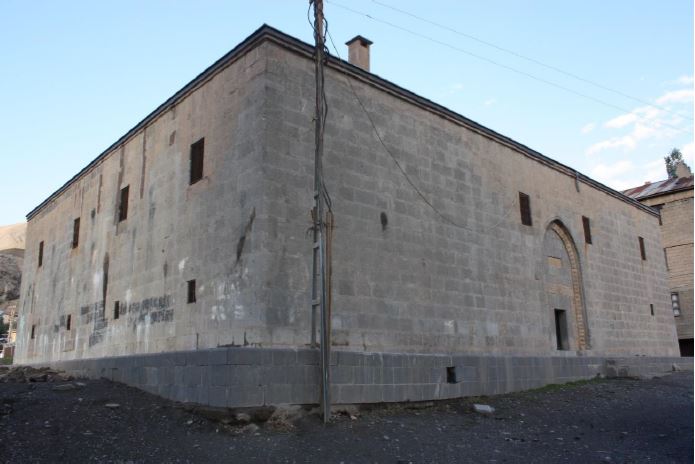
The Meydan Medrese provides a surviving setting for the history of learning. Murat Alandağlı’s study of nineteenth-century accounts discusses schools and charitable endowments and identifies the date on the medrese’s entrance inscription as 1112 AH, corresponding to 1700–1701. He rejects the unsupported 1472 date repeated in an older city entry. Attribution to İbrahim Bey is a historical inference from the period, rather than an explicit naming of the patron in that inscription. [6] The accompanying photograph records its exterior, allowing a specific building to take the place of generic claims about mountain heritage. [8]
Cilo: a changing physical landscape
The Cilo range belongs to the wider provincial landscape, rather than being interchangeable with the city itself. Roberto Sergio Azzoni and colleagues’ 2022 geomorphological mapping describes it as Turkey’s second-most glacierized area, directly contradicting the claim that it contains the country’s only glaciers. Their study identifies effects of deglaciation including unstable slopes, weathering and proglacial lakes that influence sediment movement. [7] Mountains are part of Hakkari’s history of movement and settlement, but their ice and landforms are also subjects of measurable environmental change.
Sources and further reading
- Metin Tuncel, Hakkâri, TDV İslâm Ansiklopedisi 15 (1997), pp. 205–207; city names, historical region and urban setting.
- Fatih Gencer, Merkezîleşme Politikaları Sürecinde Yurtluk-Ocaklık Sisteminin Değişimi, Tarih Araştırmaları Dergisi 30/49 (2011), pp. 75–96, especially 86–87; DOI 10.1501/Tarar_0000000484.
- İbrahim Özcoşar and Mehmet Sabri Deniz, Hakkârili Nasturilerin Osmanlı Merkez Otoritesi İle İlişkileri, Kadim Akademi SBD 5/2 (2021); patriarchal centre and relations with Ottoman authority.
- David Gaunt, Naures Atto and Soner O. Barthoma, Introduction: Contextualizing the Sayfo in the First World War, Let Them Not Return (Berghahn, 2017), especially pp. 2–6 and 20.
- Veli Sevin and Aynur Özfırat, Hakkari Steles: Warrior-Shepherds in Eastern Anatolia, A Preliminary Note, Belleten 65/243 (2001); discovery, iconography and archaeological dating.
- Murat Alandağlı, Osmanlı İmparatorluğu’nun Tanzimat Sonrası Dönemde Hakkâri’de Mali, İdarî ve Sosyo-Kültürel Yapıyı Tesis Etme Uğraşı, Külliyat 15 (2021), especially p. 68; DOI 10.51592/kulliyat.1027274.
- Roberto Sergio Azzoni, Irene Maria Bollati, Manuela Pelfini, Mehmet Akif Sarıkaya and Andrea Zerboni, Geomorphology of a Recently Deglaciated High Mountain Area in Eastern Anatolia (Turkey), Journal of Maps (2022); DOI 10.1080/17445647.2022.2035269.
- Vladdracotepeş, Meydan Medresesi exterior, dated 12 February 2020 in the Commons record; CC BY-SA 4.0.