top of page

Hushang and Tahmuras: The Kings Who Brought Fire and Writing

Illustrated banner of Kurdish and Iranic mythology evoking Hushang and Tahmuras, the early Pishdadian culture-hero kings of the Shahnameh — the discovery of fire and the binding of demons — alongside Kawa the Blacksmith, the Newroz fire, the Simurgh and the tanbur


Introduction


At the very dawn of the Iranic epic, before the golden age and before the great wars of heroes, stand two kings who gave humankind the foundations of civilization itself. They are Hushang and Tahmuras, the second and third rulers of the world in the legendary Pishdadian line, the culture-heroes who lit the first fire, forged the first iron, tamed the first beasts, and wrested from the very powers of darkness the gift of writing.


Hushang is the king who discovered fire and founded a festival in its honour that is still kept today, and who first drew metal from stone and water from the rivers. His son Tahmuras is the great demon-binder, the king who subdued the forces of chaos, rode the evil spirit Ahriman himself as a steed, and forced the conquered demons to teach him the secret of the written word. Together they are the bringers of the arts of settled life.


Their stories belong to the oldest layer of the tradition, the mythic memory of the slow human climb from the cave to the city, imagined as the deeds of founder-kings. They set the stage for the splendour of Jamshid who came after them, and they carry one of the deepest themes of the whole Iranic imagination: that civilization is the triumph of order and light over the powers of chaos and dark.


Contents


Who Were Hushang and Tahmuras?


Hushang (in the Avestan language Haoshyangha) and his son Tahmuras (Avestan Taxma Urupi) are early culture-hero kings of the Pishdadian dynasty in the Shahnameh and the older Iranic tradition. Hushang, the second king of the world, is famed as the discoverer of fire, the founder of the Sadeh festival, and the first to work iron, irrigate the land and establish law. Tahmuras, the third king, is called Divband, the demon-binder, who subdued the demons, rode the evil spirit as a steed, and forced the demons to teach humankind the art of writing.


Key Takeaways


  • Hushang and Tahmuras are early kings of the legendary Pishdadian dynasty.

  • Hushang discovered fire and founded the midwinter Sadeh festival.

  • Hushang first worked iron, dug canals, farmed and gave laws.

  • Tahmuras, called Divband, bound the demons and rode the evil spirit.

  • The demons were forced to teach Tahmuras the gift of writing.

  • Together they are the great culture-heroes of Iranic myth.


Quick Facts


  • Names: Hushang (Avestan Haoshyangha) and Tahmuras (Avestan Taxma Urupi)

  • Type: Early culture-hero kings of the Pishdadian dynasty

  • Hushang: Second king of the world; grandson of the first king Kayumars

  • Tahmuras: Third king; son of Hushang, called Divband, the demon-binder

  • Hushang's discoveries: Fire, ironworking, irrigation, farming, and law

  • Hushang's festival: Sadeh, the midwinter fire festival, still kept today

  • Tahmuras's deeds: Binding the demons and winning the gift of writing

  • Reigns: Hushang for 40 years, Tahmuras for 30 years

  • Theme: The dawn of civilization and the arts of settled life

  • Attestation: The Avesta and the Shahnameh of Ferdowsi


The First Kings of the World


The Iranic epic opens not with war but with the slow kindling of civilization. The first king of all was Kayumars, the primordial man who dwelt upon the mountains clad in leopard-skins, under whom, it is said, the arts of life first began. But his beloved son Siamak was slain by the demons of darkness, the first death and the first war between humankind and the powers of evil, and it fell to Kayumars's grandson to avenge him and carry the work of civilization forward. That grandson was Hushang.


With Hushang the line that tradition calls the Pishdadian dynasty truly begins, and indeed the dynasty takes its very name from his ancient title, Pishdad, meaning something like the first to give law or the first dispenser of justice. He and his son Tahmuras after him belong to the great founding age of the world, before kingship had hardened into the splendour and the tragedy of later reigns, when the most basic gifts of settled human life were, in the imagination of the epic, still being discovered one by one.


Hushang and the Discovery of Fire


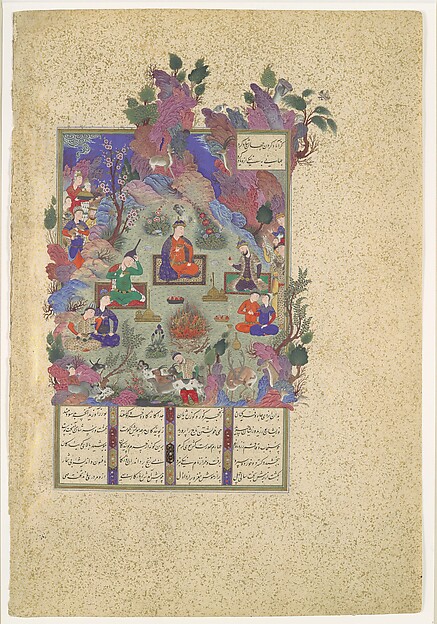
The most famous of all Hushang's deeds is the discovery of fire, and the tradition tells it as a moment of pure accident turned to revelation. One day the king saw a great dark serpent and hurled a stone at it. He missed, and the stone struck another stone; both were flint, and from the blow leapt bright sparks that kindled a flame. The serpent escaped, but fire had come into the world. Hushang saw at once that something holy had been revealed to him, and he gave thanks, recognising in the flame the divine glory of God, and he taught his people to honour it.


To mark this gift, Hushang founded a great festival of fire, the feast of Sadeh, kept at the height of midwinter to celebrate light and warmth against the season of darkness, frost and cold. Remarkably, Sadeh is still observed to this day, its bonfires lit by Iranian peoples down more than a thousand years. It belongs to the same deep family of fire-reverence that runs through the whole Iranic world, the same love of the living flame that burns in the spring bonfires of Newroz, and it marks Hushang forever as the king who first gave humankind the mastery of fire.


Hushang the Civilizer


Fire was only the beginning of Hushang's gifts. The tradition makes him the first great civilizer, the king under whom the fundamental crafts of settled life were born. He was the first to extract iron from the rock and to found the art of the smith, making axes, saws and tools, the same mastery of metal and forge that the Kurdish imagination so cherishes in the figure of Kawa the Blacksmith. With iron tools in hand, humankind could shape the world as never before.


He taught his people to draw water from the rivers in canals and channels to irrigate the dry land, and so to sow and reap and live by agriculture rather than by the hunt alone. He domesticated the ox, the ass and the sheep, turning the animals to human use, and he taught the building of houses, so that people might dwell in settled homes. And over all of this he set law and justice, ruling, the tradition says, for forty years of wise and benevolent order. In Hushang the epic remembers the whole great leap from wandering to settlement, from wildness to the ordered arts of the city.


Tahmuras the Demon-Binder


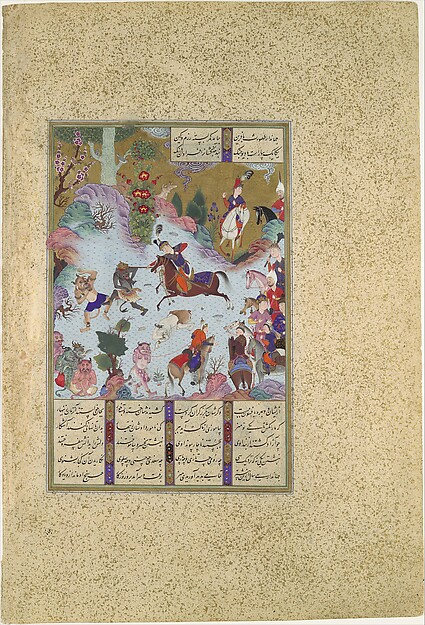
Hushang's son and successor, Tahmuras, took up a different and darker labour: the conquest of the demons themselves. His ancient name carries the sense of the strong or the brave, and his great title is Divband, the binder of the div, for he made war upon the Divs, the demons of chaos and evil, and subdued them by his power and his wisdom. Where his father had given humankind the tools of civilization, Tahmuras secured the very ground on which civilization could stand, by mastering the forces that sought to destroy it.


The most striking image of his reign is the taming of the evil spirit himself. In the tradition, Tahmuras overcame Ahriman, the very principle of darkness, transformed him into a steed, and rode upon his back around the whole circuit of the earth. It is one of the great emblems of the Iranic imagination: the king of humankind riding the spirit of evil as a tamed mount, the powers of darkness forced to bear the weight of the ordered world. For a time, at least, chaos itself was made to serve.


The Gift of Writing


Out of Tahmuras's victory over the demons came one of the greatest of all human gifts. According to the tradition, when the king had conquered the host of demons, they begged him to spare their lives, and in return for their freedom they offered to teach him a secret they had kept from humankind. That secret was writing. The demons taught Tahmuras the art of letters in many tongues and many scripts, and so, in the memory of the epic, the written word, the very foundation of learning and record, came to humanity as the ransom of the conquered powers of darkness.


It is a striking and thought-provoking myth, that so precious a gift as writing should have its origin among the demons, won by force rather than freely given. Tahmuras's reign brought other arts besides: the tradition credits him with the spinning of wool and the weaving of cloth and carpets, the shearing of sheep, the training of dogs to guard the flocks, the taming of birds of prey for the hunt, and the harnessing of animals as beasts of burden. Like his father, he was a bringer of the practical arts, but his crowning gift was the one he wrested from the demons themselves.


The Dawn of Civilization


Hushang and Tahmuras are, above all, culture-heroes, and their stories are the mythic memory of the great steps by which humankind rose to civilization. Fire and metalworking, agriculture and irrigation, the domestication of animals, weaving, the building of houses, law, and finally writing itself: in the imagination of the Shahnameh, each of these vast and gradual achievements is gathered up and personified in the deeds of a founding king, so that the whole long ascent of human culture is told as a story.


Running through it all is one of the deepest themes of the Iranic worldview: that civilization is the victory of order and light over chaos and darkness. Hushang's fire pushes back the night; his laws push back disorder; Tahmuras's conquest of the demons pushes back the very powers of evil and even forces them to serve human progress. The arts of settled life are not merely useful in this vision; they are sacred, part of the great work of upholding the good creation against the forces that would unmake it. In these two kings, the epic remembers that to build, to forge, to farm and to write is itself a kind of triumph over the dark.


The Pishdadian Line


Hushang and Tahmuras hold their place near the very head of the Pishdadian dynasty, the first great line of Iranic kings. After the first king Kayumars came Hushang, and after Hushang his son Tahmuras, and after Tahmuras came the dazzling figure of Jamshid, under whom the world reached a golden age of peace and plenty before his pride brought him low and opened the way for the serpent-tyrant Zahhak.


The culture-hero kings thus lay the foundations upon which the whole later epic is built. Their gifts of fire, iron, law and writing are the inheritance that Jamshid raises to splendour, that Zahhak's tyranny threatens, and that the hero-king Faridun at last restores. Without the quiet, founding work of Hushang and Tahmuras, the great dramas of the heroic age would have no civilized world in which to unfold. They are the patient builders at the dawn, before the storm.


Hushang, Tahmuras and the Kurds


As founding kings of the Iranic epic, Hushang and Tahmuras belong to the shared heritage of all the Iranic peoples, the Kurds among them. The whole Pishdadian dawn, with its discovery of fire and its taming of the world, is part of the common Iranic inheritance that the Kurds carry alongside their own beloved legends. And Hushang's gift of fire, honoured in the feast of Newroz bonfires and in the deep Kurdish reverence for the living flame, speaks directly to a people for whom fire on the mountains has always been a sign of life and freedom.


As always with this heritage, it would be wrong to claim Hushang and Tahmuras as uniquely Kurdish figures. They are the common inheritance of a whole family of peoples, and their fullest form is in the Persian epic of Ferdowsi. But the Kurds may rightly count these founding kings among the legends of their wider world, the bringers of fire and craft and law whose gifts underlie the whole civilization that the Iranic peoples share, and whose memory still warms the midwinter and the spring.


Debates and Misconceptions


Did Hushang found Nowruz or Sadeh? The well-attested tradition is that Hushang founded Sadeh, the midwinter fire-festival that celebrates his discovery of fire. The great spring festival of Nowruz is associated in the epic with the later king Jamshid, not with Hushang. The two should not be confused: Sadeh is the feast of fire at the heart of winter, Nowruz the feast of renewal at the start of spring.


Who was the first king of the world? In the version made famous by Ferdowsi, the first king is Kayumars, and Hushang is his grandson and successor. But the matter is genuinely tangled in the oldest sources: in the most ancient hymns, the lists of the first kings and heroes actually begin with Hushang himself, which suggests that he was once remembered as the very first king of the world before Kayumars was placed before him. He is one of several rival first-king figures in the deep tradition.


Were Hushang and Tahmuras historical kings? No, they are legendary culture-heroes, not historical monarchs. They appear already in the ancient Avesta as Haoshyangha and Taxma Urupi, figures of the mythic age belonging to the shared Indo-Iranian past. Their stories are the poetic memory of the rise of human civilization, told as the deeds of founding kings, rather than the record of any datable reigns.


  • Jamshid: the splendid king who followed them and raised the world to a golden age

  • Zahhak: the serpent-tyrant whose darkness followed the fall of Jamshid

  • Faridun: the hero-king who overthrew Zahhak and restored the light

  • The Divs: the demons whom Tahmuras bound and forced to serve

  • Ahriman: the evil spirit whom Tahmuras rode as a steed

  • The Shahnameh: the Book of Kings, which preserves their stories


Frequently Asked Questions


Who were Hushang and Tahmuras?


They were early culture-hero kings of the Pishdadian dynasty in the Iranic epic. Hushang, the second king of the world, discovered fire and founded the arts of civilization; his son Tahmuras, the third king, was the demon-binder who subdued the demons and won the gift of writing.


How did Hushang discover fire?


The tradition tells that Hushang threw a stone at a dark serpent and missed; the stone struck another flint stone, and the sparks kindled a flame. The serpent escaped, but fire had been discovered. Hushang gave thanks for the gift and founded the festival of Sadeh to honour it.


Why is Tahmuras called the demon-binder?


Tahmuras bears the title Divband, the binder of the div, because he made war on the demons and subdued them. Most famously, he overcame the evil spirit Ahriman, transformed him into a steed, and rode him around the world, an emblem of humankind mastering the powers of chaos.


How did writing come to humankind?


In the tradition, when Tahmuras had conquered the demons, they begged for their lives and in return taught him a secret they had hidden from humanity: the art of writing, in many scripts and tongues. So the written word came to humankind as the ransom of the conquered demons.


What is the festival of Sadeh?


Sadeh is an ancient midwinter fire festival, founded according to legend by Hushang to celebrate the discovery of fire. It honours light and warmth against the darkness and cold of winter, and it is still celebrated by Iranian peoples today, more than a thousand years later.


Were Hushang and Tahmuras Persian or Kurdish?


Like the rest of this heritage, they belong to all the Iranic peoples in common, including Kurds and Persians. Their fullest form is in the Persian Shahnameh, but they are the shared inheritance of a whole family of peoples rather than the property of any one nation.


References and Further Reading


Comments


bottom of page