The Shahnameh is Ferdowsi’s Persian epic of kings, champions and families, completed around 1010. Across roughly 50,000 rhyming couplets, it brings creation stories, heroic legend and accounts of Iran’s ancient rulers into a narrative ending with the fall of the Sasanian kingdom.
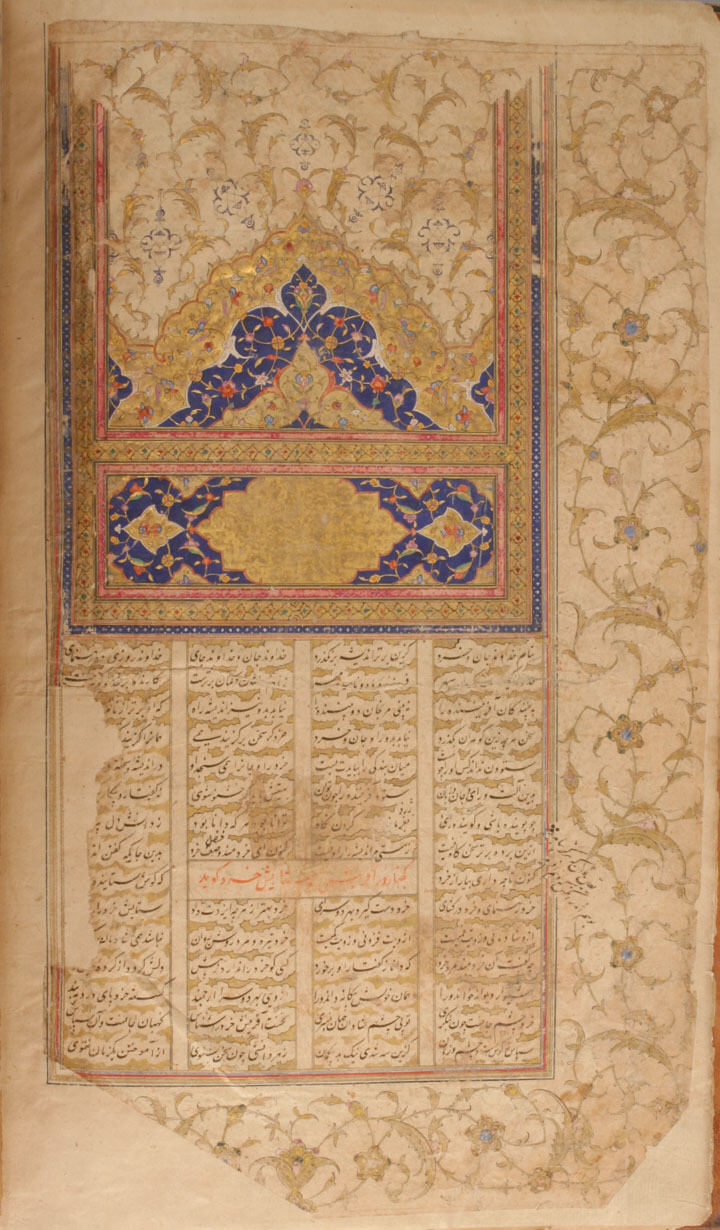
_of_Firdausi_MET_sf1974-290-43-1.jpg)
A guide to the poem’s changing world
The poem proceeds through successive reigns, while the familiar division into mythical, legendary and historical ages helps readers navigate its changing scale. Early kings establish crafts and social order; Jamshid’s pride costs him divine glory, or farr. The heroic narratives centre on families such as Sam, Zal and Rostam of Sistan and on wars between Iran and Turan. The later narrative includes Alexander and the Sasanian rulers, combining remembered history with romance and exemplary stories. [2] The three ages are a reading framework, with permeable boundaries between them.
Power is tested through relationships
Kingship brings obligations as well as splendour. The Fitzwilliam Museum’s interpretation follows a widening tension between Iran’s rulers and the champions of Sistan: Zal warns against bad counsel, while Rostam challenges unjust or inept kings. Fathers and sons face competing duties, notably in the stories of Siyavush and Esfandiyar. Both princes are destroyed after confronting a father’s wrongful demand, though they choose different responses. [2] These conflicts give family scenes political weight and make advice, conscience and the consequences of obedience recurring concerns.
Why manuscripts and editions differ
Ferdowsi’s autograph has not survived. The Pembroke Shahnameh Centre identifies the earliest surviving manuscript as an incomplete copy dated 1217, now in Florence—more than two centuries after the poem’s completion. It also notes substantial differences in length between manuscript versions. [3] Copying, collecting and editing therefore form part of the work’s history. A manuscript’s date belongs to that physical copy, and the paintings within a later book belong to its artists’ period. The illuminated page shown here comes from a seventeenth-century manuscript in the Met. [4]
The book as art and a gift between courts
Francesca Leoni describes the Shahnameh’s use as instruction for rulers and as a means of claiming legitimate succession. The manuscript made for Shah Tahmasp in sixteenth-century Tabriz brought calligraphers and painters together over many years. Its 759 text folios and 258 paintings made it an elaborate court undertaking. In 1568 it reached the Ottoman court among diplomatic gifts. Later additions in Ottoman Turkish record readers’ continuing engagement with its pictures; today its leaves are dispersed among collections. [1] Such a history connects reading the poem with patronage, diplomacy and the movement of artworks.
Kurdish and Gorani epic traditions
Farangis Ghaderi’s study of Gorani literature describes the Kurdish Shahnameh as an oral and manuscript tradition with stories shared with Ferdowsi and stories of its own. She discusses Shahnameh-khani performances accompanied by music and displayed paintings, and manuscripts often recording individual stories in separate booklets. Among the published works she identifies are Mohammad Mokri’s edition of Bijan and Manijeh and Mustefa Goran’s Javahirpush. The latter names a descendant of Rostam and develops wars involving heroes, demons and magicians. [5] These specific works and practices give Kurdish connections to the epic a literary history grounded in texts, performers and transmission.
Three episodes to begin with
Sam’s abandonment of the white-haired Zal, followed by his remorse, opens questions about parenthood and appearance. [6] Esfandiyar’s dragon encounter combines a bladed cart, courage and vulnerability to poisonous fumes. [7] Shaghad’s conspiracy begins with continued tribute payments and a manufactured family insult. [8] Read these episodes with attention to who speaks, who offers advice and what a decision costs others. Their distinct scenes provide an entry into the larger poem’s concerns with responsibility, power and loss.
Sources and further reading
- Francesca Leoni, The Shahnama of Shah Tahmasp, Metropolitan Museum of Art, June 2008.
- Fitzwilliam Museum, Structure and Themes: Myth, Legend and History; Shahnameh exhibition.
- Pembroke College, University of Cambridge, The Pembroke Shahnameh Centre for Persian Studies; text and manuscript history.
- Metropolitan Museum of Art, Shahnama of Firdausi, 1660s, manuscript 1974.290.43.
- Farangis Ghaderi, The Literary Legacy of the Ardalans, Kurdish Studies 5 (2017), 36–63, especially p. 48, Gorani Epic.
- Ferdowsi, Shahnameh, Manuchehr, section 2: Sam, Zal and the Simurgh; Ganjoor.
- Ferdowsi, Seven Labours of Esfandiyar, section 4: dragon and bladed cart.
- Ferdowsi, Rostam and Shaghad, section 2: marriage, tribute and conspiracy.