Kobanê, or Ayn al-Arab, is a predominantly Kurdish city on Syria’s border with Turkey. Refugee records, satellite analysis and residents’ testimony reveal a history extending beyond the 2014–2015 battle.
A border city and a place of refuge
Kobanê, also called Kobani and Ayn al-Arab, lies in northern Syria on the Turkish border. Human Rights Watch describes its population as predominantly Kurdish. [4] On 20 September 2014, UNHCR reported an estimated 70,000 Syrians had crossed into Turkey as fighting around the city forced people to flee. [1] This was a rapidly changing refugee count, not a census of the city or the final total displaced during the siege.
The battle and the January 2015 turning point
Kurdish defenders, including the YPG and YPJ, became central to Kobani’s international significance. The European Parliament’s research briefing identifies the battle as an early point of US support for the YPG and dates the city’s liberation to January 2015. [8] A contemporaneous CENTCOM release dated 26 January reported anti-ISIS forces controlling approximately 90 percent of the city. It stressed that the wider fight against ISIS continued. [2] The victory in Kobani should therefore be distinguished from the subsequent campaign across Syria.
Measuring the destruction
UNOSAT’s February 2015 assessment compared imagery from 6 September 2014 and 22 January 2015. Its city-wide analysis counted 3,247 affected structures: 1,206 destroyed, 1,169 severely damaged and 872 moderately damaged. It also identified 979 impact craters in and around Kobani. [3] The agency marked the findings as preliminary and not field-validated. These categories provide a more precise description than treating every damaged structure as destroyed or assigning an unexplained percentage to the whole city.
The June 2015 attack on civilians
The end of the siege did not end danger for residents. Human Rights Watch interviewed fifteen witnesses, eight of them wounded, about the 25 June 2015 attack. They described attackers identified locally as ISIS deliberately targeting civilians and using uniforms resembling those of opposing forces. Kurdish authorities and local monitors reported 233–262 civilian deaths. HRW could not independently confirm the overall toll, but obtained names of sixty people killed. [4] Keeping that distinction preserves both the scale of the loss and the limits of the evidence.
Rebuilding healthcare
MSF worked with the Kobane Health Administration from March 2015 to restore basic services. Its October update recorded 11,800 outpatient consultations through September, alongside vaccination and psychological-support work. [5] A 2016 project account recalls that a new MSF hospital was destroyed during a 2015 attack just before opening. [6] Reconstruction involved restoring staff, services and access to care as well as replacing buildings.
A city with cultural life
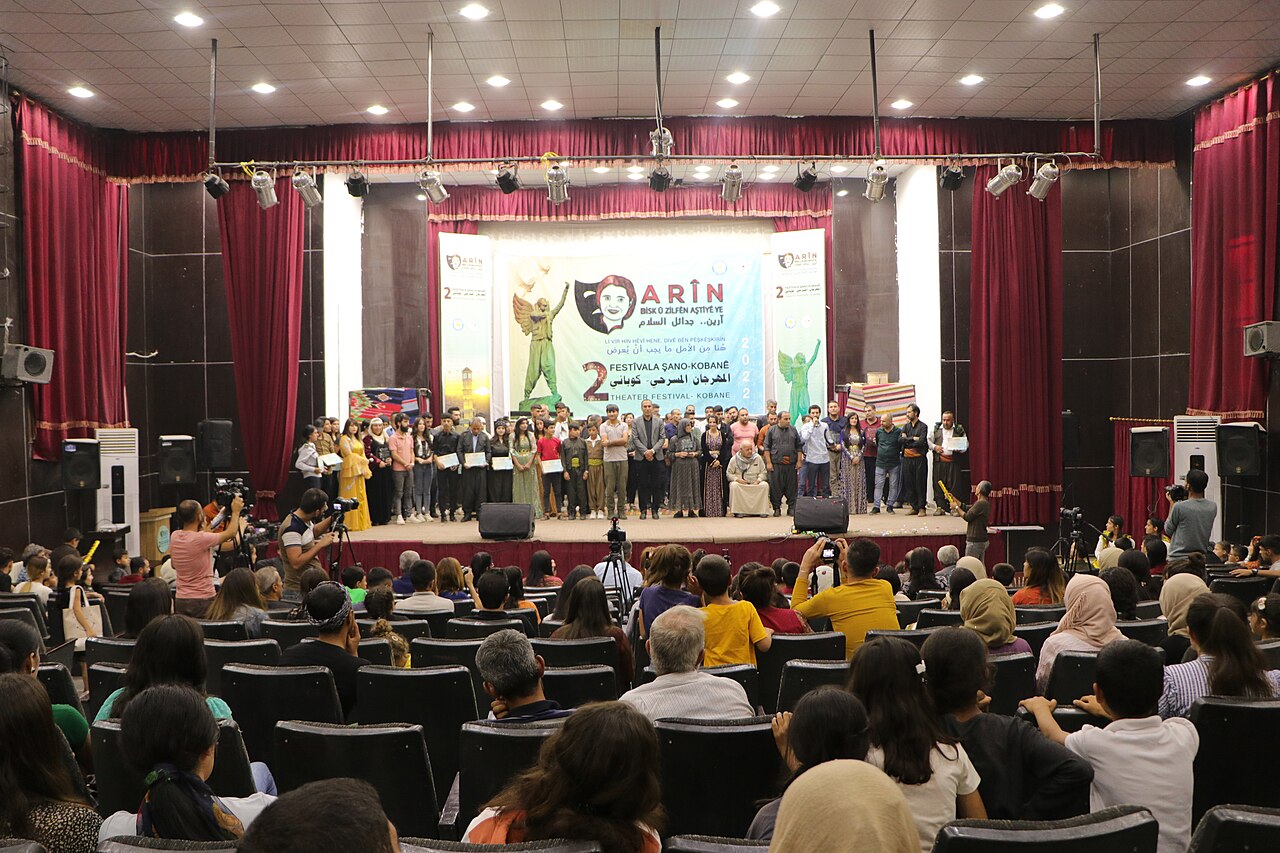
VOA Kurdish’s photo gallery, published on 17 October 2022, documents the second Arîn Mîrkan theatre festival in Kobani. The accompanying photograph shows participants on a stage before an audience. [9] It is evidence of a particular cultural gathering, rather than proof that every neighbourhood had recovered. Including such events gives residents a place in the city’s history beyond their roles as fighters, refugees or victims.
A dated account of developments in 2026
On 23 January 2026, a UN briefing reported closed roads into Kobani, interrupted water, electricity and internet, and shortages of essential goods. [7] The European Parliament’s 16 July briefing describes the 30 January ceasefire and phased integration agreement between Damascus and the SDF. It records subsequent military integration while noting that restrictions on humanitarian access and public services in Kobani continued after the ceasefire. [8] These observations belong to their stated dates; they do not establish conditions on every later day.
Sources and further reading
- UNHCR, Sudden refugee influx of Syrians into Turkey, 20 September 2014; initial agency estimate.
- US Central Command, Statement on the Tactical Situation in Kobani, release 201501902, dated 26 January 2015.
- UNITAR/UNOSAT, Damage Assessment of Kobane, Aleppo Governorate, Syria, product 921, 11 February 2015.
- Human Rights Watch, Syria: Deliberate Killing of Civilians by ISIS, 3 July 2015; witness investigation.
- Médecins Sans Frontières, Syria: Crisis Update, 22 October 2015, Ayn Al Arab/Kobane section.
- MSF, Providing healthcare in communities affected by conflict and violence in northern Syria, 10 August 2016; accompanying project text.
- United Nations, Noon briefing highlights, 23 January 2026, Syria/Kobani subsection reporting OCHA information.
- Carmen-Cristina Cîrlig, Ceasefire agreement in northeast Syria: Assessing progress in implementation, European Parliamentary Research Service, 16 July 2026.
- VOA Kurdish, Duyemîn Festîvala Arîn bisk û zilfên aştiyê Ya Şanoyê li Kobanê, photo gallery, 17 October 2022.