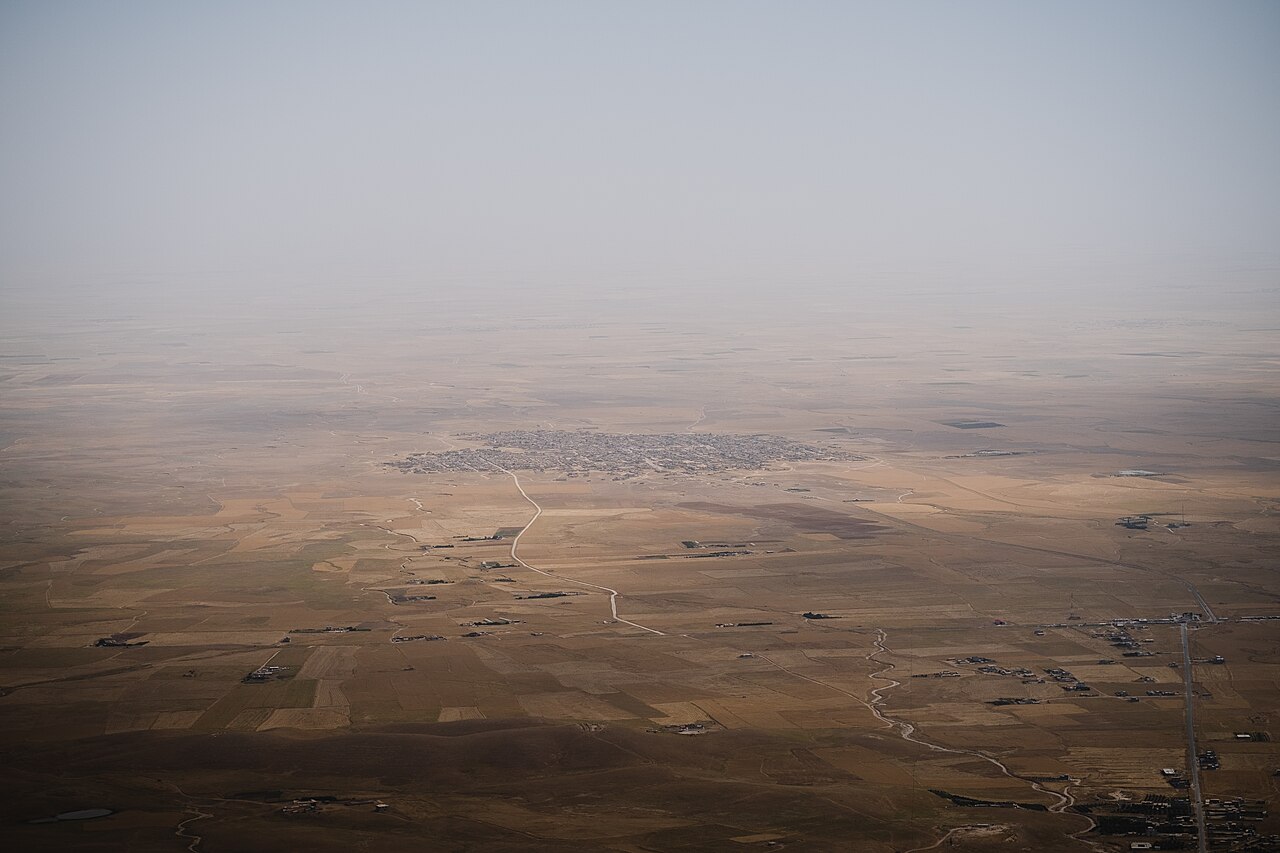
Sinjar is a town and district in Iraq’s Nineveh Governorate, centred on a mountain landscape important to Yazidi life. Its history connects persecution and displacement with continuing efforts to recover homes, identify victims and rebuild community institutions.

A district, a town and a mountain
Sinjar, also written Şingal or Şengal, includes the town, villages and settlements around Mount Sinjar in northwestern Iraq. Yazidi communities speak Kurdish, while their national identifications vary. NIOD’s historical account describes both attachments to Kurdish movements and demands for a distinct Yazidi identity. It also traces displacement before 2014: Baathist Arabisation moved villagers into collective settlements and disrupted relationships with land. This earlier history helps explain why housing and property remain central to recovery. [1]
The attack of 3 August 2014
ISIS attacked Sinjar on 3 August 2014. The withdrawal of Peshmerga forces left much of the population exposed. Many people fled to the mountain; a corridor opened by YPG/YPJ and PKK forces, with Yazidi volunteers, enabled escape towards Syria. [1] The UN Commission of Inquiry’s June 2016 announcement identified genocide, crimes against humanity and war crimes. It described killings, sexual slavery, forced conversion and the removal of children from their families. Its findings drew on survivor interviews and documentary evidence. The violence extended across the Iraqi–Syrian border as captives were moved between locations. [2]
The damaged built environment
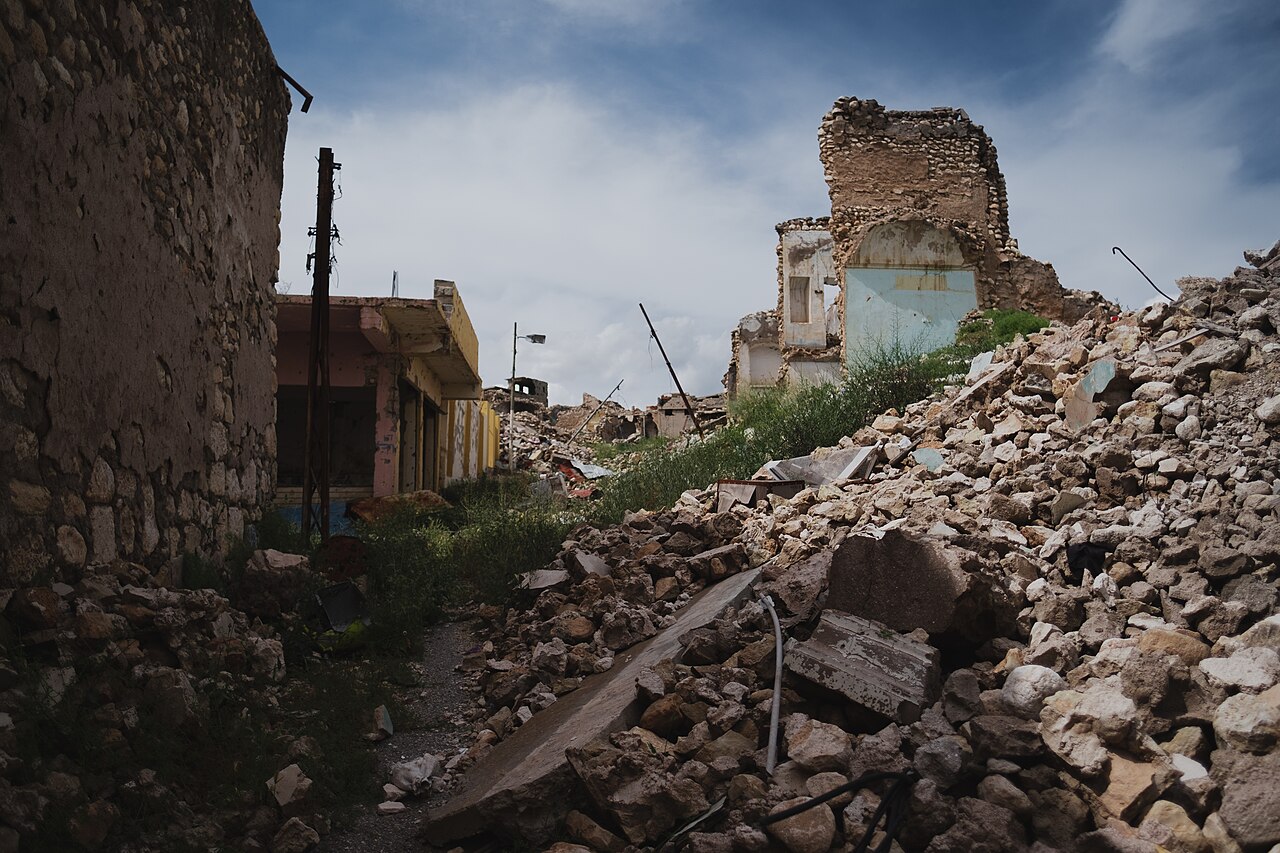
A 2015 UNITAR–UNOSAT assessment identified 1,780 potentially affected structures in the mapped Sinjar area, including 544 classified as destroyed and 473 as severely damaged. These were satellite-based estimates: the analysts explicitly called them preliminary, noted imagery limitations and stated that field validation had not yet occurred. [3] The dated photograph below provides a closer view of damaged streets and houses in 2019. Together, these records show different scales of evidence for the physical work required after the war.

Why return takes more than a journey
IOM’s February 2024 qualitative study of areas with limited or no return in Sinjar and Qahtaniya recorded several obstacles together: insecurity, damaged housing and infrastructure, weak services and livelihoods, contested administration, and fears of renewed intergroup violence. These concerns came from displaced people and key informants. [4] A family’s decision consequently involves the availability of a habitable house, an income, public services and confidence in the surrounding community. Return totals alone cannot describe whether those conditions are present.
Land documents and the possibility of rebuilding
At a ceremony on 14 April 2025, authorities launched the distribution of 1,338 ownership letters and issued approximately 100 title deeds to Yazidi residents of Dugrey and Tel Uzair Mujama’at. UN-Habitat described this as recognition of ownership after generations of exclusion. It also reported the waiver of payments under a March 2025 cabinet resolution. The announcement distinguished ownership letters, occupancy certificates and completed title deeds; it anticipated further upgrading of documents. These were steps within an ongoing process of securing property rights. [5]
Identification, burial and remembrance
On 24 January 2024, Iraqi authorities returned the remains of 41 identified Yazidi victims to relatives in Sinjar. UNITAD’s account describes the work of Iraq’s Mass Graves Directorate and Medico-Legal Directorate, supported by forensic equipment and expertise. Families could then bury relatives according to their traditions. Psychosocial assistance accompanied the ceremony. [6] Recovery includes this careful identification work and the ability to mourn, alongside rebuilding streets and homes.
A dated picture of community recovery
A UN statement published on 25 September 2026 describes a peacebuilding review held two days earlier. It reports five local peace structures bringing together 50 women, community memorial initiatives in Hardan, Khanasor and Dae Peri, livelihood support for 110 people and psychosocial support reaching 411 returnees. [7] These are reported results of a particular programme. They show practical forms of participation and support while the wider work of recovery continues.
Sources and further reading
- NIOD Institute for War, Holocaust and Genocide Studies, Ten years of ongoing genocide against the Yazidis: historical background, identity and the 2014 attack.
- UN Commission of Inquiry on Syria / OHCHR, ISIS is committing genocide against the Yazidis, press announcement, 16 June 2016; reproduced by ecoi.net.
- UNITAR–UNOSAT, Damage Assessment of Sinjar Area, Nineveh Province, Iraq, version 2.0, 2015: satellite findings and methodological limitations.
- IOM, Prospects for Resolving Displacement in Areas of Limited and No Return in Sinjar District and Qahtaniya Subdistrict, February 2024, executive summary.
- United Nations in Iraq / UN-Habitat, Recognition of Yazidi Land Ownership in Sinjar, 15 April 2025; ceremony of 14 April.
- UNITAD, Families Bid Solemn Farewell to Identified Yazidi Victims of ISIL Genocide in Sinjar, 25 January 2024; ceremony of 24 January.
- United Nations in Iraq, Government of Iraq and UN Partners Review Peacebuilding Progress in Sinjar, 25 September 2026; meeting of 23 September.